

By Jin Yuhan
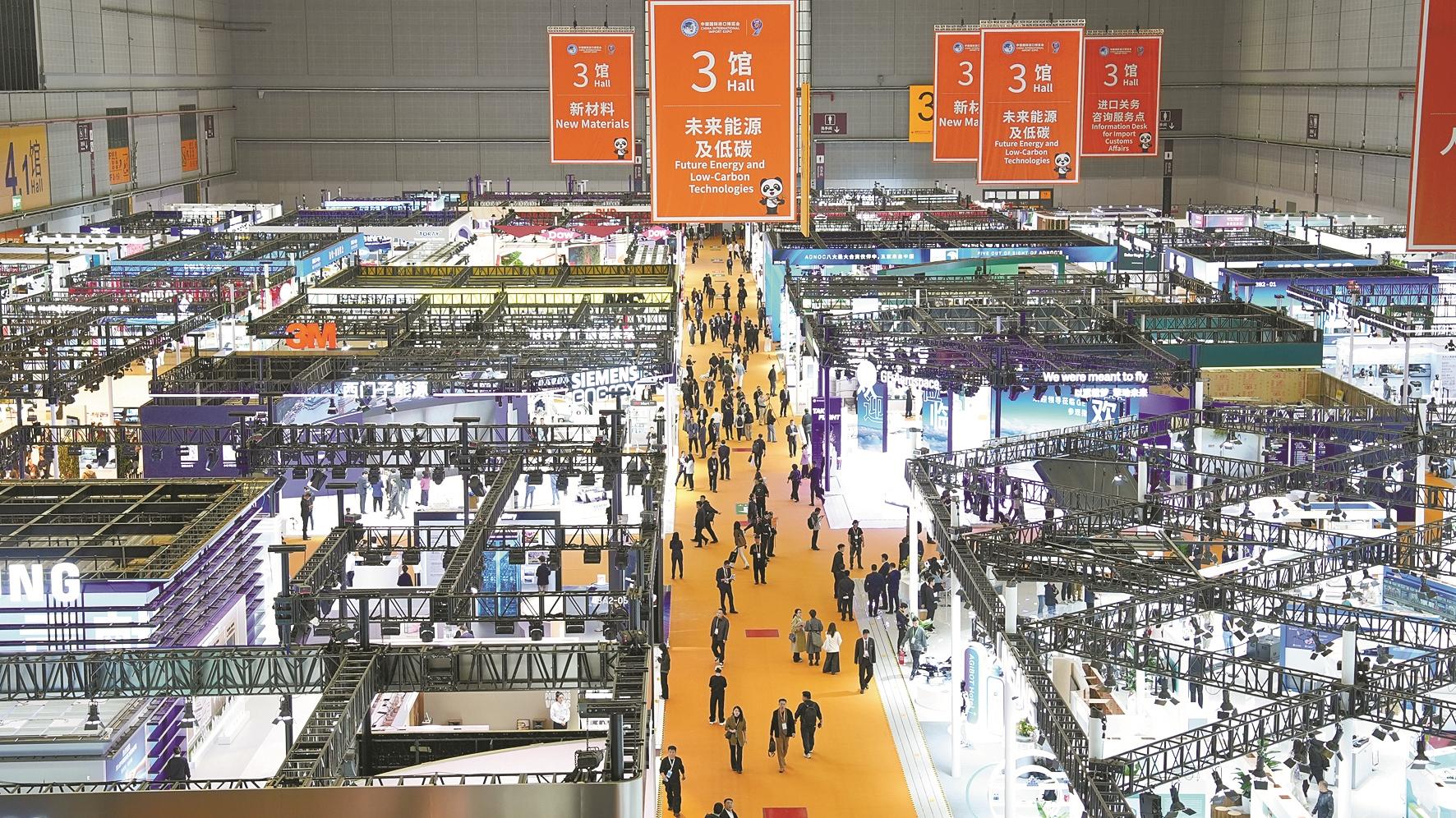
The 9th China International Import Expo (CIIE) runs in Shanghai from November 5 to 10, with exhibitors and buyers from across the globe gathering once again for what has become an annual rendezvous to tap into China's openness.
This year the Ningbo trade delegation is shopping across technical equipment, consumer goods, agricultural and food products, trade in services, medical devices, health products, automobiles, and smart mobility. More than 5,000 Ningbo buyers are here, hunting for the world's best.
Ningbo Companies Rush Fresh Offerings
Less than an hour after the pavilion opened, Zheng Yao, general manager of Jiexiya (Ningbo) International Trade Co., Ltd., had already sold the first piece from the company's latest collection of Czech crystal jewelry in China.
"One of our biggest highlights this year is a jewelry collection making its debut in China," Zheng said. The whole line is on show for the first time, with brooches, bracelets and rings priced at one or two hundred yuan up to necklaces that cost several thousand. "Czech crystal is world famous. Customers have long been asking us to make crystal jewelry, so this year we brought that category to the show."
Crystal glasses are still Jiexiya's signature product. On the floor, a veteran Czech artisan first sketched a pattern on a goblet with a pen, then ran it through a machine that engraved along the lines, drawing fine, delicate designs on the surface.
"Showing it up close lets customers appreciate the century-old craftsmanship better. We could also fulfill customization requests," Zheng said. "If someone wants their name engraved on a goblet, we can do it right there on the spot."
Jiexiya has taken part in all nine editions of the CIIE, and its booth has grown every year. "Customers keep asking 'can you bring more products to the show?' We also want to reach new consumer markets beyond the corporate gifting and collectibles we're strong at," Zheng said.
Ningbo buyers are not only exploring new categories and industries but also testing new ways to sell.
"The CIIE and e-commerce are now tightly woven together," said Duan Xiaohong, general manager of Ningbo Imported Goods Exhibition & Trade Center Co., Ltd. "Almost every booth is running livestreams that tie into online platforms."
Duan sees this as a shift in how people exhibit: booths are no longer just places to lay out samples and wait for buyers. Instead, exhibitors use them to draw visitors into a broader online experience, encouraging them to follow their WeChat accounts, visit online stores and watch livestreams. These online channels, in turn, bring more people back to the booth, creating a cycle of engagement between online and offline channels.
Product strategy is shifting too. "In the past our lineup leaned heavily on traditional wines, but competition has gotten fiercer over the past two or three years, so we're actively changing course—exploring newer, lighter, healthier products," Duan said.
According to Ningbo Customs, trade between Ningbo and Central and Eastern European countries reached 47.85 billion yuan in the first three quarters of this year, up 5.3% year on year.
Robots Show Up to Work
Walk into the AI pavilion in Hall 3, and the robots have taken over.
Making its first appearance at the CIIE, Zhejiang Humanoid Robot Innovation Center is demonstrating three industrial use cases already proven on real production lines.
"It's like moving a miniature factory onto the show floor," said Mr. Xun, who heads the center's overseas business. The solutions for manufacturing, smart logistics, biochemical lab work, and smart garment-making on display are already deployed and operating at scale at major automakers and auto suppliers.
He said taking part in the CIIE is largely about letting more overseas visitors see how far China's humanoid robots have actually come. "Overseas people judge what's happening here mostly from what they see online—some of it exaggerated, some of it too bleak. They don't know what these robots can and can't do in specific scenarios," Xun said. They want to use live, case-based demonstrations to break through that gap.
"The dexterity of the movements is impressive," said Mert Orham Astam, founder of Netherlands-based HaptonTech, which makes tactile materials and novel flexible materials. He is talking with the Zhejiang team about whether his company's materials could be used for the robots' contact surfaces—"making the hands and surfaces look more lifelike and work better".
A Zhejiang Humanoid Robot executive said the center prefers to tie its R&D directly to customers and work with them on the factory floor. In his view, accumulating data from specific industries and refining models for those use cases is the most important task right now.
For Chinese companies going global, the CIIE is an efficient springboard. Zhejiang Humanoid Robot has already stepped abroad: it has customers in Germany, France, Italy and Spain, and next year will shift more of its effort to the Southeast Asian market.
From January to July this year, operating revenue from Ningbo's core AI industry rose 20.5% year on year, with sub-sectors such as computing services, algorithmic models and smart terminals up 20.1% , 34.2% and 17.7% respectively.