
Zhao Yu
On November 10, more than 30 German and French companies met in Ningbo for the 2026 "Invest in Ningbo" German-French Intelligent Manufacturing Industry Matchmaking Conference.Local Ningbo entrepreneurs and representatives of German and French firms already operating in Ningbo were also in attendance.
The visitors came with new technology and project proposals. Ningbo, as host, was ready to listen. Over the course of the day, the three sides laid out what they had and what they needed.
Now the real work begins: turning expressions of interest into actual investments, and a one-time meeting into a lasting relationship.
Long-Timers Pitch the City
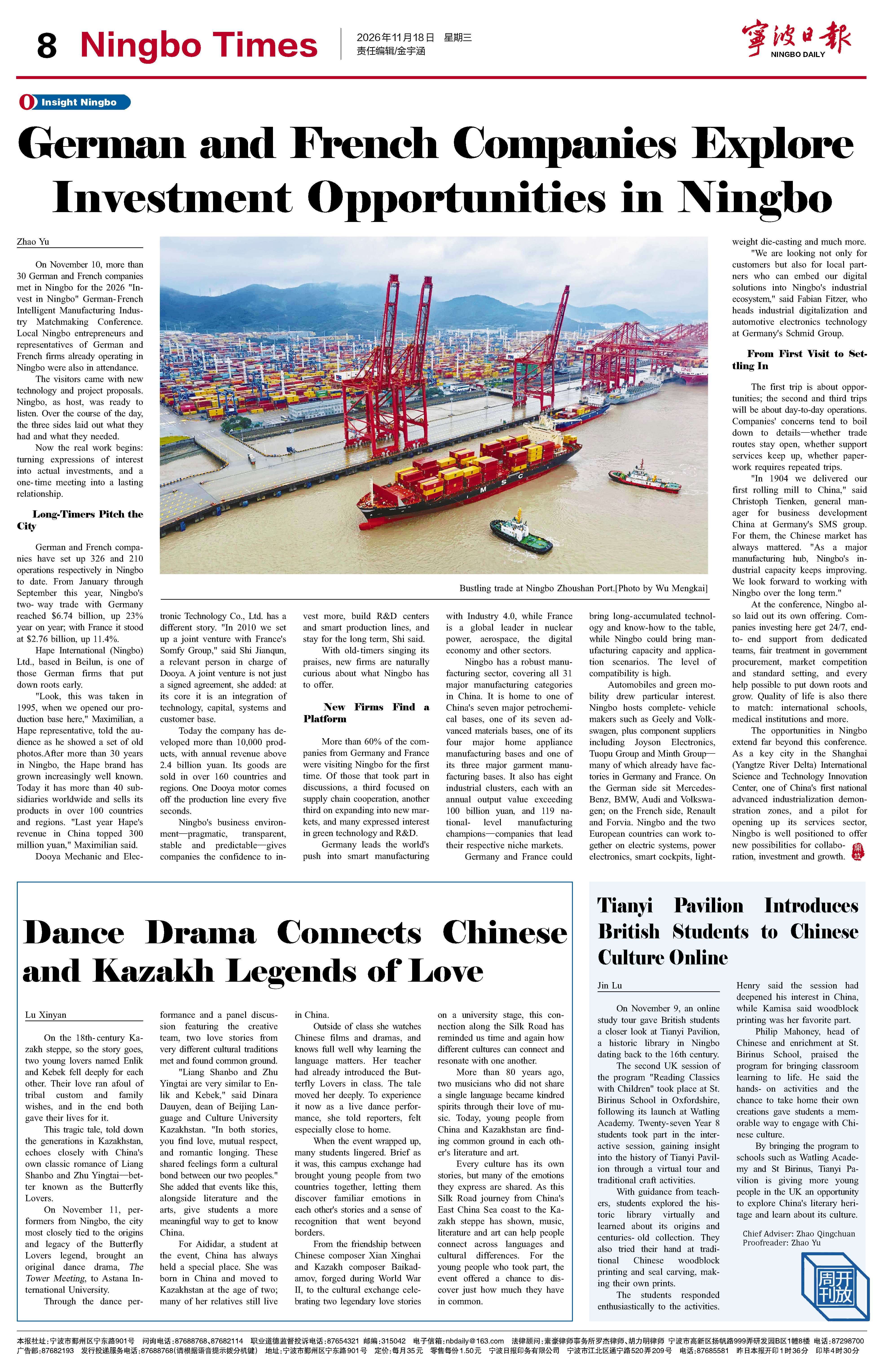
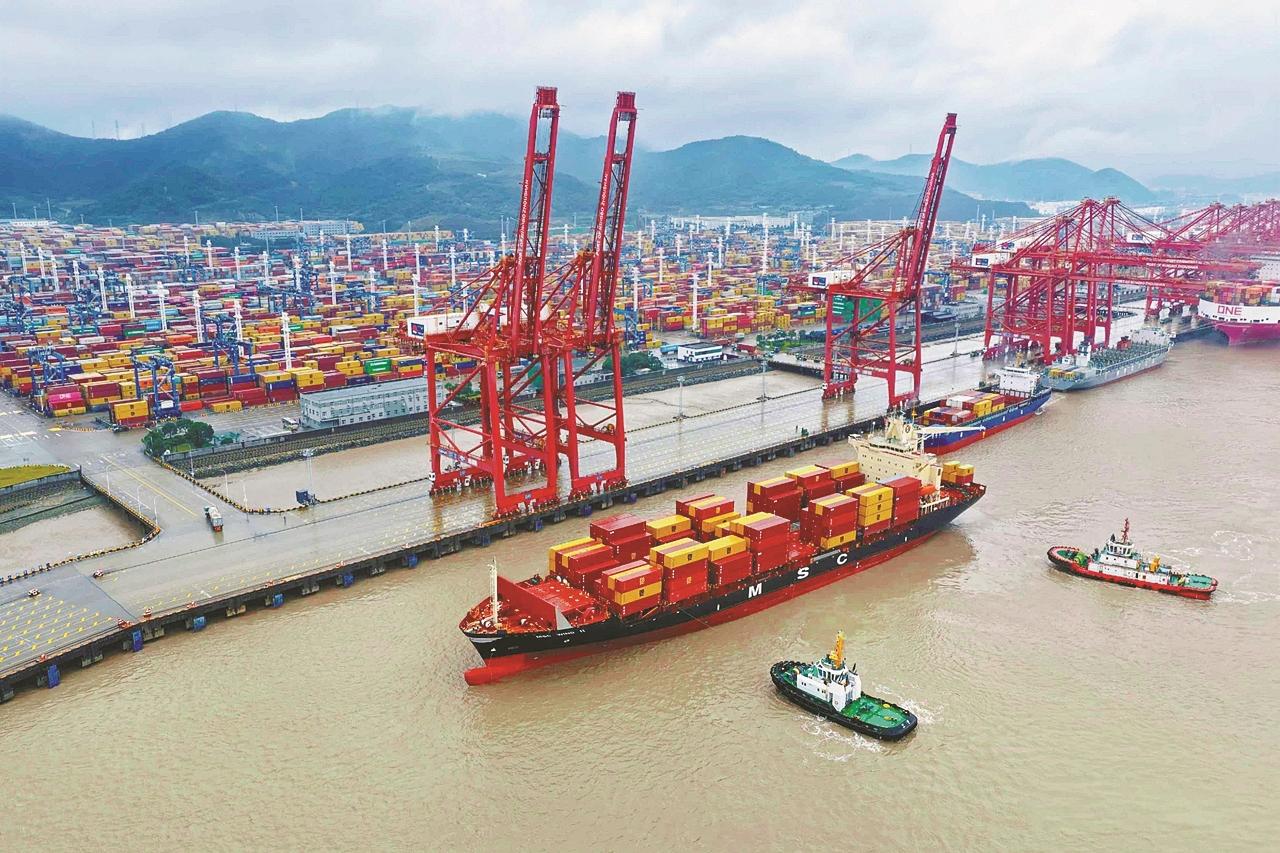
German and French companies have set up 326 and 210 operations respectively in Ningbo to date. From January through September this year, Ningbo's two-way trade with Germany reached $6.74 billion, up 23% year on year; with France it stood at $2.76 billion, up 11.4%.
Hape International (Ningbo) Ltd., based in Beilun, is one of those German firms that put down roots early.
"Look, this was taken in 1995, when we opened our production base here," Maximilian, a Hape representative, told the audience as he showed a set of old photos.After more than 30 years in Ningbo, the Hape brand has grown increasingly well known. Today it has more than 40 subsidiaries worldwide and sells its products in over 100 countries and regions. "Last year Hape's revenue in China topped 300 million yuan," Maximilian said.
Dooya Mechanic and Electronic Technology Co., Ltd. has a different story. "In 2010 we set up a joint venture with France's Somfy Group," said Shi Jianqun, a relevant person in charge of Dooya. A joint venture is not just a signed agreement, she added: at its core it is an integration of technology, capital, systems and customer base.
Today the company has developed more than 10,000 products, with annual revenue above 2.4 billion yuan. Its goods are sold in over 160 countries and regions. One Dooya motor comes off the production line every five seconds.
Ningbo's business environment—pragmatic, transparent, stable and predictable—gives companies the confidence to invest more, build R&D centers and smart production lines, and stay for the long term, Shi said.
With old-timers singing its praises, new firms are naturally curious about what Ningbo has to offer.
New Firms Find a Platform
More than 60% of the companies from Germany and France were visiting Ningbo for the first time. Of those that took part in discussions, a third focused on supply chain cooperation, another third on expanding into new markets, and many expressed interest in green technology and R&D.
Germany leads the world's push into smart manufacturing with Industry 4.0, while France is a global leader in nuclear power, aerospace, the digital economy and other sectors.
Ningbo has a robust manufacturing sector, covering all 31 major manufacturing categories in China. It is home to one of China's seven major petrochemical bases, one of its seven advanced materials bases, one of its four major home appliance manufacturing bases and one of its three major garment manufacturing bases. It also has eight industrial clusters, each with an annual output value exceeding 100 billion yuan, and 119 national-level manufacturing champions—companies that lead their respective niche markets.
Germany and France could bring long-accumulated technology and know-how to the table, while Ningbo could bring manufacturing capacity and application scenarios. The level of compatibility is high.
Automobiles and green mobility drew particular interest.Ningbo hosts complete-vehicle makers such as Geely and Volkswagen, plus component suppliers including Joyson Electronics, Tuopu Group and Minth Group—many of which already have factories in Germany and France. On the German side sit Mercedes-Benz, BMW, Audi and Volkswagen; on the French side, Renault and Forvia. Ningbo and the two European countries can work together on electric systems, power electronics, smart cockpits, lightweight die-casting and much more.
"We are looking not only for customers but also for local partners who can embed our digital solutions into Ningbo's industrial ecosystem," said Fabian Fitzer, who heads industrial digitalization and automotive electronics technology at Germany's Schmid Group.
From First Visit to Settling In
The first trip is about opportunities; the second and third trips will be about day-to-day operations.Companies' concerns tend to boil down to details—whether trade routes stay open, whether support services keep up, whether paperwork requires repeated trips.
"In 1904 we delivered our first rolling mill to China," said Christoph Tienken, general manager for business development China at Germany's SMS group. For them, the Chinese market has always mattered. "As a major manufacturing hub, Ningbo's industrial capacity keeps improving. We look forward to working with Ningbo over the long term."
At the conference, Ningbo also laid out its own offering. Companies investing here get 24/7, end-to-end support from dedicated teams, fair treatment in government procurement, market competition and standard setting, and every help possible to put down roots and grow. Quality of life is also there to match: international schools, medical institutions and more.
The opportunities in Ningbo extend far beyond this conference. As a key city in the Shanghai (Yangtze River Delta) International Science and Technology Innovation Center, one of China's first national advanced industrialization demonstration zones, and a pilot for opening up its services sector, Ningbo is well positioned to offer new possibilities for collaboration, investment and growth.