
By Jin Yuhan
On April 28 this year, a ceremony marking the 40th anniversary of the sister-city relationship between Ningbo and Aachen was held at Aachen City Hall. On October 20, at Ningbo's invitation, Aachen's mayor led a 30-member delegation on a return visit to Ningbo.
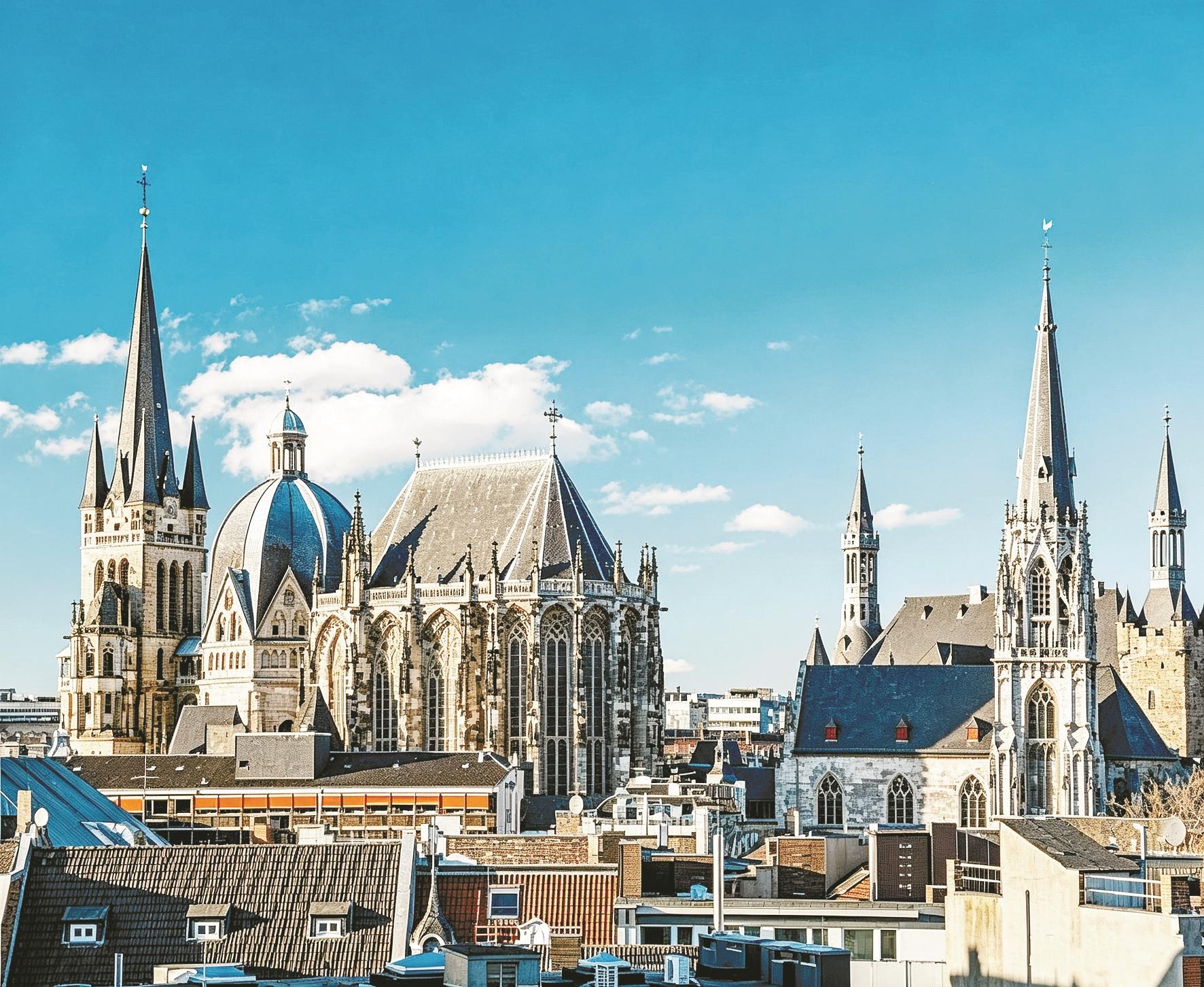
Over the past 40 years, Ningbo has become more than a distant place name for people in Aachen. The city has built lasting connections with Aachen through schools, hospitals, businesses and museums. Located in western Germany near the borders with the Netherlands and Belgium, Aachen has also become one of Ningbo's longest-standing partners in Europe. There is a street named Ningbo Street in Aachen.
According to the Ningbo Foreign Affairs Office, Ningbo has established various forms of friendly relations with 122 cities in 60 countries across five continents. Among its international partners, Aachen was the first city in Europe to establish a sister-city relationship with Ningbo.
Education as the Foundation
In 1984, Fachhochschule Aachen helped Ningbo plan a new type of higher education institution, laying part of the groundwork for what is now Ningbo University of Technology. German experts and teachers made repeated visits to Ningbo to advise on academic programs, laboratory development and faculty training, while scholars and engineers from Ningbo traveled to Aachen to study.
These educational exchanges helped pave the way for formal ties between the two cities. In 1985, Ningbo proposed establishing a sister-city relationship with Aachen. On October 25, 1986, the two cities formalized the relationship. Aachen became Ningbo's first sister city in Europe, while Ningbo became Aachen's first sister city in Asia.
Forty years later, educational cooperation continues to develop. At this year's anniversary event, the Eastern Institute of Technology, Ningbo, and RWTH Aachen University signed a memorandum of understanding on academic cooperation.
Under the agreement, the two institutions plan to promote student exchanges, joint research and industry collaboration, initially focusing on fields such as mechanical engineering and artificial intelligence.
A Friendship Sustained Through Generations
The friendship between Ningbo and Aachen over the past 40 years has been sustained by generations of people working to bring the two communities closer together.
In 1990, the Aachen-Ningbo Sister City Promotion Association was founded. In the years that followed, Herbert Prömper, chair of the Association, visited Ningbo almost every year, sometimes staying for as long as a month.
His office holds thousands of business cards from people he has met in Ningbo. He can readily explain which schools in the two cities are paired and which hospitals have established exchange programs. People in Ningbo affectionately call him "Grandpa Aachen," while German media refer to him as "Mr. Ningbo." His efforts also helped bring about the naming of Ningbo Street in Aachen in 2006.
In 2005, Ningbo Foreign Affairs School and PIUS-Gymnasium in Aachen established a sister-school partnership. Since then, students from the two schools have taken part in exchange visits every two years, with around 25 students from each city joining each exchange and forming friendships that often last well beyond the visits.
Leonie Zoika, from Aachen, and Yan Jiaqi, from Ningbo, first met online before visiting each other's homes. In 2016, at the age of 18, Leonie returned to Ningbo and worked as a teaching assistant in the German-language program at Ningbo Foreign Affairs School.
After her six-month placement ended, she continued to keep in touch with teachers at the school by email.
"Leonie shared important moments in her life with us, such as going to Malaysia to rescue stray dogs and applying to study psychology at university. She sees Ningbo as a second home," said Gui Pan, a teacher in the school's German-language program.
The connection has continued into the next generation. In 2018, Leonie's younger brother took part in an exchange program at Ningbo Foreign Affairs School and spoke at a school event as a student representative. He also brought a special gift from his sister: a handwritten letter of thanks.
Industry Drives Cooperation
For Volker Hagen, executive director and chief financial officer of the Aachen-Ningbo Sister City Promotion Association, one of Ningbo's most striking qualities is its ability to turn plans into action.
Hagen first visited Ningbo in 2003. Impressed by its port, industrial infrastructure and efficient business environment, he decided to settle in Beilun and establish a consulting company to help German small and medium-sized enterprises enter the Chinese market. Over the past two decades, he has helped connect around 50 German companies with Chinese partners, 12 of which have established operations in Ningbo.
"The sister-city relationship provides a lasting channel for cooperation, helping Aachen's technologies find practical applications in Ningbo's manufacturing sector," Hagen said.
Ningbo has a major port and a broad manufacturing base, while Aachen is home to leading engineering universities and technology transfer organizations. As industrial ties deepen, cooperation is expanding beyond individual projects to include closer links between the two cities' innovation and industrial networks.
In April this year, a Ningbo delegation visited AGIT, an Aachen-based innovation and technology transfer organization, to discuss how research findings could be translated into commercial applications.
The itinerary for the latest Aachen delegation includes visits to companies in Ningbo such as Geely, Fotile and Joyson Electronics. Their production facilities and laboratories will offer opportunities to learn more about the city's manufacturing capabilities and technological advances. Discussions are expected to explore potential cooperation in areas such as new energy, digitalization and sustainable development, where both sides face common technological challenges and changing market demands.
A memorandum signed by the two cities during the latest visit also outlines plans to further develop their sister-city relationship. From a street named Ningbo in Aachen to closer cooperation in education, business and technology, the partnership continues to evolve as the two cities look toward the next 40 years.