
By Zhao Yu
On the evening of September 18, the David H. Koch Theater at Lincoln Center began to fill with an enthusiastic chatter, all of it circling one name: Mulan.
The occasion was the New York run of Mulan, an original dance drama by the Ningbo Performance & Arts Group, which played four performances between September 18 and 20. It is part of a 2026 U.S. tour under China Arts and Entertainment Group's overseas showcase program, and the company's second American trip after Boston and Washington in 2023. Traveling with it was "Global Chinese Culture with Ningbo Companies Overseas", a campaign that has followed Ningbo businesses abroad for two years but had never before set up inside a venue of Lincoln Center's stature.
Onstage: Nine Years, a Hundred Shows
By opening night, all four tiers of the house were open, with barely a gap among its 2,586 seats.
Not a word is spoken from the stage. The piece opens on war drums and a young woman at her loom—Mulan, who sets down her shuttle, passes herself off as a man and marches to war in her father's place. Over the next two hours the action moves from army camp to battlefield and finally home, where she sheds her armor and reunites with her parents.
Since its 2017 premiere at Beijing's National Centre for the Performing Arts, the production has been staged more than 100 times worldwide. Its co-directors, Zhou Liya and Han Zhen, are two of the best-known choreographers working in Chinese dance today.
The work first traveled to the United States in September 2023, with six shows in Boston and Washington that drew close to 10,000 people. At one performance, a cast of just over 50 held an audience of 1,600 applauding for a full 15 minutes. Xinhua News Agency later called the tour a high point of China-U.S. cultural exchange.
In New York, the dancers came out for three curtain calls, the applause ran past ten minutes, and much of the audience stayed on its feet and kept clapping after the stage had emptied.
"Fantastic. Epic. Grand." That was the verdict of Cody Andrus, an American in the audience who had never seen Chinese dance drama live. What struck him most, he said, was the way the choreography absorbs martial arts and sword work. "It's so different from American ballet and modern dance—especially the formations, the way the whole company shifts at once and the patterns they throw across that big stage," he said. "Brilliant."
For Lin Hong, chairman of the Ningbo Performance & Arts Group, the return to America is proof the piece has outgrown its beginnings as a local export. "A dance drama born in Ningbo has reached the mainstream of New York's cultural life," she said. She hopes the run will give American audiences a deeper feel for traditional Chinese culture.
Offstage: A Slice of Ningbo as a Pop-up
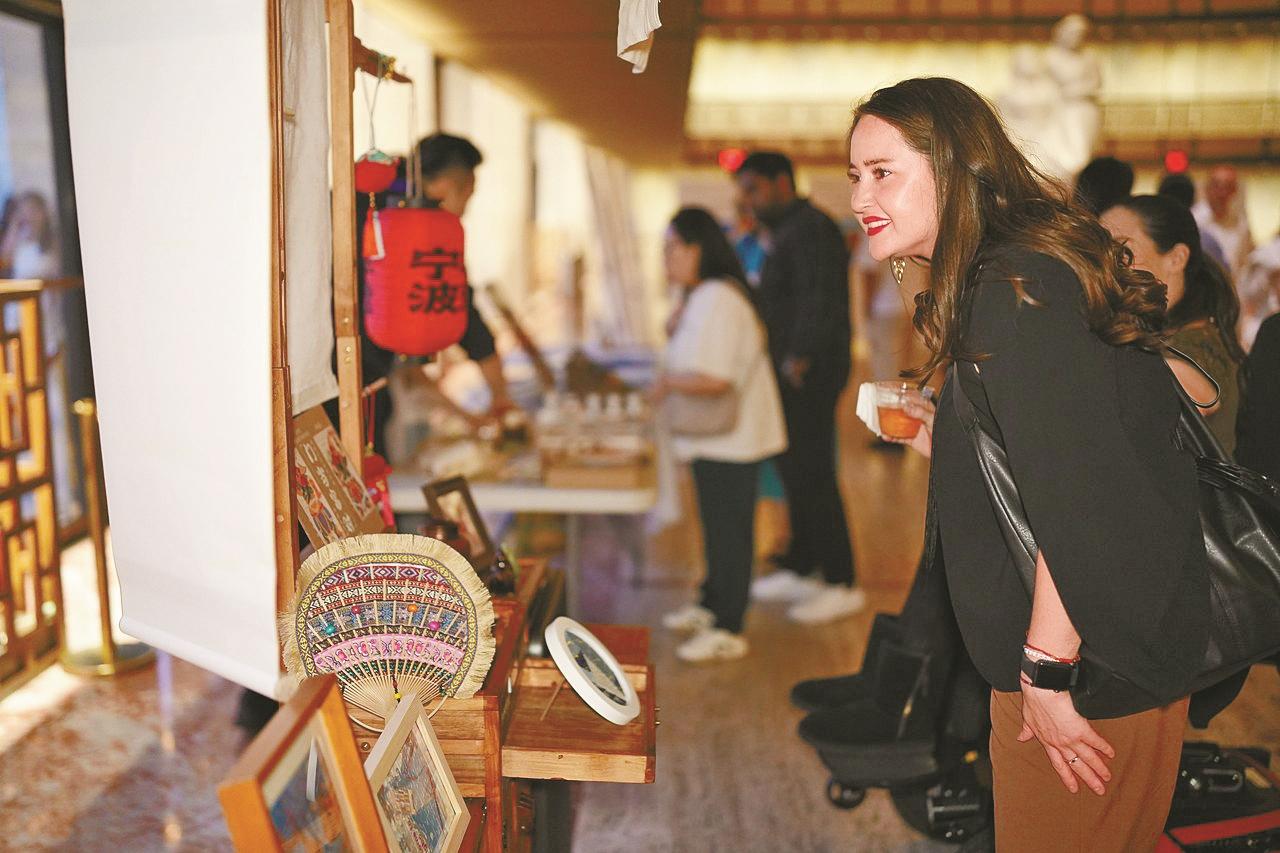
The story continued offstage. In the theater's front lobby, an exhibition and a Ningbo tourism promotion packed a compact tour of the city into more than ten bilingual panels.
They covered the 7,000-year-old rice-farming settlement at Hemudu; Tianyi Pavilion, a private library now four centuries old; the Ningbo Zhoushan Port, the world's busiest for 17 years running; and the Chinese crested tern, a seabird long presumed extinct until it reappeared near the Jiushan Islands of Ningbo.
Display tables were lined with celadon horses and beaded phoenix hairpins, keepsakes from the riverside towns of the Yangtze River Delta. The busiest stop was a set of nine rubber stamps modeled on traditional Chinese seal carving, arranged as a wordless exchange across the Pacific. Three borrowed American icons—the Statue of Liberty, the Wall Street bull and the bald eagle—to give local visitors a way in. Three offered the Great Wall, a panda and a flying apsara as an introduction to Chinese imagery. The last three spoke for Ningbo itself: the port that opens the city to the sea, the Butterfly Lovers legend that ranks among China's national intangible heritage traditions, and the tourism slogan "In Ningbo, enjoy!".
Visitors stamped their own souvenirs, each red impression a small, hands-on encounter with a Chinese intangible heritage.
In two years, the campaign has followed Ningbo companies to more than 20 countries, including Cambodia, Spain and Vietnam. Lincoln Center is its first stop inside a major American arts venue—and this time it arrived alongside Mulan.