

By Zhao Yu
"My first trip last year was promising enough to bring me back a second time," said Zhu Yu'an, who runs a cookware company in Ningbo.
Zhu is the head of Yuyao Huanjin Trading Co., Ltd, which had previously sold its products only on the domestic market. He returned to Almaty this month for the China (Ningbo) International Consumer Goods Fair Kazakhstan, held from Aug 6 to 8.
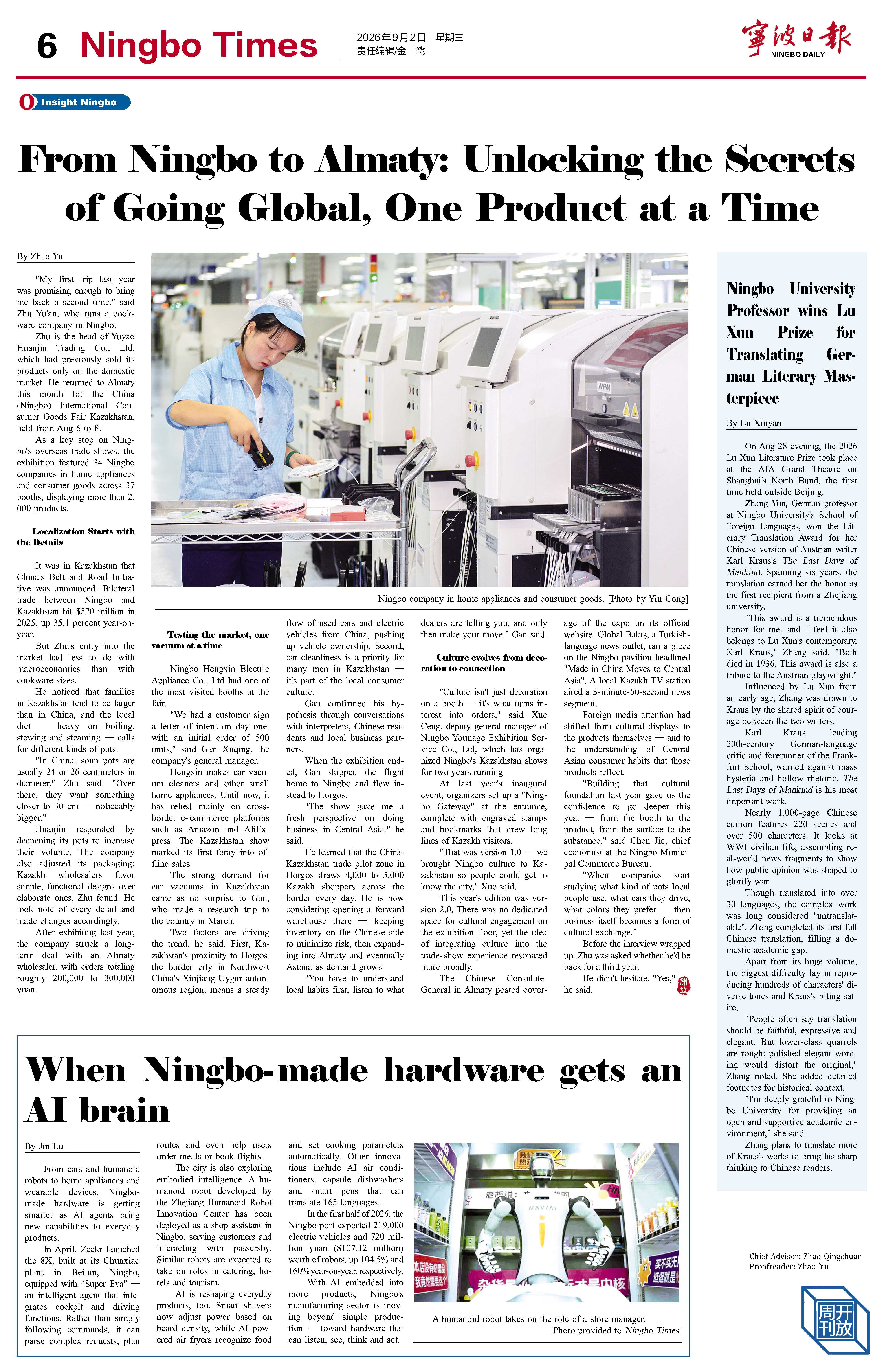
As a key stop on Ningbo's overseas trade shows, the exhibition featured 34 Ningbo companies in home appliances and consumer goods across 37 booths, displaying more than 2,000 products.
Localization Starts with the Details
It was in Kazakhstan that China's Belt and Road Initiative was announced. Bilateral trade between Ningbo and Kazakhstan hit $520 million in 2025, up 35.1 percent year-on-year.
But Zhu's entry into the market had less to do with macroeconomics than with cookware sizes.
He noticed that families in Kazakhstan tend to be larger than in China, and the local diet — heavy on boiling, stewing and steaming — calls for different kinds of pots.
"In China, soup pots are usually 24 or 26 centimeters in diameter," Zhu said. "Over there, they want something closer to 30 cm — noticeably bigger."
Huanjin responded by deepening its pots to increase their volume. The company also adjusted its packaging: Kazakh wholesalers favor simple, functional designs over elaborate ones, Zhu found. He took note of every detail and made changes accordingly.
After exhibiting last year, the company struck a long-term deal with an Almaty wholesaler, with orders totaling roughly 200,000 to 300,000 yuan.
Testing the market, one vacuum at a time
Ningbo Hengxin Electric Appliance Co., Ltd had one of the most visited booths at the fair.
"We had a customer sign a letter of intent on day one, with an initial order of 500 units," said Gan Xuqing, the company's general manager.
Hengxin makes car vacuum cleaners and other small home appliances. Until now, it has relied mainly on cross-border e-commerce platforms such as Amazon and AliExpress. The Kazakhstan show marked its first foray into offline sales.
The strong demand for car vacuums in Kazakhstan came as no surprise to Gan, who made a research trip to the country in March.
Two factors are driving the trend, he said. First, Kazakhstan's proximity to Horgos, the border city in Northwest China's Xinjiang Uygur autonomous region, means a steady flow of used cars and electric vehicles from China, pushing up vehicle ownership. Second, car cleanliness is a priority for many men in Kazakhstan — it's part of the local consumer culture.
Gan confirmed his hypothesis through conversations with interpreters, Chinese residents and local business partners.
When the exhibition ended, Gan skipped the flight home to Ningbo and flew instead to Horgos.
"The show gave me a fresh perspective on doing business in Central Asia," he said.
He learned that the China-Kazakhstan trade pilot zone in Horgos draws 4,000 to 5,000 Kazakh shoppers across the border every day. He is now considering opening a forward warehouse there — keeping inventory on the Chinese side to minimize risk, then expanding into Almaty and eventually Astana as demand grows.
"You have to understand local habits first, listen to what dealers are telling you, and only then make your move," Gan said.
Culture evolves from decoration to connection
"Culture isn't just decoration on a booth — it's what turns interest into orders," said Xue Ceng, deputy general manager of Ningbo Younage Exhibition Service Co., Ltd, which has organized Ningbo's Kazakhstan shows for two years running.
At last year's inaugural event, organizers set up a "Ningbo Gateway" at the entrance, complete with engraved stamps and bookmarks that drew long lines of Kazakh visitors.
"That was version 1.0 — we brought Ningbo culture to Kazakhstan so people could get to know the city," Xue said.
This year's edition was version 2.0. There was no dedicated space for cultural engagement on the exhibition floor, yet the idea of integrating culture into the trade-show experience resonated more broadly.
The Chinese Consulate-General in Almaty posted coverage of the expo on its official website. Global Bakış, a Turkish-language news outlet, ran a piece on the Ningbo pavilion headlined "Made in China Moves to Central Asia". A local Kazakh TV station aired a 3-minute-50-second news segment.
Foreign media attention had shifted from cultural displays to the products themselves — and to the understanding of Central Asian consumer habits that those products reflect.
"Building that cultural foundation last year gave us the confidence to go deeper this year — from the booth to the product, from the surface to the substance," said Chen Jie, chief economist at the Ningbo Municipal Commerce Bureau.
"When companies start studying what kind of pots local people use, what cars they drive, what colors they prefer — then business itself becomes a form of cultural exchange."
Before the interview wrapped up, Zhu was asked whether he'd be back for a third year.
He didn't hesitate. "Yes," he said.