


By Zhao Yu
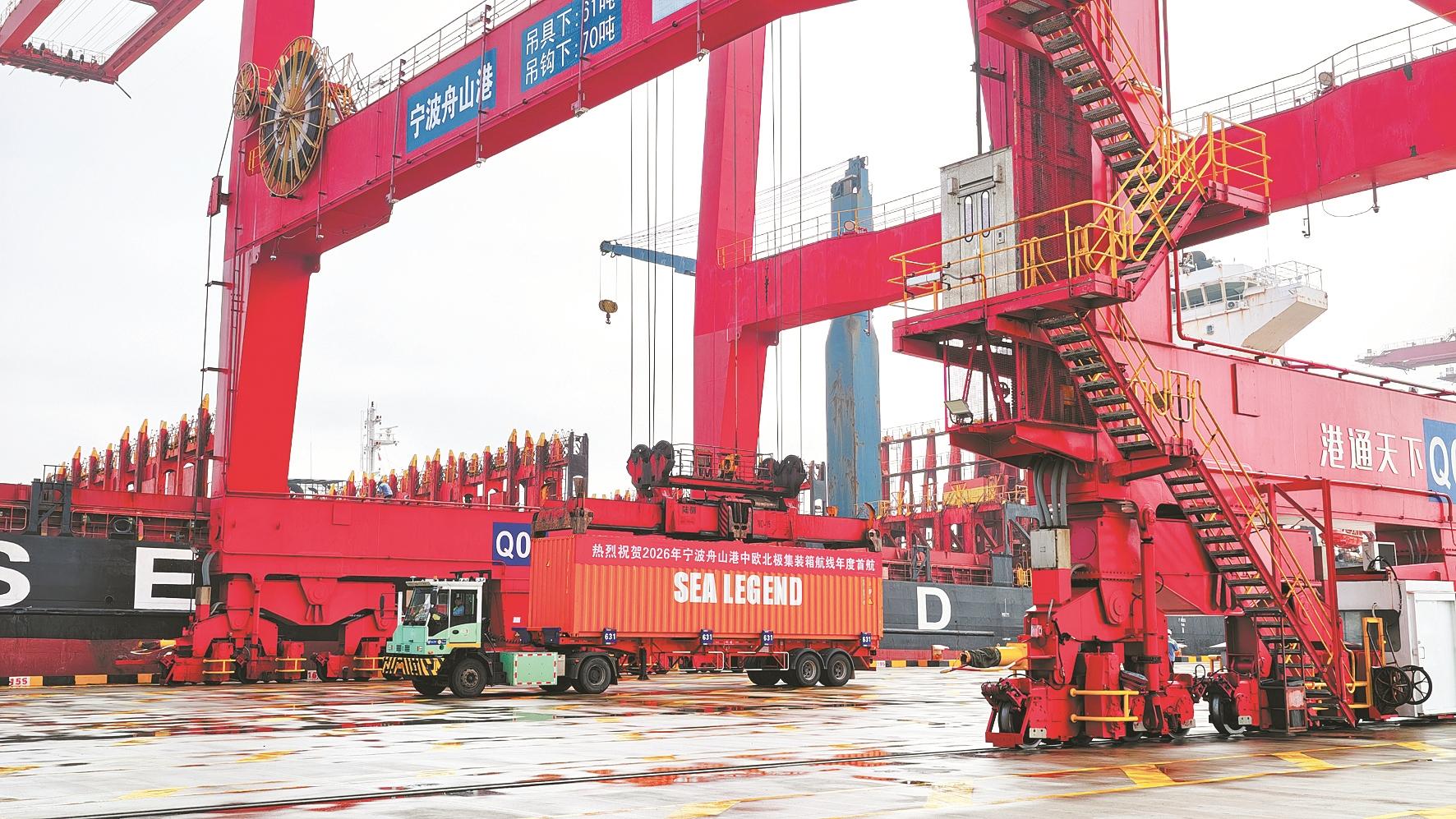
A few days ago, Huizhou EVE Energy Co., Ltd. sent two TEUs of lithium batteries by road to Ningbo Zhoushan Port, where they were loaded for shipment to Europe via the Arctic. The relatively small consignment was part of the company's initial attempt using the route.
On Aug. 15, the cargo was loaded onto the Dubai Tower at Ningbo Zhoushan Port. Ningbo, the vessel's first port of call in China, is set to handle nearly 1,000 TEUs before the ship continues to Shanghai, Taicang and Qingdao to take on additional cargo. The vessel will then sail west along the Northeast Passage, carrying nearly 1,500 TEUs in total and reaching the UK in about 20 days.
Last year, the route was operated only once. This year, seven to eight vessels will rotate on the service, with eight sailings scheduled each week during the navigable season. The China-Europe Arctic Container Express from Ningbo Zhoushan Port has entered a new phase of regular weekly service.
The rapid expansion reflects growing confidence in the Arctic route, which has evolved from a one-off trial into a regular seasonal service in just a year.
From One-Off Trial to Weekly Service
On Sept. 22, 2025, the China-Europe Arctic Express from Ningbo Zhoushan Port to Felixstowe completed its maiden voyage. The vessel sailed the full length of the Northeast Passage, reaching the UK in 20 days.
For decades, Asia-Europe maritime trade has relied heavily on the southern route through the Strait of Malacca, the Indian Ocean, the Red Sea and the Suez Canal. The Arctic route can cut the voyage by more than one-third, while also reducing the risks of overdependence on a single shipping corridor. The Financial Times has described the Arctic as becoming a viable alternative to traditional global shipping routes.
The Arctic route runs through the Bering Strait and the Barents Sea and covers roughly 5,000 kilometers, making it the shortest maritime link between Northeast Asia and Western Europe. But for liner shipping, speed alone is not enough. What matters is a reliable schedule that allows customers to plan shipments with confidence.
That has been a key focus for route operator Sea Legend Line, which spent nearly a year working with partners to refine operating procedures, optimize fleet deployment and improve supporting facilities at ports along the route. The efforts paved the way for the China-Europe Arctic Express to move from a one-off trial to regular weekly sailings during the navigable season.
"With a stable weekly schedule during the navigable season, manufacturers can plan production, exporters can book shipping space, and European customers can prepare their warehouse capacity accordingly," said Fang Yi, CEO of Sea Legend.
After leaving Ningbo, the service calls at major ports in Northern Europe and the Baltic region, including Felixstowe in the UK, Rotterdam in the Netherlands, Hamburg in Germany and Gdynia in Poland. The network links ports along China's coast with major European destinations.
Government support has also expanded. On Aug. 1, the Ministry of Transport released China's first public Arctic sea-ice forecast and added an Arctic route section to its website, providing shipping companies with information on ice conditions, international regulations and the requirements of Arctic coastal states.
Together, these developments are helping turn the Arctic route from a seasonal experiment into a more established link between Asian and European markets.
What It Takes to Keep the Route Running
Industry insiders say the Arctic route remains constrained by seasonal ice conditions and is currently navigable for only a few months each year, from late July through October. It is unlikely to replace traditional shipping routes in the near term, but its role could grow as navigability improves over time.
Russian monitoring data released on Aug. 10 showed moderate to heavy sea ice in parts of the Vilkitsky Strait, the East Siberian Sea and the Chukchi Sea. Of the seven vessels operating on the route, only the Dubai Tower and Istanbul Bridge have an Ice1 rating under Russia's ice-class system. The other vessels may require icebreaker assistance in some sections.
Furthermore, shortage of qualified crew members is another major challenge, according to Huang Geng, director of the Chuanshan Maritime Safety Administration Office in Ningbo. "Crew members operating in polar waters must complete specialized training under the Polar Code, covering skills such as ship handling in ice, polar communications and emergency response. The training is demanding and lengthy. The number of Chinese crew members with the required qualifications remains far below the industry's growing needs."
Maritime authorities in Ningbo are now working with Ningbo University to explore specialized training programs for crew members preparing to operate in polar waters.
Meanwhile, more shipping companies are preparing to enter the Arctic market. Together, they will provide container and multipurpose vessel capacity of about 20,000 TEUs, as well as 1.4 million deadweight tons of dry-bulk capacity.
Interest is also growing beyond China. South Korea's PanStar plans to launch an Arctic service from Busan to Europe on Aug. 22, while the South Korean government is working to establish a more systematic framework for Arctic shipping.
The Arctic shipping market is therefore entering a more competitive phase, with both Chinese and international operators positioning themselves for future growth. Sea Legend Line has set a goal of extending the stable navigable season to about four months within three to five years, with year-round Arctic operations targeted within five to ten years.