

By Jin Yuhan
"The official jerseys for favorites such as Argentina and Spain are produced right here in our workshop," said Sun Haiming, production manager of Garment Division No. 4 at Shenzhou Group.
As the 2026 FIFA World Cup unfolds across the United States, Canada and Mexico, demand for official team jerseys has surged worldwide. This year marked a breakthrough for the Shenzhou Group, as it secured high-profile World Cup apparel contracts for six national teams.
The company manufactured Curaçao's complete on-field kit, including jerseys and shorts, while also producing official licensed fan jerseys for Argentina, Spain and Germany.
Winning those orders was the culmination of nearly two years of preparation, requiring the company to meet demanding production schedules and stringent technical standards.
Years of Preparation
Scoring contracts for official football jersey production is highly competitive. "Many Chinese textile companies are involved in manufacturing fan jerseys, but few have the opportunity to participate in the design and development of official player kits," said an industry insider.
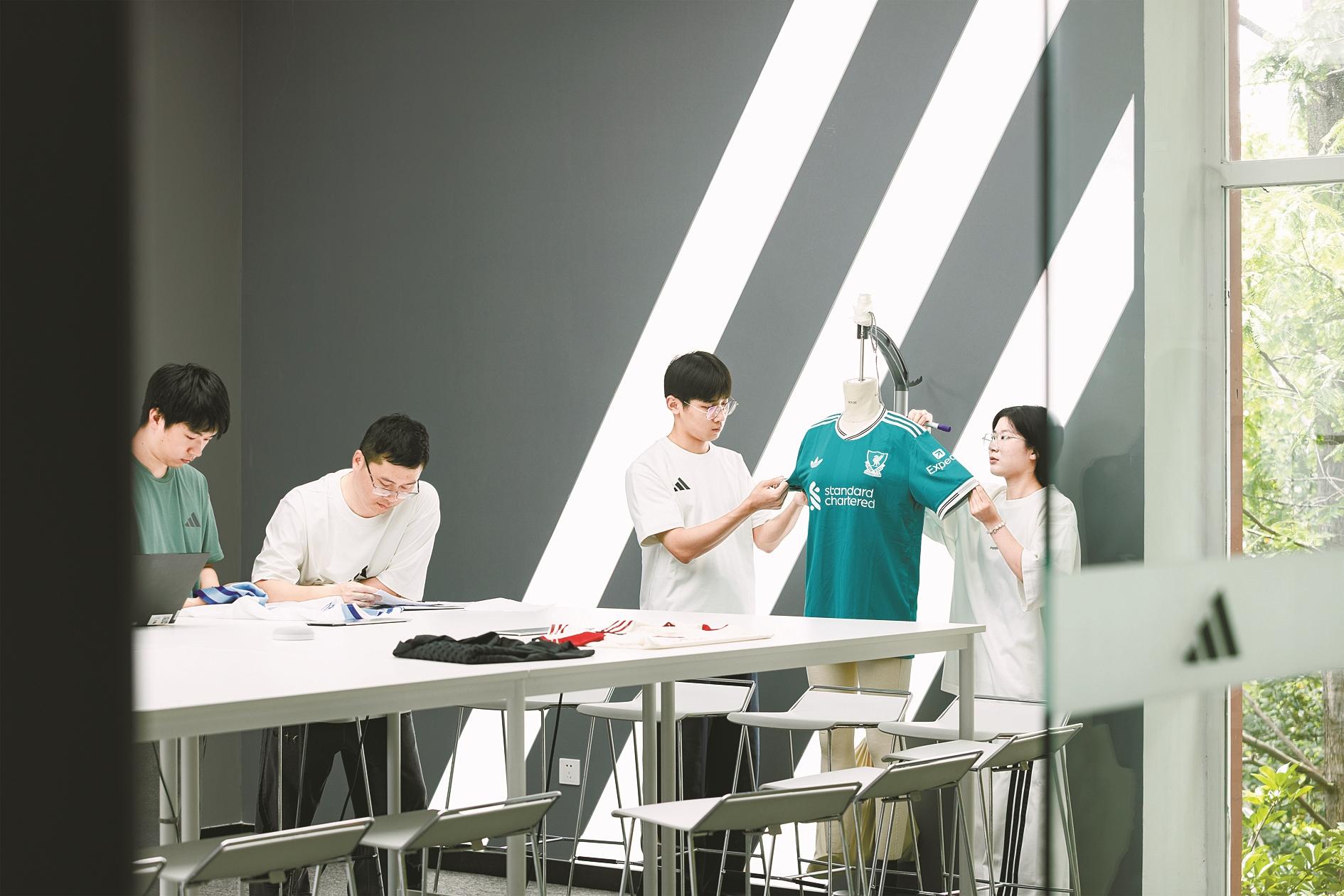
Shenzhou's breakthrough came after years of experience building and profile cultivation. Before taking on World Cup-related orders, the company had already produced customized jerseys for 11 top football clubs worldwide, including Liverpool FC, gaining extensive experience in sports apparel manufacturing for professional teams and major sporting events.
In October 2024, Shenzhou entered into an agreement with Adidas and began developing jerseys for the Ukrainian national team. "This was the first time our company had independently developed a national team football jersey from the ground up," said Xu Hui, business development manager of Shenzhou.
Although Ukraine ultimately did not qualify for the 2026 World Cup, the project enabled Shenzhou to participate throughout the development process, including fabric testing and product refinement, providing valuable experience for future national team jersey production.
Around the same period, merchandise production contracts for four other national teams, including Germany, Spain and Argentina, were transferred to Shenzhou. Multiple production lines worked simultaneously to meet the different technical requirements of each team.
One of the biggest challenges in shifting production to Chinese facilities was ensuring consistency in sizing, colors and craftsmanship with overseas supply chains.
For example, the commemorative Germany jersey features a print spanning the chest and shoulders. Because the seam runs directly through the design and must be stitched from the reverse side, operators cannot see the pattern as they sew. Even a slight deviation can throw the graphic out of alignment. The jersey also uses lightweight, highly elastic performance fabric that is prone to deformation during processing. A stitching error of just a few millimeters could cause the printed pattern to shift.
After thousands of rounds of testing and adjustments, the team introduced infrared positioning technology and automated synchronized sewing equipment to improve cutting accuracy and compensate for the limitations of manual production.
The company ultimately achieved stable quality control and delivered orders on schedule. Among the World Cup-related products produced by Shenzhou, Germany's official licensed replica jersey recorded the largest shipment volume and became one of the best-selling team jerseys associated with this year's tournament.
Racing Against the Clock
The biggest challenge for Shenzhou came last November. After the World Cup qualifiers concluded, Curaçao — a Caribbean nation with a population of fewer than 160,000 — secured a historic first-ever place in the tournament finals. The unexpected qualification left suppliers with just 120 days to complete the entire process, from initial design to final shipment.
In the football apparel industry, developing and producing a complete jersey typically takes at least six months. "It was an extremely tight timeline, with little room for error. But the opportunity to produce match jerseys for World Cup players is rare, and we had to make the most of it," said He Panlun, business development supervisor at Shenzhou Group. The evening the order was confirmed, the project team worked through the night to develop an accelerated production plan covering every stage of the process.
Inspired by Curaçao's colorful coastal architecture, the jersey design features large areas of high-saturation prints. This meant strict requirements for color accuracy and alignment between the body and sleeve patterns.
"Remote adjustments online were not enough to resolve every issue, so we sent technical specialists to Europe to work directly with the client and finalize the details," He said.
Meanwhile, Shenzhou's printing workshop produced six color samples in a single day, allowing the client to compare shades and make adjustments on site. Within one month, the team completed style development and finalized production processes. The full order was delivered within the 120-day deadline.
In May 2026, Curaçao's jerseys entered the global market. During the World Cup group stage, the team wore Shenzhou-produced kits in its match against Germany.
Ready for the Champions
On e-commerce platforms, official replica jerseys for this World Cup are selling for more than 1,000 yuan. Behind the premium price are advanced materials and precision manufacturing — capabilities that have helped Shenzhou secure high-value sportswear orders.
At Shenzhou's production lines, a precision sewing process is completed every 25 seconds, while a fully finished player-grade jersey can be produced in around 25 minutes.
"To compete with suppliers worldwide and win these orders, fast response alone is not enough. Companies also need flexible production capacity and intelligent manufacturing systems," said Xu.
Hem finishing is one of the key processes that determine a jersey's overall quality. Previously, sewing operators often needed at least a year of hands-on training to consistently produce smooth hems. With automated equipment, new operators can now master the process within two hours, while maintaining greater consistency and reducing production defects.
The workshop has also reserved a dedicated flexible smart production line to prepare for potential surges in demand during the final stage of the tournament. "If Spain or Argentina win the championship, we can begin producing championship jerseys within four days and quickly supply the domestic fan market," said Sun.