

By Zhao Yu
The FIFA World Cup 2026, jointly hosted by the United States, Canada and Mexico, got underway on June 12 Beijing time. Featuring 48 teams, 104 matches and 16 host cities, it is the largest edition of the tournament in history.
As the competition unfolds, businesses in Ningbo are looking to capitalize on rising football-related demand. Shopping districts and commercial centers across the city are rolling out football-themed events, while local manufacturers have secured overseas orders for World Cup merchandise and related products.
Turning Matchday Excitement Into Consumer Spending
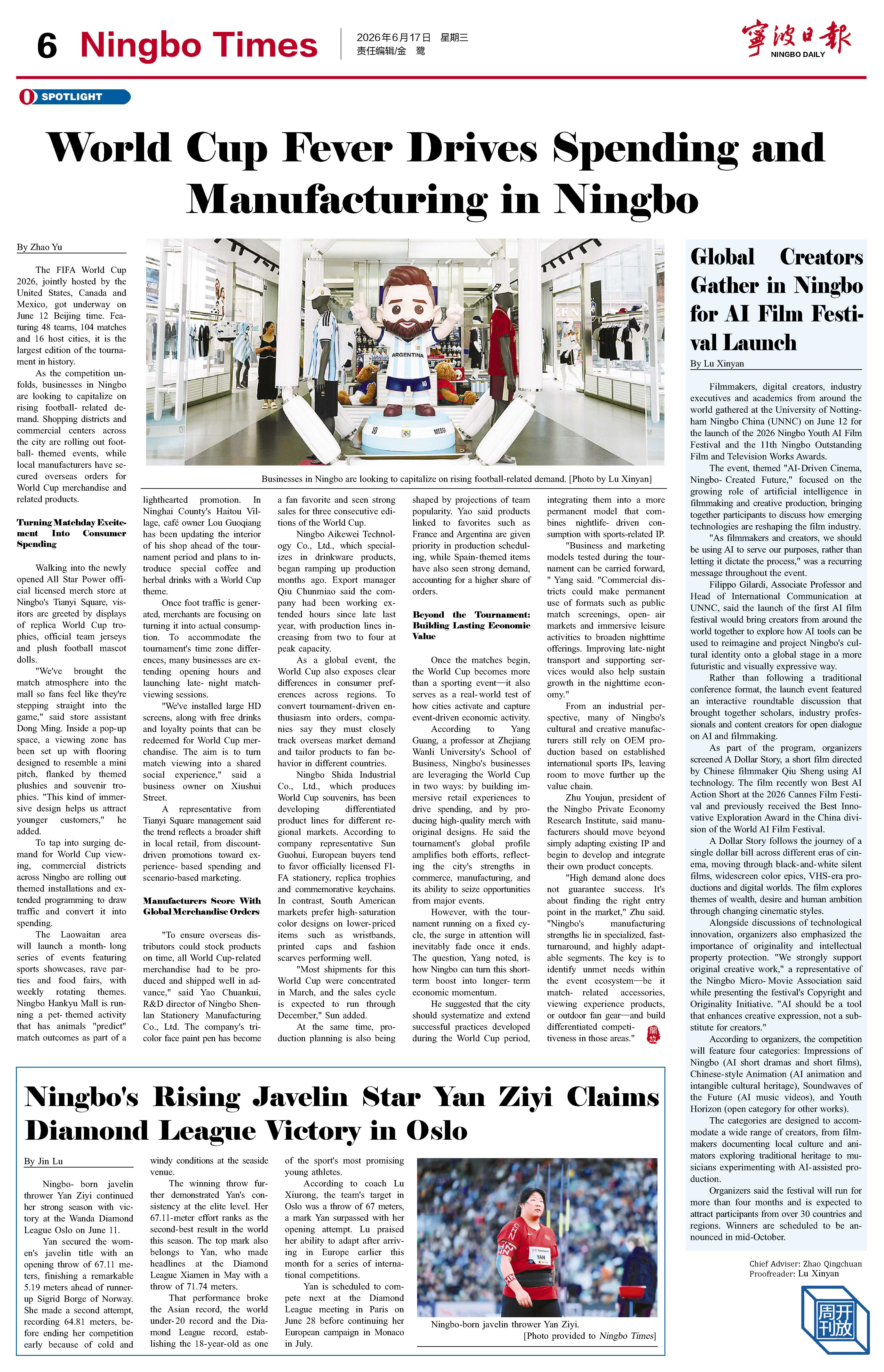
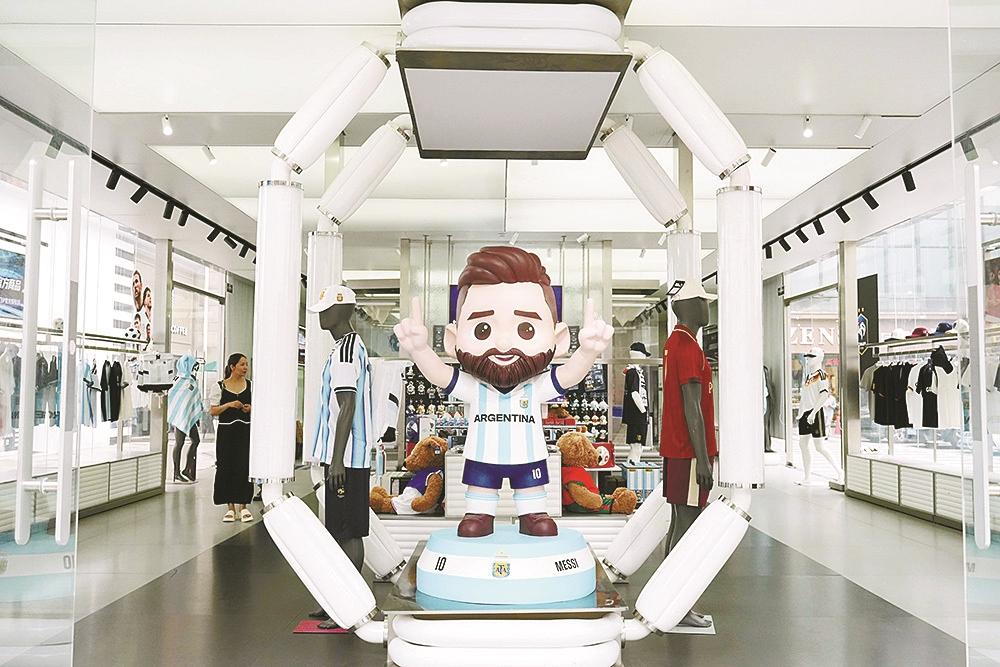
Walking into the newly opened All Star Power official licensed merch store at Ningbo's Tianyi Square, visitors are greeted by displays of replica World Cup trophies, official team jerseys and plush football mascot dolls.
"We've brought the match atmosphere into the mall so fans feel like they're stepping straight into the game," said store assistant Dong Ming. Inside a pop-up space, a viewing zone has been set up with flooring designed to resemble a mini pitch, flanked by themed plushies and souvenir trophies. "This kind of immersive design helps us attract younger customers," he added.
To tap into surging demand for World Cup viewing, commercial districts across Ningbo are rolling out themed installations and extended programming to draw traffic and convert it into spending.
The Laowaitan area will launch a month-long series of events featuring sports showcases, rave parties and food fairs, with weekly rotating themes. Ningbo Hankyu Mall is running a pet-themed activity that has animals "predict" match outcomes as part of a lighthearted promotion. In Ninghai County's Haitou Village, café owner Lou Guoqiang has been updating the interior of his shop ahead of the tournament period and plans to introduce special coffee and herbal drinks with a World Cup theme.
Once foot traffic is generated, merchants are focusing on turning it into actual consumption. To accommodate the tournament's time zone differences, many businesses are extending opening hours and launching late-night match-viewing sessions.
"We've installed large HD screens, along with free drinks and loyalty points that can be redeemed for World Cup merchandise. The aim is to turn match viewing into a shared social experience," said a business owner on Xiushui Street.
A representative from Tianyi Square management said the trend reflects a broader shift in local retail, from discount-driven promotions toward experience-based spending and scenario-based marketing.
Manufacturers Score With Global Merchandise Orders
"To ensure overseas distributors could stock products on time, all World Cup-related merchandise had to be produced and shipped well in advance," said Yao Chuankui, R&D director of Ningbo Shenlan Stationery Manufacturing Co., Ltd. The company's tri-color face paint pen has become a fan favorite and seen strong sales for three consecutive editions of the World Cup.
Ningbo Aikewei Technology Co., Ltd., which specializes in drinkware products, began ramping up production months ago. Export manager Qiu Chunmiao said the company had been working extended hours since late last year, with production lines increasing from two to four at peak capacity.
As a global event, the World Cup also exposes clear differences in consumer preferences across regions. To convert tournament-driven enthusiasm into orders, companies say they must closely track overseas market demand and tailor products to fan behavior in different countries.
Ningbo Shida Industrial Co., Ltd., which produces World Cup souvenirs, has been developing differentiated product lines for different regional markets. According to company representative Sun Guohui, European buyers tend to favor officially licensed FIFA stationery, replica trophies and commemorative keychains. In contrast, South American markets prefer high-saturation color designs on lower-priced items such as wristbands, printed caps and fashion scarves performing well.
"Most shipments for this World Cup were concentrated in March, and the sales cycle is expected to run through December," Sun added.
At the same time, production planning is also being shaped by projections of team popularity. Yao said products linked to favorites such as France and Argentina are given priority in production scheduling, while Spain-themed items have also seen strong demand, accounting for a higher share of orders.
Beyond the Tournament: Building Lasting Economic Value
Once the matches begin, the World Cup becomes more than a sporting event—it also serves as a real-world test of how cities activate and capture event-driven economic activity.
According to Yang Guang, a professor at Zhejiang Wanli University's School of Business, Ningbo's businesses are leveraging the World Cup in two ways: by building immersive retail experiences to drive spending, and by producing high-quality merch with original designs. He said the tournament's global profile amplifies both efforts, reflecting the city's strengths in commerce, manufacturing, and its ability to seize opportunities from major events.
However, with the tournament running on a fixed cycle, the surge in attention will inevitably fade once it ends. The question, Yang noted, is how Ningbo can turn this short-term boost into longer-term economic momentum.
He suggested that the city should systematize and extend successful practices developed during the World Cup period, integrating them into a more permanent model that combines nightlife-driven consumption with sports-related IP.
"Business and marketing models tested during the tournament can be carried forward," Yang said. "Commercial districts could make permanent use of formats such as public match screenings, open-air markets and immersive leisure activities to broaden nighttime offerings. Improving late-night transport and supporting services would also help sustain growth in the nighttime economy."
From an industrial perspective, many of Ningbo's cultural and creative manufacturers still rely on OEM production based on established international sports IPs, leaving room to move further up the value chain.
Zhu Youjun, president of the Ningbo Private Economy Research Institute, said manufacturers should move beyond simply adapting existing IP and begin to develop and integrate their own product concepts.
"High demand alone does not guarantee success. It's about finding the right entry point in the market," Zhu said. "Ningbo's manufacturing strengths lie in specialized, fast-turnaround, and highly adaptable segments. The key is to identify unmet needs within the event ecosystem—be it match-related accessories, viewing experience products, or outdoor fan gear—and build differentiated competitiveness in those areas."