
By Jin Yuhan
As urban renewal gathers pace, the need to manage and recycle construction and demolition waste is growing. Household renovation waste, in particular, has long posed a challenge due to its mixed composition and the difficulty of sorting it.
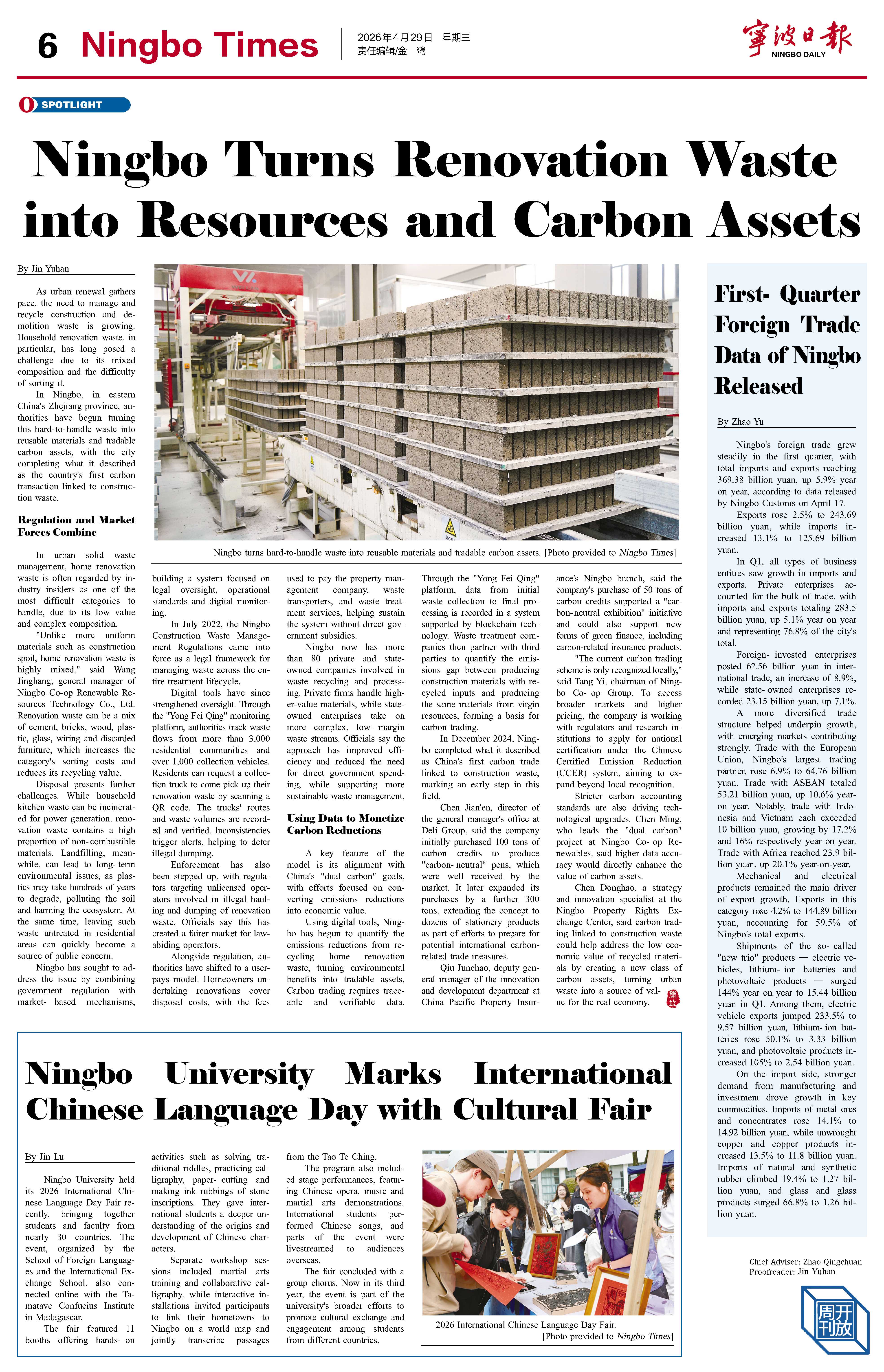
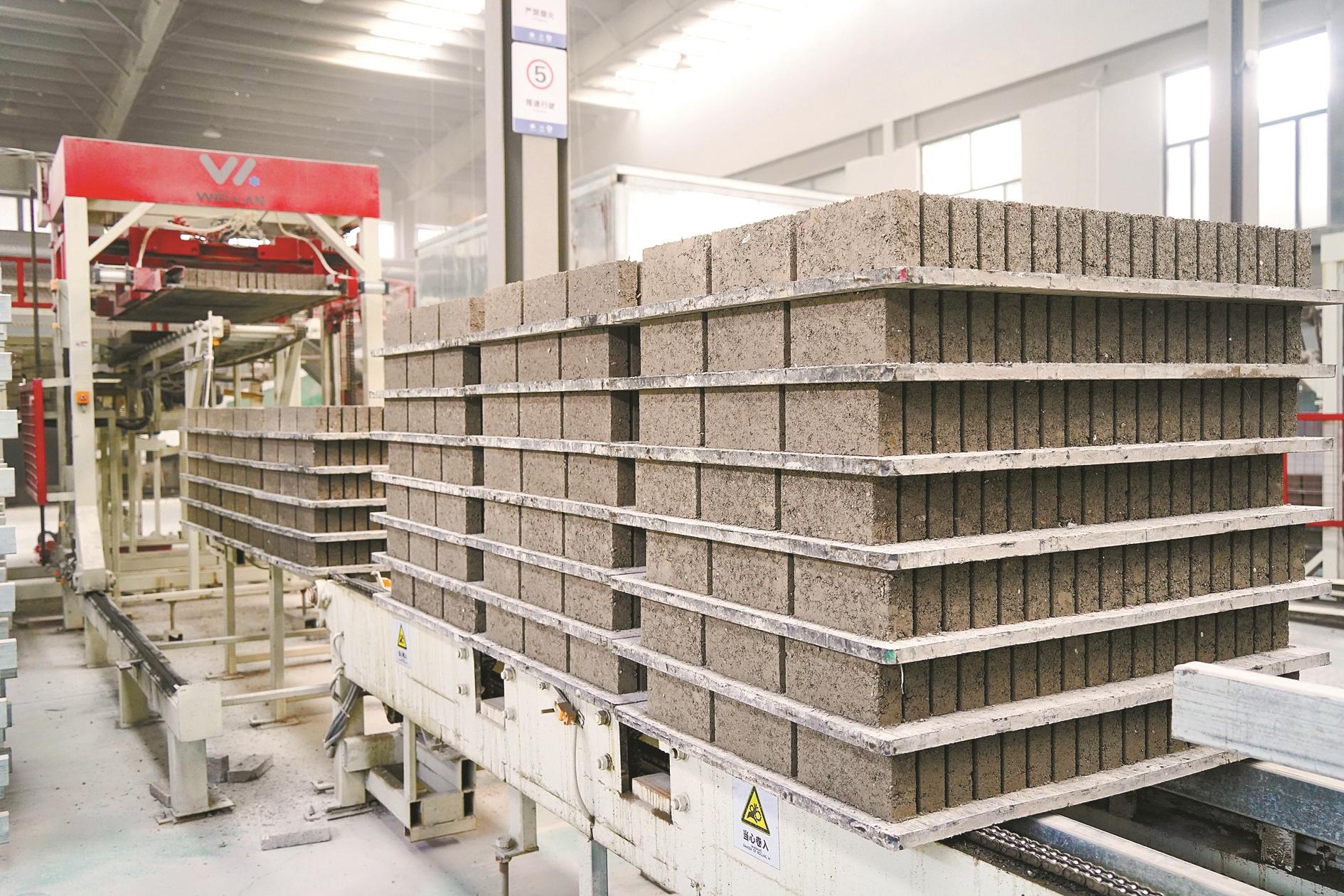
In Ningbo, in eastern China's Zhejiang province, authorities have begun turning this hard-to-handle waste into reusable materials and tradable carbon assets, with the city completing what it described as the country's first carbon transaction linked to construction waste.
Regulation and Market Forces Combine
In urban solid waste management, home renovation waste is often regarded by industry insiders as one of the most difficult categories to handle, due to its low value and complex composition.
"Unlike more uniform materials such as construction spoil, home renovation waste is highly mixed," said Wang Jinghang, general manager of Ningbo Co-op Renewable Resources Technology Co., Ltd. Renovation waste can be a mix of cement, bricks, wood, plastic, glass, wiring and discarded furniture, which increases the category's sorting costs and reduces its recycling value.
Disposal presents further challenges. While household kitchen waste can be incinerated for power generation, renovation waste contains a high proportion of non-combustible materials. Landfilling, meanwhile, can lead to long-term environmental issues, as plastics may take hundreds of years to degrade, polluting the soil and harming the ecosystem. At the same time, leaving such waste untreated in residential areas can quickly become a source of public concern.
Ningbo has sought to address the issue by combining government regulation with market-based mechanisms, building a system focused on legal oversight, operational standards and digital monitoring.
In July 2022, the Ningbo Construction Waste Management Regulations came into force as a legal framework for managing waste across the entire treatment lifecycle.
Digital tools have since strengthened oversight. Through the "Yong Fei Qing" monitoring platform, authorities track waste flows from more than 3,000 residential communities and over 1,000 collection vehicles. Residents can request a collection truck to come pick up their renovation waste by scanning a QR code. The trucks' routes and waste volumes are recorded and verified. Inconsistencies trigger alerts, helping to deter illegal dumping.
Enforcement has also been stepped up, with regulators targeting unlicensed operators involved in illegal hauling and dumping of renovation waste. Officials say this has created a fairer market for law-abiding operators.
Alongside regulation, authorities have shifted to a user-pays model. Homeowners undertaking renovations cover disposal costs, with the fees used to pay the property management company, waste transporters, and waste treatment services, helping sustain the system without direct government subsidies.
Ningbo now has more than 80 private and state-owned companies involved in waste recycling and processing. Private firms handle higher-value materials, while state-owned enterprises take on more complex, low-margin waste streams. Officials say the approach has improved efficiency and reduced the need for direct government spending, while supporting more sustainable waste management.
Using Data to Monetize Carbon Reductions
A key feature of the model is its alignment with China's "dual carbon" goals, with efforts focused on converting emissions reductions into economic value.
Using digital tools, Ningbo has begun to quantify the emissions reductions from recycling home renovation waste, turning environmental benefits into tradable assets. Carbon trading requires traceable and verifiable data. Through the "Yong Fei Qing" platform, data from initial waste collection to final processing is recorded in a system supported by blockchain technology. Waste treatment companies then partner with third parties to quantify the emissions gap between producing construction materials with recycled inputs and producing the same materials from virgin resources, forming a basis for carbon trading.
In December 2024, Ningbo completed what it described as China's first carbon trade linked to construction waste, marking an early step in this field.
Chen Jian'en, director of the general manager's office at Deli Group, said the company initially purchased 100 tons of carbon credits to produce "carbon-neutral" pens, which were well received by the market. It later expanded its purchases by a further 300 tons, extending the concept to dozens of stationery products as part of efforts to prepare for potential international carbon-related trade measures.
Qiu Junchao, deputy general manager of the innovation and development department at China Pacific Property Insurance's Ningbo branch, said the company's purchase of 50 tons of carbon credits supported a "carbon-neutral exhibition" initiative and could also support new forms of green finance, including carbon-related insurance products.
"The current carbon trading scheme is only recognized locally," said Tang Yi, chairman of Ningbo Co-op Group. To access broader markets and higher pricing, the company is working with regulators and research institutions to apply for national certification under the Chinese Certified Emission Reduction (CCER) system, aiming to expand beyond local recognition.
Stricter carbon accounting standards are also driving technological upgrades. Chen Ming, who leads the "dual carbon" project at Ningbo Co-op Renewables, said higher data accuracy would directly enhance the value of carbon assets.
Chen Donghao, a strategy and innovation specialist at the Ningbo Property Rights Exchange Center, said carbon trading linked to construction waste could help address the low economic value of recycled materials by creating a new class of carbon assets, turning urban waste into a source of value for the real economy.