


By Jin Yuhan
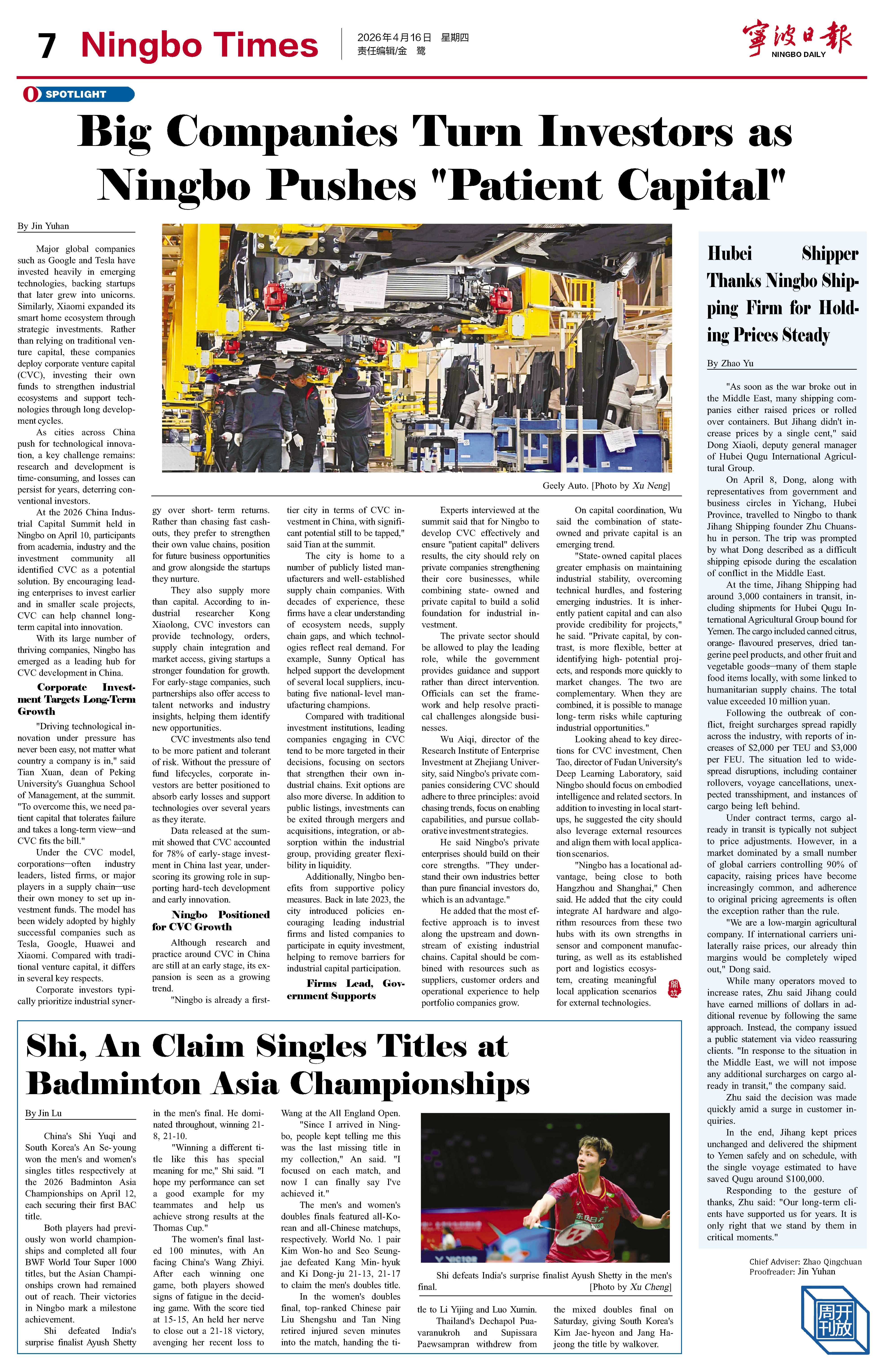
Major global companies such as Google and Tesla have invested heavily in emerging technologies, backing startups that later grew into unicorns. Similarly, Xiaomi expanded its smart home ecosystem through strategic investments. Rather than relying on traditional venture capital, these companies deploy corporate venture capital (CVC), investing their own funds to strengthen industrial ecosystems and support technologies through long development cycles.
As cities across China push for technological innovation, a key challenge remains: research and development is time-consuming, and losses can persist for years, deterring conventional investors.
At the 2026 China Industrial Capital Summit held in Ningbo on April 10, participants from academia, industry and the investment community all identified CVC as a potential solution. By encouraging leading enterprises to invest earlier and in smaller scale projects, CVC can help channel long-term capital into innovation.
With its large number of thriving companies, Ningbo has emerged as a leading hub for CVC development in China.
Corporate Investment Targets Long-Term Growth
"Driving technological innovation under pressure has never been easy, not matter what country a company is in," said Tian Xuan, dean of Peking University's Guanghua School of Management, at the summit. "To overcome this, we need patient capital that tolerates failure and takes a long-term view—and CVC fits the bill."
Under the CVC model, corporations—often industry leaders, listed firms, or major players in a supply chain—use their own money to set up investment funds. The model has been widely adopted by highly successful companies such as Tesla, Google, Huawei and Xiaomi. Compared with traditional venture capital, it differs in several key respects.
Corporate investors typically prioritize industrial synergy over short-term returns. Rather than chasing fast cash-outs, they prefer to strengthen their own value chains, position for future business opportunities and grow alongside the startups they nurture.
They also supply more than capital. According to industrial researcher Kong Xiaolong, CVC investors can provide technology, orders, supply chain integration and market access, giving startups a stronger foundation for growth. For early-stage companies, such partnerships also offer access to talent networks and industry insights, helping them identify new opportunities.
CVC investments also tend to be more patient and tolerant of risk. Without the pressure of fund lifecycles, corporate investors are better positioned to absorb early losses and support technologies over several years as they iterate.
Data released at the summit showed that CVC accounted for 78% of early-stage investment in China last year, underscoring its growing role in supporting hard-tech development and early innovation.
Ningbo Positioned for CVC Growth
Although research and practice around CVC in China are still at an early stage, its expansion is seen as a growing trend.
"Ningbo is already a first-tier city in terms of CVC investment in China, with significant potential still to be tapped," said Tian at the summit.
The city is home to a number of publicly listed manufacturers and well-established supply chain companies. With decades of experience, these firms have a clear understanding of ecosystem needs, supply chain gaps, and which technologies reflect real demand. For example, Sunny Optical has helped support the development of several local suppliers, incubating five national-level manufacturing champions.
Compared with traditional investment institutions, leading companies engaging in CVC tend to be more targeted in their decisions, focusing on sectors that strengthen their own industrial chains. Exit options are also more diverse. In addition to public listings, investments can be exited through mergers and acquisitions, integration, or absorption within the industrial group, providing greater flexibility in liquidity.
Additionally, Ningbo benefits from supportive policy measures. Back in late 2023, the city introduced policies encouraging leading industrial firms and listed companies to participate in equity investment, helping to remove barriers for industrial capital participation.
Firms Lead, Government Supports
Experts interviewed at the summit said that for Ningbo to develop CVC effectively and ensure "patient capital" delivers results, the city should rely on private companies strengthening their core businesses, while combining state-owned and private capital to build a solid foundation for industrial investment.
The private sector should be allowed to play the leading role, while the government provides guidance and support rather than direct intervention. Officials can set the framework and help resolve practical challenges alongside businesses.
Wu Aiqi, director of the Research Institute of Enterprise Investment at Zhejiang University, said Ningbo's private companies considering CVC should adhere to three principles: avoid chasing trends, focus on enabling capabilities, and pursue collaborative investment strategies.
He said Ningbo's private enterprises should build on their core strengths. "They understand their own industries better than pure financial investors do, which is an advantage."
He added that the most effective approach is to invest along the upstream and downstream of existing industrial chains. Capital should be combined with resources such as suppliers, customer orders and operational experience to help portfolio companies grow.
On capital coordination, Wu said the combination of state-owned and private capital is an emerging trend.
"State-owned capital places greater emphasis on maintaining industrial stability, overcoming technical hurdles, and fostering emerging industries. It is inherently patient capital and can also provide credibility for projects," he said. "Private capital, by contrast, is more flexible, better at identifying high-potential projects, and responds more quickly to market changes. The two are complementary. When they are combined, it is possible to manage long-term risks while capturing industrial opportunities."
Looking ahead to key directions for CVC investment, Chen Tao, director of Fudan University's Deep Learning Laboratory, said Ningbo should focus on embodied intelligence and related sectors. In addition to investing in local startups, he suggested the city should also leverage external resources and align them with local application scenarios.
"Ningbo has a locational advantage, being close to both Hangzhou and Shanghai," Chen said. He added that the city could integrate AI hardware and algorithm resources from these two hubs with its own strengths in sensor and component manufacturing, as well as its established port and logistics ecosystem, creating meaningful local application scenarios for external technologies.