

By Zhao Yu
The Arctic Ocean's so-called "golden waterway" is expected to begin regular operations this summer. Authorities in Zhejiang Province have recently issued an action plan outlining potential regular container services along the route. The move signals a shift in the world's first China–Europe Arctic container service toward regular operations.
Rising tensions in the Strait of Hormuz have disrupted traditional shipping lanes, driving up freight rates and reducing schedule reliability. The Arctic route offers a faster and more reliable alternative for shipping between China and Europe.
Companies Turn to Arctic Corridor
"Last year we were still waiting and seeing, but this year we are getting anxious," said Shi Yu, head of Ningbo Mascube Import & Export Co. Recently, three of the company's containers were rolled or rebooked multiple times, delaying departure from March 23 to April 8 and frustrating consignees at the destination.
Rising freight costs on traditional European routes, capacity shortages, and schedule disruptions have pushed Shi to consider a previously alternative route through the Arctic. Traditional routes via the Suez Canal take about 40 days, and via the Cape of Good Hope about 50 days. The Arctic route shortens the voyage by 20–30 days, making it the fastest sea link between Asia and Europe and offering advantages in both timeliness and safety.
Cost remains the primary concern for companies. Zhu Xuan, head of a electric vehicle company in Changzhou, Jiangsu, estimated that using the Arctic route would save $30 per unit compared with road transport, but cost $3.30 more than traditional sea freight.
"If regular operations can bring shipping costs down, Chinese exporters will be more willing to adopt the Arctic route," Zhu said.
Hu Chenjie, general manager of Ningbo Xindajie Electric Co., echoed the view. "The key is the final freight rate. Once it becomes competitive, we will prioritize the Arctic route and let our European customers know about its benefits," he said.
Several Ningbo-based export executives noted that in a complex and volatile international environment, the Arctic corridor—with stable schedules, low geopolitical risk, and high capacity—fills a market gap: faster than other sea freight options, cheaper than air freight.
Challenges to Regular Operations Remain
Launching the China–Europe Arctic Express has been a multi-year effort. Polar navigation means dealing with shifting ice and extreme cold, placing stringent demands on both vessels and crews.
The captain of the first Arctic Express vessel comes from Shanghai-based Sea Legend Shipping, which began preparing for trial runs of the Arctic route three years ago. The company upgraded ship hardware, trained crews for polar certification, and developed precise ice-regime weather routing.
Last year, Sea Legend Shipping invested over $1 million in ship upgrades, while each crew training session cost around 200,000 yuan. The maiden voyage carried 3,000 TEUs but incurred a loss of $1 million to $1.5 million, or roughly $333–500 per container.
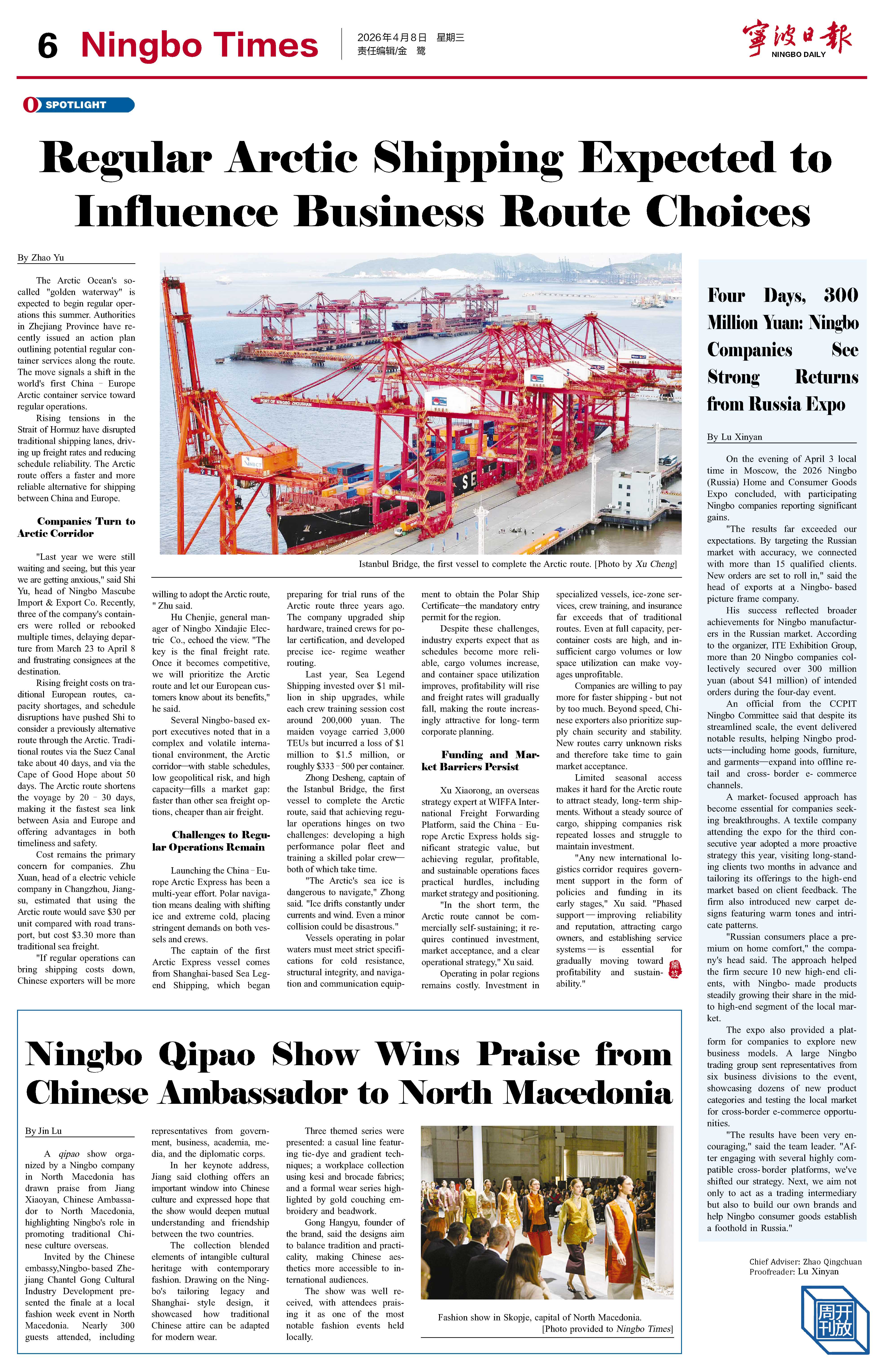
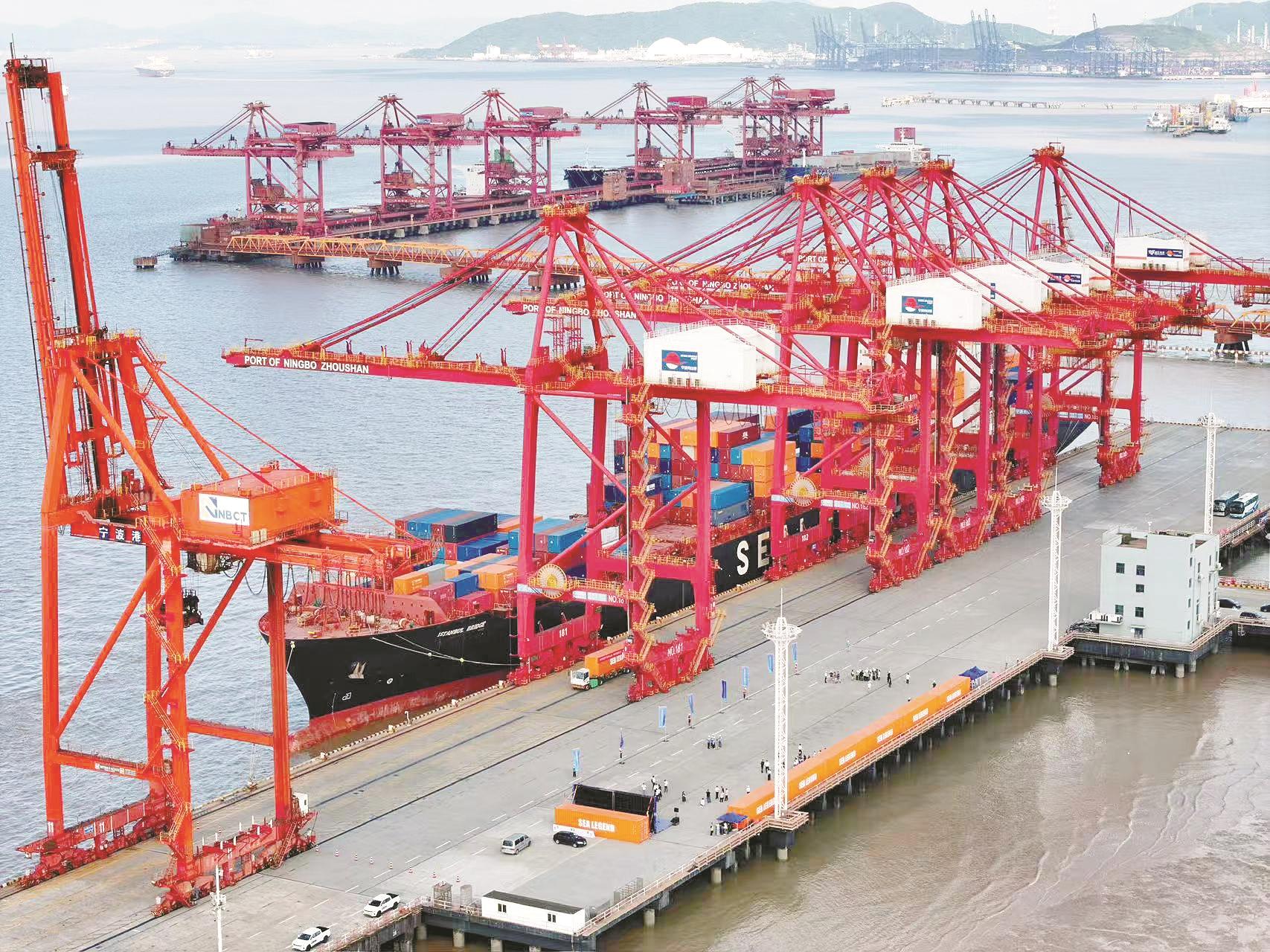
Zhong Desheng, captain of the Istanbul Bridge, the first vessel to complete the Arctic route, said that achieving regular operations hinges on two challenges: developing a high performance polar fleet and training a skilled polar crew—both of which take time.
"The Arctic's sea ice is dangerous to navigate," Zhong said. "Ice drifts constantly under currents and wind. Even a minor collision could be disastrous."
Vessels operating in polar waters must meet strict specifications for cold resistance, structural integrity, and navigation and communication equipment to obtain the Polar Ship Certificate—the mandatory entry permit for the region.
Despite these challenges, industry experts expect that as schedules become more reliable, cargo volumes increase, and container space utilization improves, profitability will rise and freight rates will gradually fall, making the route increasingly attractive for long-term corporate planning.
Funding and Market Barriers Persist
Xu Xiaorong, an overseas strategy expert at WIFFA International Freight Forwarding Platform, said the China–Europe Arctic Express holds significant strategic value, but achieving regular, profitable, and sustainable operations faces practical hurdles, including market strategy and positioning.
"In the short term, the Arctic route cannot be commercially self-sustaining; it requires continued investment, market acceptance, and a clear operational strategy," Xu said.
Operating in polar regions remains costly. Investment in specialized vessels, ice-zone services, crew training, and insurance far exceeds that of traditional routes. Even at full capacity, per-container costs are high, and insufficient cargo volumes or low space utilization can make voyages unprofitable.
Companies are willing to pay more for faster shipping - but not by too much. Beyond speed, Chinese exporters also prioritize supply chain security and stability. New routes carry unknown risks and therefore take time to gain market acceptance.
Limited seasonal access makes it hard for the Arctic route to attract steady, long-term shipments. Without a steady source of cargo, shipping companies risk repeated losses and struggle to maintain investment.
"Any new international logistics corridor requires government support in the form of policies and funding in its early stages," Xu said. "Phased support—improving reliability and reputation, attracting cargo owners, and establishing service systems—is essential for gradually moving toward profitability and sustainability."