

By Jin Yuhan
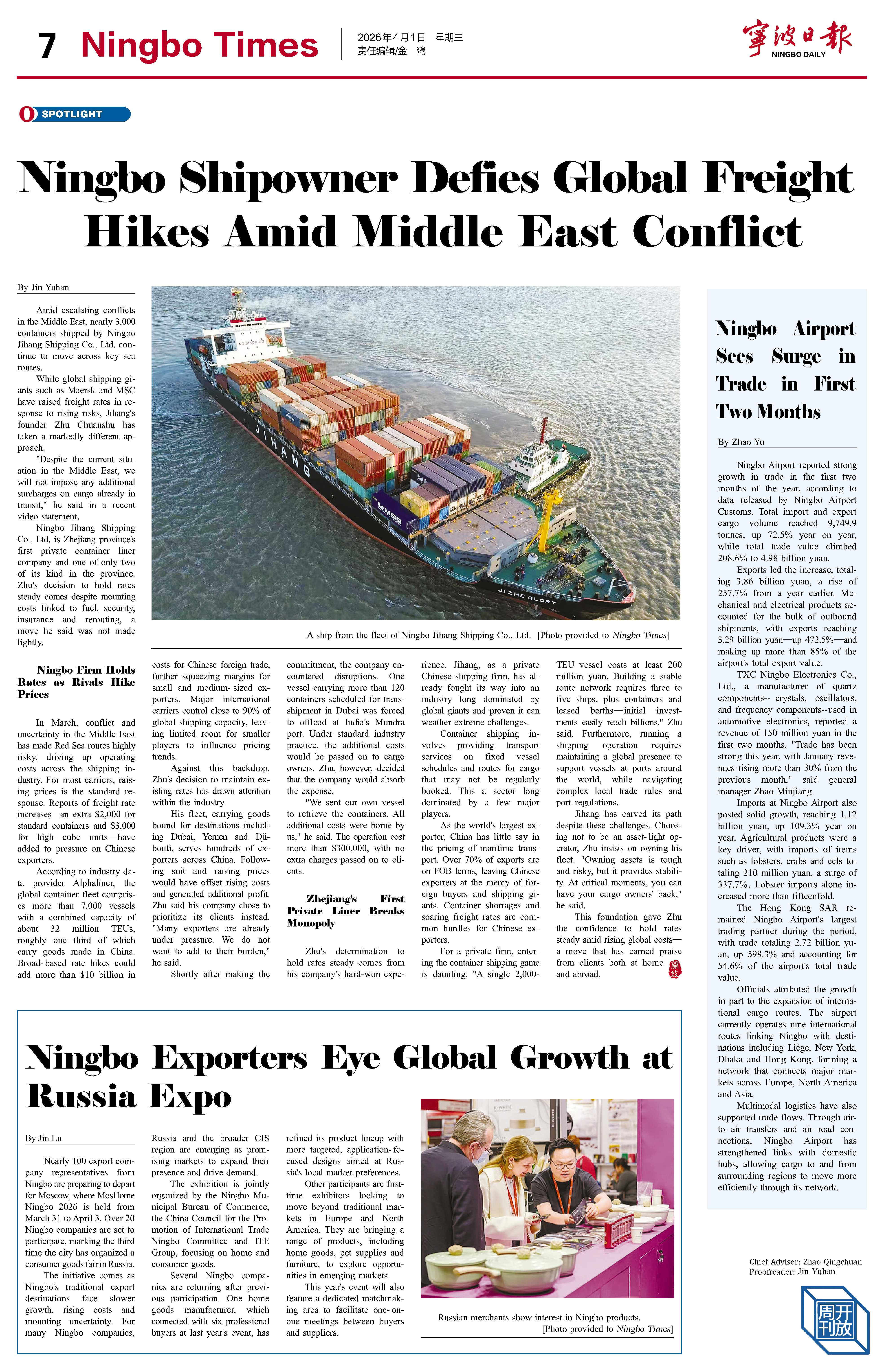
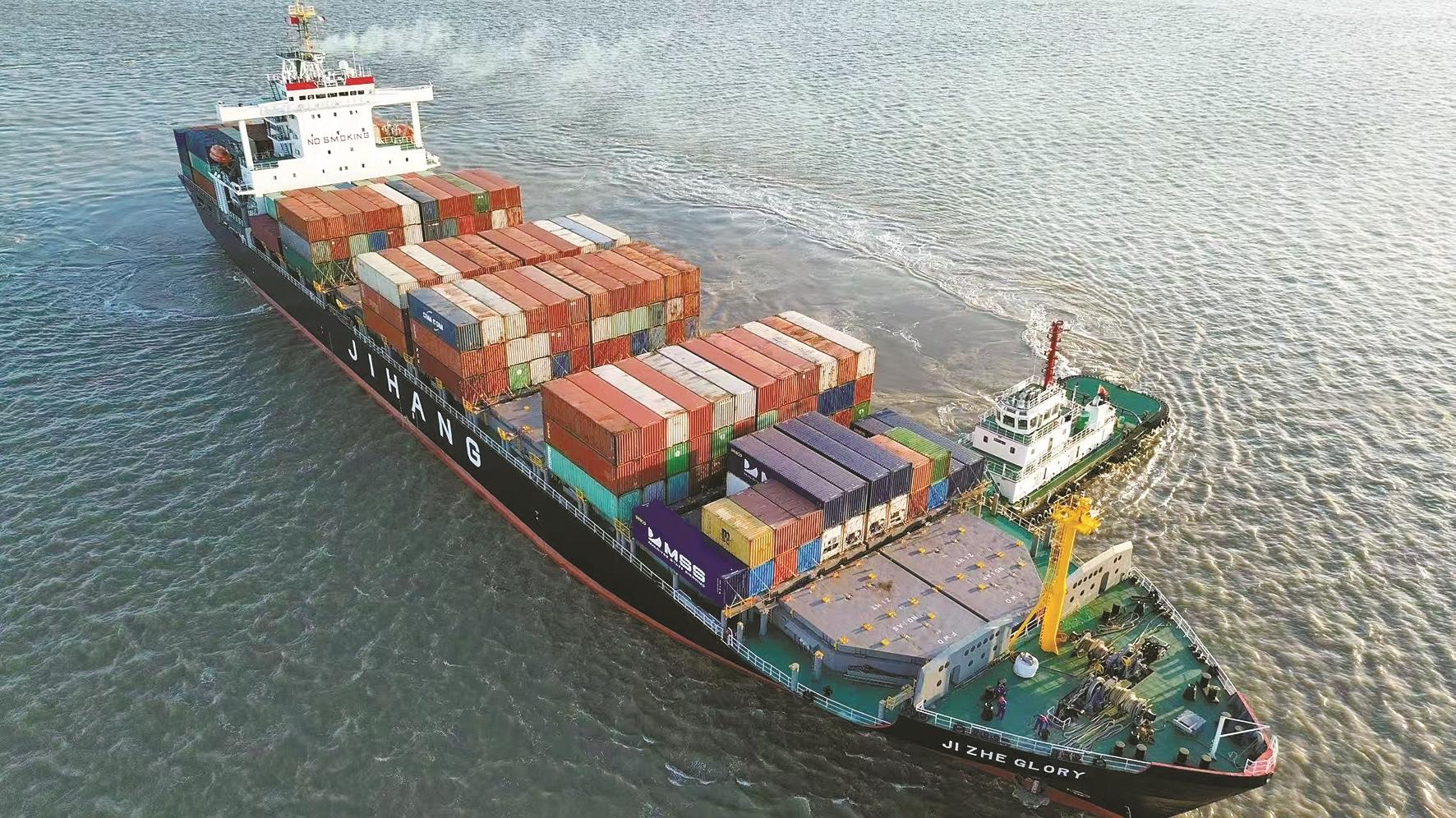
Amid escalating conflicts in the Middle East, nearly 3,000 containers shipped by Ningbo Jihang Shipping Co., Ltd. continue to move across key sea routes.
While global shipping giants such as Maersk and MSC have raised freight rates in response to rising risks, Jihang's founder Zhu Chuanshu has taken a markedly different approach.
"Despite the current situation in the Middle East, we will not impose any additional surcharges on cargo already in transit," he said in a recent video statement.
Ningbo Jihang Shipping Co., Ltd. is Zhejiang province's first private container liner company and one of only two of its kind in the province. Zhu's decision to hold rates steady comes despite mounting costs linked to fuel, security, insurance and rerouting, a move he said was not made lightly.
Ningbo Firm Holds Rates as Rivals Hike Prices
In March, conflict and uncertainty in the Middle East has made Red Sea routes highly risky, driving up operating costs across the shipping industry. For most carriers, raising prices is the standard response. Reports of freight rate increases—an extra $2,000 for standard containers and $3,000 for high-cube units—have added to pressure on Chinese exporters.
According to industry data provider Alphaliner, the global container fleet comprises more than 7,000 vessels with a combined capacity of about 32 million TEUs, roughly one-third of which carry goods made in China. Broad-based rate hikes could add more than $10 billion in costs for Chinese foreign trade, further squeezing margins for small and medium-sized exporters. Major international carriers control close to 90% of global shipping capacity, leaving limited room for smaller players to influence pricing trends.
Against this backdrop, Zhu's decision to maintain existing rates has drawn attention within the industry.
His fleet, carrying goods bound for destinations including Dubai, Yemen and Djibouti, serves hundreds of exporters across China. Following suit and raising prices would have offset rising costs and generated additional profit. Zhu said his company chose to prioritize its clients instead. "Many exporters are already under pressure. We do not want to add to their burden," he said.
Shortly after making the commitment, the company encountered disruptions. One vessel carrying more than 120 containers scheduled for transshipment in Dubai was forced to offload at India's Mundra port. Under standard industry practice, the additional costs would be passed on to cargo owners. Zhu, however, decided that the company would absorb the expense.
"We sent our own vessel to retrieve the containers. All additional costs were borne by us," he said. The operation cost more than $300,000, with no extra charges passed on to clients.
Zhejiang's First Private Liner Breaks Monopoly
Zhu's determination to hold rates steady comes from his company's hard-won experience. Jihang, as a private Chinese shipping firm, has already fought its way into an industry long dominated by global giants and proven it can weather extreme challenges.
Container shipping involves providing transport services on fixed vessel schedules and routes for cargo that may not be regularly booked. This a sector long dominated by a few major players.
As the world's largest exporter, China has little say in the pricing of maritime transport. Over 70% of exports are on FOB terms, leaving Chinese exporters at the mercy of foreign buyers and shipping giants. Container shortages and soaring freight rates are common hurdles for Chinese exporters.
For a private firm, entering the container shipping game is daunting. "A single 2,000-TEU vessel costs at least 200 million yuan. Building a stable route network requires three to five ships, plus containers and leased berths—initial investments easily reach billions," Zhu said. Furthermore, running a shipping operation requires maintaining a global presence to support vessels at ports around the world, while navigating complex local trade rules and port regulations.
Jihang has carved its path despite these challenges. Choosing not to be an asset-light operator, Zhu insists on owning his fleet. "Owning assets is tough and risky, but it provides stability. At critical moments, you can have your cargo owners' back," he said.
This foundation gave Zhu the confidence to hold rates steady amid rising global costs—a move that has earned praise from clients both at home and abroad.