
By Jin Yuhan
On the afternoon of Feb 26, German Chancellor Friedrich Merz visited China and led a delegation to tour Unitree Robotics in Hangzhou.
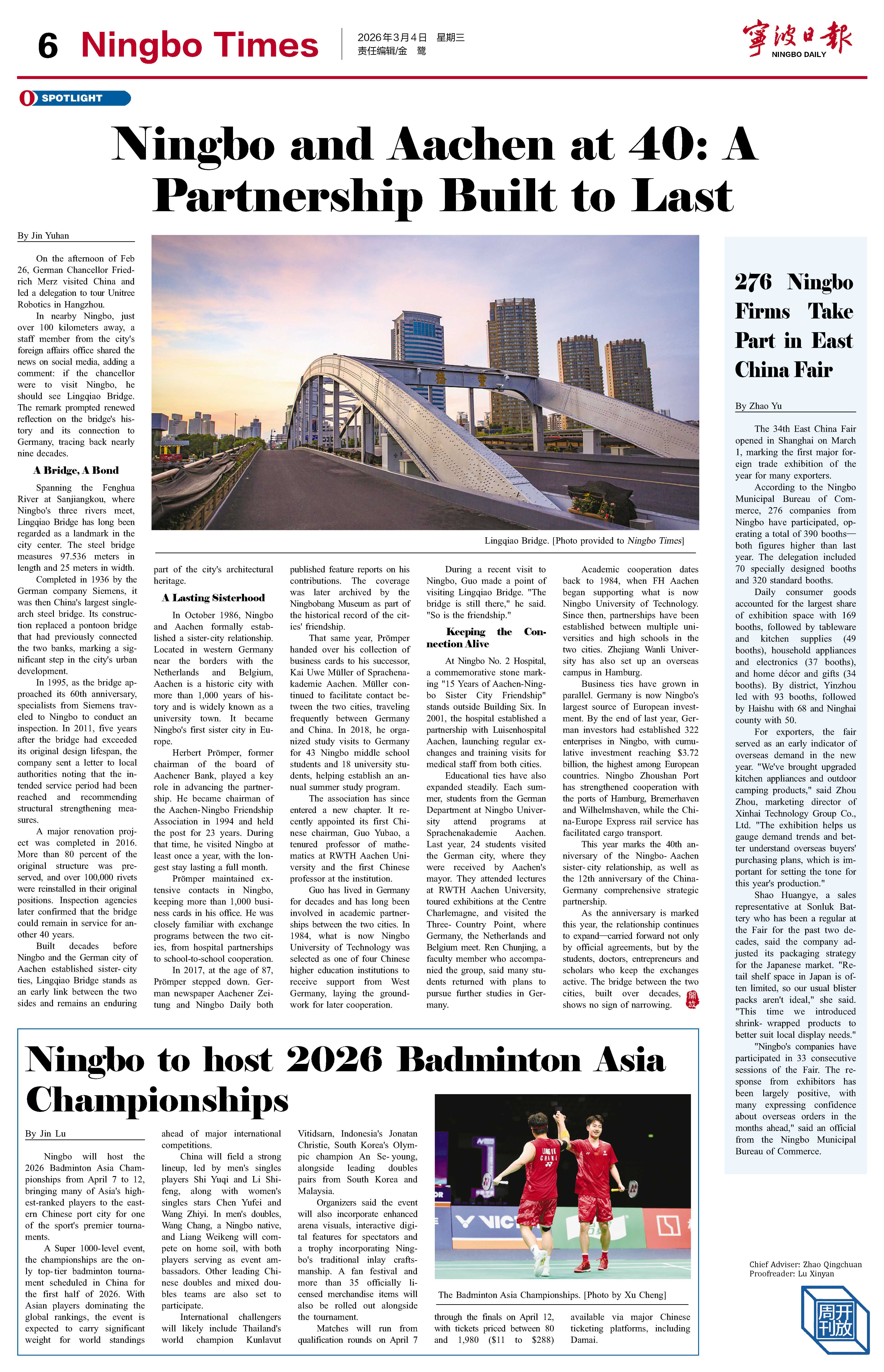
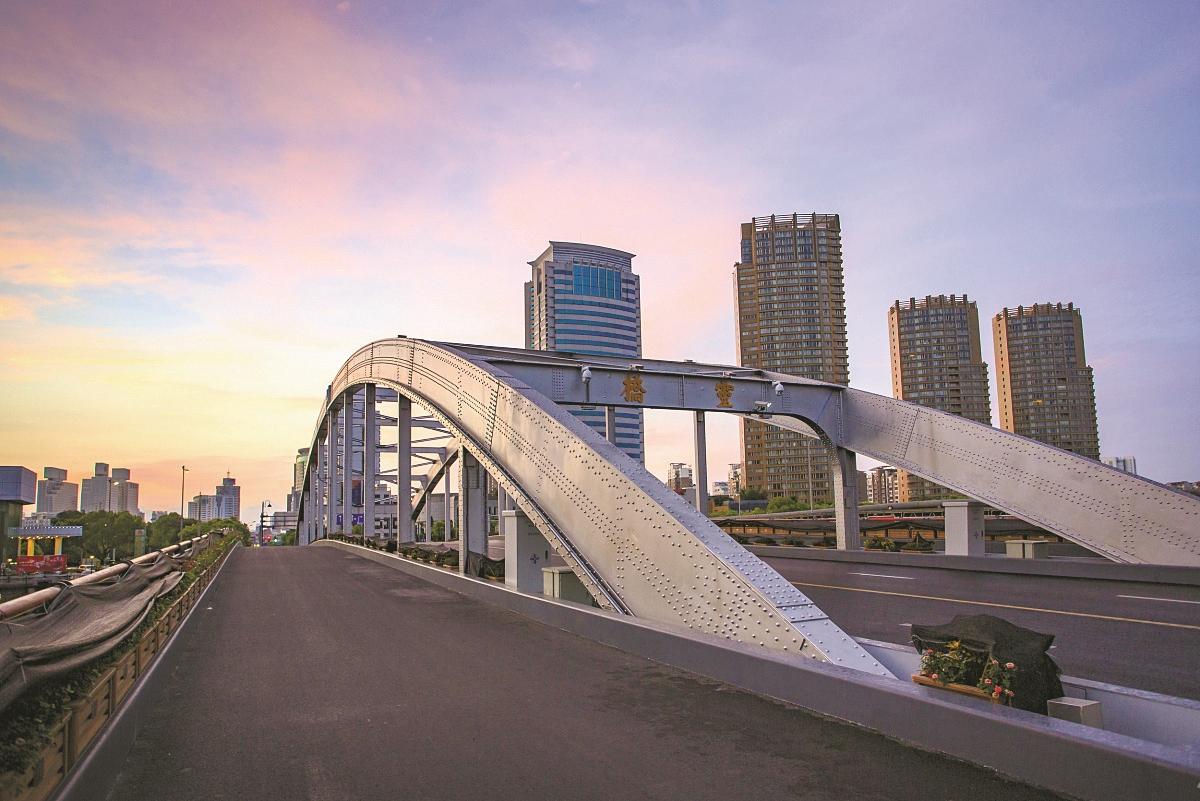
In nearby Ningbo, just over 100 kilometers away, a staff member from the city's foreign affairs office shared the news on social media, adding a comment: if the chancellor were to visit Ningbo, he should see Lingqiao Bridge. The remark prompted renewed reflection on the bridge's history and its connection to Germany, tracing back nearly nine decades.
A Bridge, A Bond
Spanning the Fenghua River at Sanjiangkou, where Ningbo's three rivers meet, Lingqiao Bridge has long been regarded as a landmark in the city center. The steel bridge measures 97.536 meters in length and 25 meters in width.
Completed in 1936 by the German company Siemens, it was then China's largest single-arch steel bridge. Its construction replaced a pontoon bridge that had previously connected the two banks, marking a significant step in the city's urban development.
In 1995, as the bridge approached its 60th anniversary, specialists from Siemens traveled to Ningbo to conduct an inspection. In 2011, five years after the bridge had exceeded its original design lifespan, the company sent a letter to local authorities noting that the intended service period had been reached and recommending structural strengthening measures.
A major renovation project was completed in 2016. More than 80 percent of the original structure was preserved, and over 100,000 rivets were reinstalled in their original positions. Inspection agencies later confirmed that the bridge could remain in service for another 40 years.
Built decades before Ningbo and the German city of Aachen established sister-city ties, Lingqiao Bridge stands as an early link between the two sides and remains an enduring part of the city's architectural heritage.
A Lasting Sisterhood
In October 1986, Ningbo and Aachen formally established a sister-city relationship. Located in western Germany near the borders with the Netherlands and Belgium, Aachen is a historic city with more than 1,000 years of history and is widely known as a university town. It became Ningbo's first sister city in Europe.
Herbert Prömper, former chairman of the board of Aachener Bank, played a key role in advancing the partnership. He became chairman of the Aachen-Ningbo Friendship Association in 1994 and held the post for 23 years. During that time, he visited Ningbo at least once a year, with the longest stay lasting a full month.
Prömper maintained extensive contacts in Ningbo, keeping more than 1,000 business cards in his office. He was closely familiar with exchange programs between the two cities, from hospital partnerships to school-to-school cooperation.
In 2017, at the age of 87, Prömper stepped down. German newspaper Aachener Zeitung and Ningbo Daily both published feature reports on his contributions. The coverage was later archived by the Ningbobang Museum as part of the historical record of the cities' friendship.
That same year, Prömper handed over his collection of business cards to his successor, Kai Uwe Müller of Sprachenakademie Aachen. Müller continued to facilitate contact between the two cities, traveling frequently between Germany and China. In 2018, he organized study visits to Germany for 43 Ningbo middle school students and 18 university students, helping establish an annual summer study program.
The association has since entered a new chapter. It recently appointed its first Chinese chairman, Guo Yubao, a tenured professor of mathematics at RWTH Aachen University and the first Chinese professor at the institution.
Guo has lived in Germany for decades and has long been involved in academic partnerships between the two cities. In 1984, what is now Ningbo University of Technology was selected as one of four Chinese higher education institutions to receive support from West Germany, laying the groundwork for later cooperation.
During a recent visit to Ningbo, Guo made a point of visiting Lingqiao Bridge. "The bridge is still there," he said. "So is the friendship."
Keeping the Connection Alive
At Ningbo No. 2 Hospital, a commemorative stone marking "15 Years of Aachen-Ningbo Sister City Friendship" stands outside Building Six. In 2001, the hospital established a partnership with Luisenhospital Aachen, launching regular exchanges and training visits for medical staff from both cities.
Educational ties have also expanded steadily. Each summer, students from the German Department at Ningbo University attend programs at Sprachenakademie Aachen. Last year, 24 students visited the German city, where they were received by Aachen's mayor. They attended lectures at RWTH Aachen University, toured exhibitions at the Centre Charlemagne, and visited the Three-Country Point, where Germany, the Netherlands and Belgium meet. Ren Chunjing, a faculty member who accompanied the group, said many students returned with plans to pursue further studies in Germany.
Academic cooperation dates back to 1984, when FH Aachen began supporting what is now Ningbo University of Technology. Since then, partnerships have been established between multiple universities and high schools in the two cities. Zhejiang Wanli University has also set up an overseas campus in Hamburg.
Business ties have grown in parallel. Germany is now Ningbo's largest source of European investment. By the end of last year, German investors had established 322 enterprises in Ningbo, with cumulative investment reaching $3.72 billion, the highest among European countries. Ningbo Zhoushan Port has strengthened cooperation with the ports of Hamburg, Bremerhaven and Wilhelmshaven, while the China-Europe Express rail service has facilitated cargo transport.
This year marks the 40th anniversary of the Ningbo-Aachen sister-city relationship, as well as the 12th anniversary of the China-Germany comprehensive strategic partnership.
As the anniversary is marked this year, the relationship continues to expand—carried forward not only by official agreements, but by the students, doctors, entrepreneurs and scholars who keep the exchanges active. The bridge between the two cities, built over decades, shows no sign of narrowing.