

By Zhao Yu
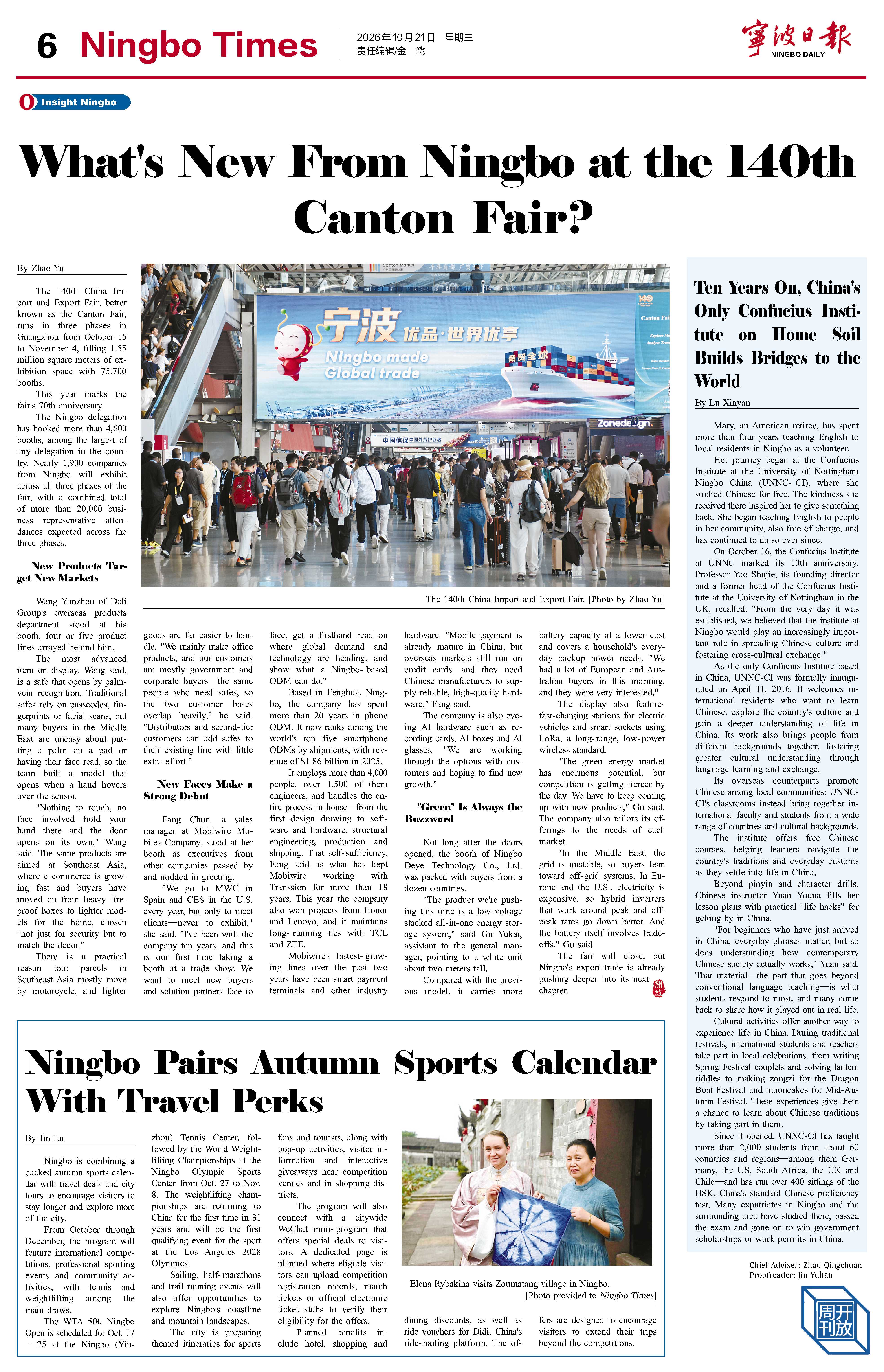
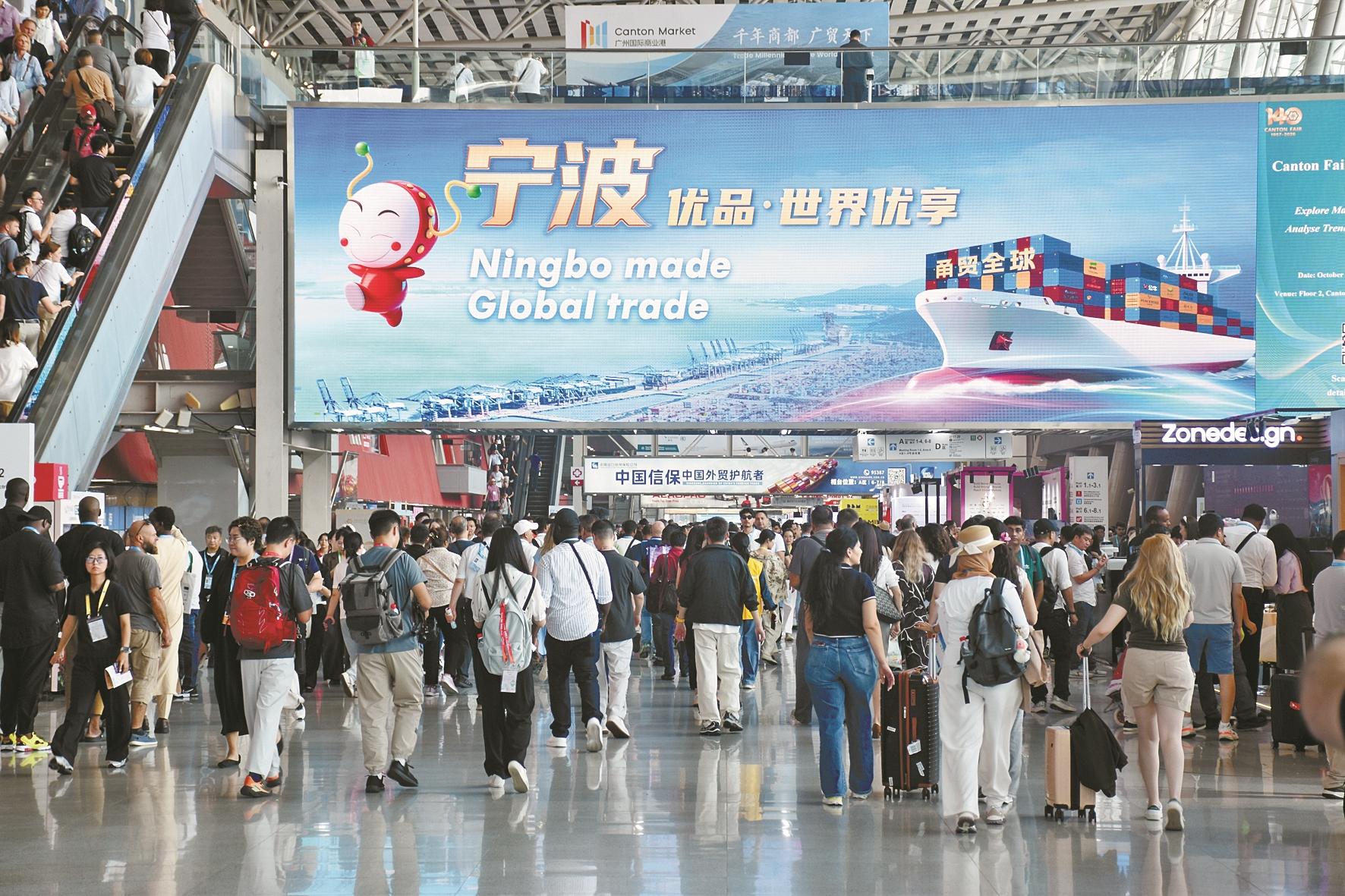
The 140th China Import and Export Fair, better known as the Canton Fair, runs in three phases in Guangzhou from October 15 to November 4, filling 1.55 million square meters of exhibition space with 75,700 booths.
This year marks the fair's 70th anniversary.
The Ningbo delegation has booked more than 4,600 booths, among the largest of any delegation in the country. Nearly 1,900 companies from Ningbo will exhibit across all three phases of the fair, with a combined total of more than 20,000 business representative attendances expected across the three phases.
New Products Target New Markets
Wang Yunzhou of Deli Group's overseas products department stood at his booth, four or five product lines arrayed behind him.
The most advanced item on display, Wang said, is a safe that opens by palm-vein recognition. Traditional safes rely on passcodes, fingerprints or facial scans, but many buyers in the Middle East are uneasy about putting a palm on a pad or having their face read, so the team built a model that opens when a hand hovers over the sensor.
"Nothing to touch, no face involved—hold your hand there and the door opens on its own," Wang said. The same products are aimed at Southeast Asia, where e-commerce is growing fast and buyers have moved on from heavy fireproof boxes to lighter models for the home, chosen "not just for security but to match the decor."
There is a practical reason too: parcels in Southeast Asia mostly move by motorcycle, and lighter goods are far easier to handle. "We mainly make office products, and our customers are mostly government and corporate buyers—the same people who need safes, so the two customer bases overlap heavily," he said. "Distributors and second-tier customers can add safes to their existing line with little extra effort."
New Faces Make a Strong Debut
Fang Chun, a sales manager at Mobiwire Mobiles Company, stood at her booth as executives from other companies passed by and nodded in greeting.
"We go to MWC in Spain and CES in the U.S. every year, but only to meet clients—never to exhibit," she said. "I've been with the company ten years, and this is our first time taking a booth at a trade show. We want to meet new buyers and solution partners face to face, get a firsthand read on where global demand and technology are heading, and show what a Ningbo-based ODM can do."
Based in Fenghua, Ningbo, the company has spent more than 20 years in phone ODM. It now ranks among the world's top five smartphone ODMs by shipments, with revenue of $1.86 billion in 2025.
It employs more than 4,000 people, over 1,500 of them engineers, and handles the entire process in-house—from the first design drawing to software and hardware, structural engineering, production and shipping. That self-sufficiency, Fang said, is what has kept Mobiwire working with Transsion for more than 18 years. This year the company also won projects from Honor and Lenovo, and it maintains long-running ties with TCL and ZTE.
Mobiwire's fastest-growing lines over the past two years have been smart payment terminals and other industry hardware. "Mobile payment is already mature in China, but overseas markets still run on credit cards, and they need Chinese manufacturers to supply reliable, high-quality hardware," Fang said.
The company is also eyeing AI hardware such as recording cards, AI boxes and AI glasses. "We are working through the options with customers and hoping to find new growth."
"Green" Is Always the Buzzword
Not long after the doors opened, the booth of Ningbo Deye Technology Co., Ltd. was packed with buyers from a dozen countries.
"The product we're pushing this time is a low-voltage stacked all-in-one energy storage system," said Gu Yukai, assistant to the general manager, pointing to a white unit about two meters tall.
Compared with the previous model, it carries more battery capacity at a lower cost and covers a household's everyday backup power needs. "We had a lot of European and Australian buyers in this morning, and they were very interested."
The display also features fast-charging stations for electric vehicles and smart sockets using LoRa, a long-range, low-power wireless standard.
"The green energy market has enormous potential, but competition is getting fiercer by the day. We have to keep coming up with new products," Gu said. The company also tailors its offerings to the needs of each market.
"In the Middle East, the grid is unstable, so buyers lean toward off-grid systems. In Europe and the U.S., electricity is expensive, so hybrid inverters that work around peak and off-peak rates go down better. And the battery itself involves trade-offs," Gu said.
The fair will close, but Ningbo's export trade is already pushing deeper into its next chapter.