


At the former residence of Wang Yangming in Yuyao, a county-level city under Ningbo in east China's Zhejiang Province, a cup of coffee offers a contemporary take on a centuries-old philosophy.A visitor takes a photo of the branded "Wang's Coffee".
Young visitors can order a coffee branded "Wang's Coffee," with a message printed on the sleeve: "Be the master of your own heart."
More than 500 years ago, Wang Yangming, a native of Yuyao and one of China's most influential philosophers, developed his theory of the "Unity of Knowledge and Action". Today, his teachings are finding new expression in everyday life, from coffee shops and short videos to factory floors and port terminals across Ningbo.
In Ningbo, this principle is more than a philosophical concept. It can be seen in classrooms, precision manufacturing, anonymous charitable donations and the round-the-clock operations of Ningbo-Zhoushan Port, the world's largest port by cargo throughput.
Knowledge: Confidence in One's Own Potential
Wang Yangming's legacy is woven into the fabric of daily life in Yuyao, where his name appears on streets, schools and public parks. His ideas have also found a place in business management.
Dong Ping, a professor at Zhejiang University, explains Wang's teaching that "the Way of the sage is inherently present within oneself" as the belief that answers do not always lie elsewhere, but can be found within.
For Lü Guangcong, a veteran mold maker who founded Zhejiang Yangming Auto Parts Co., Ltd., the philosophy has become a business principle. More than a decade after starting his business, he renamed the company after Wang Yangming. He believes that putting one's heart into every mold and component, refining each product and mastering the details are essential to building a lasting business.
A similar approach guides FOTILE, a kitchen-appliance manufacturer based in Cixi, Ningbo. For three decades, the company has focused on kitchen appliances. Its chairman, Mao Zhongqun, has maintained three commitments: not going public, not engaging in price wars and not pursuing acquisitions. Even amid fierce price competition, the company continues to invest at least 5 percent of its annual revenue in research and development.
Action: Refining Skills Through Practice
Wang Yangming emphasized learning through real-world challenges.
Mao Lei, who has worked in optics for 43 years, led his team in developing China's first space-based experimental microscope, which traveled aboard the Shenzhou-12 spacecraft to the ‘Tianhe' core module of China's space station. His team also broke foreign technological monopolies by developing China's first four-color laser confocal microscope.
At the Meishan terminal of Ningbo-Zhoushan Port, remote-control crane operator Wu Qifei has turned hands-on experience into technical expertise. After remote-control systems were introduced in 2011, he and his colleagues spent more than 400 days and nights addressing screen delays and control-response problems. Their work resulted in the ‘Qifei Remote-Controlled Quay Crane Operating Method'.
Unity: Turning Conviction into Shared Progress
For Wang Yangming, knowledge and action are inseparable. In Ningbo, this principle extends beyond individual achievement to collective responsibility and shared prosperity.
In 2005, Yao Lijun returned from Japan to Yuyao to develop semiconductor sputtering targets, a key material used in chip manufacturing, through KFMI. At the company's most difficult stage, monthly sales fell to just 80,000 yuan, while a multinational corporation offered to acquire the business.
Yao persevered. KFMI eventually achieved a target-material purity of 99.9999 percent, with its shipment volume ranking first globally.
A Philosophy That Reaches Beyond Borders
Wang Yangming's influence has also fostered connections across borders.
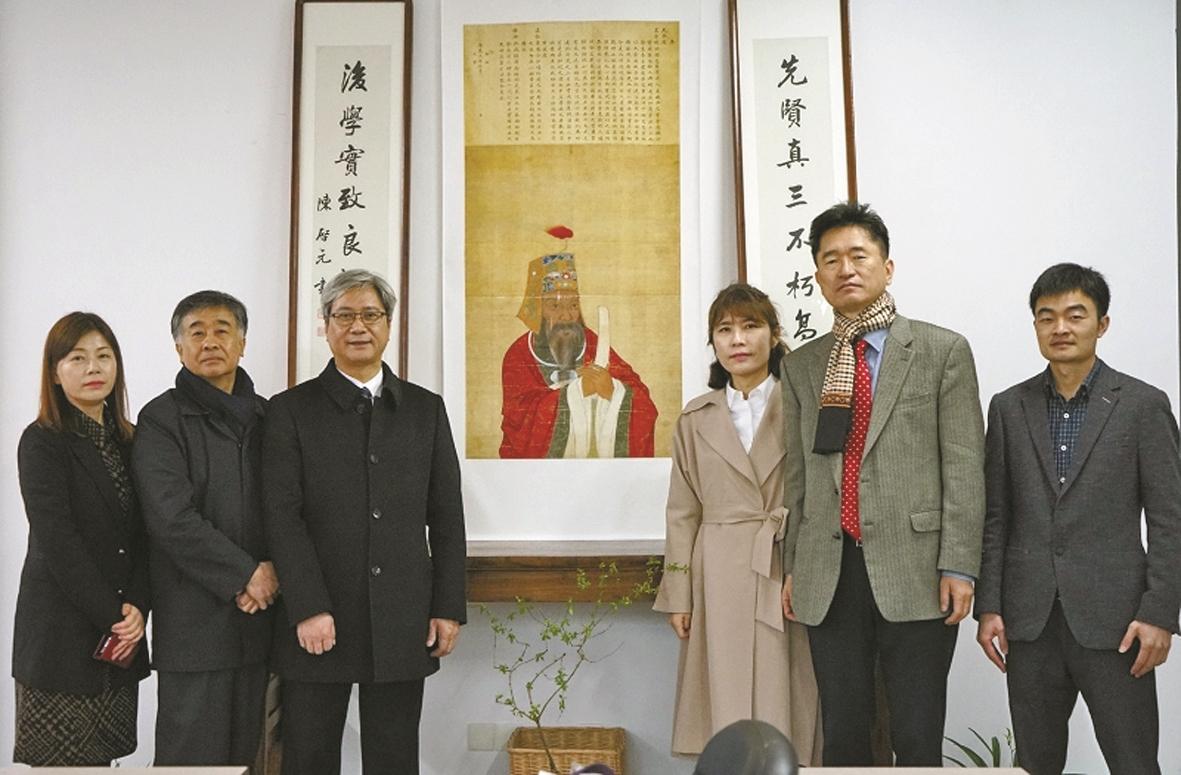
In 2011, Jung Hyun-min, then director of Busan's marine and fisheries administration in South Korea, visited Ningbo for the first time. Before his official schedule began, he went straight to Wang Yangming's former residence in Yuyao.
Jung said Wang Yangming's philosophy is known as "Practical Learning" in South Korea.
Over the following 15 years, Jung worked to strengthen ties between the two cities, helping Ningbo-Zhoushan Port and Busan Port establish a sister-port relationship and sign a marine-economy cooperation agreement. This year, Ningbo awarded him the title of honorary citizen.
From advanced manufacturing and charitable giving to port cooperation and international exchanges, Wang Yangming's philosophy continues to shape how Ningbo approaches knowledge, work and social responsibility.
More than 500 years after Wang Yangming's time, his philosophy remains alive in the everyday life of Ningbo.
Reporters: Shan Yuzifeng
Gu Jiacheng
Translator: Ye Ke