

As the sea breeze swept across Colombo in July, it carried more than the scent of the Indian Ocean. It also witnessed a dialogue between civilizations and a shared vision for sustainable development.
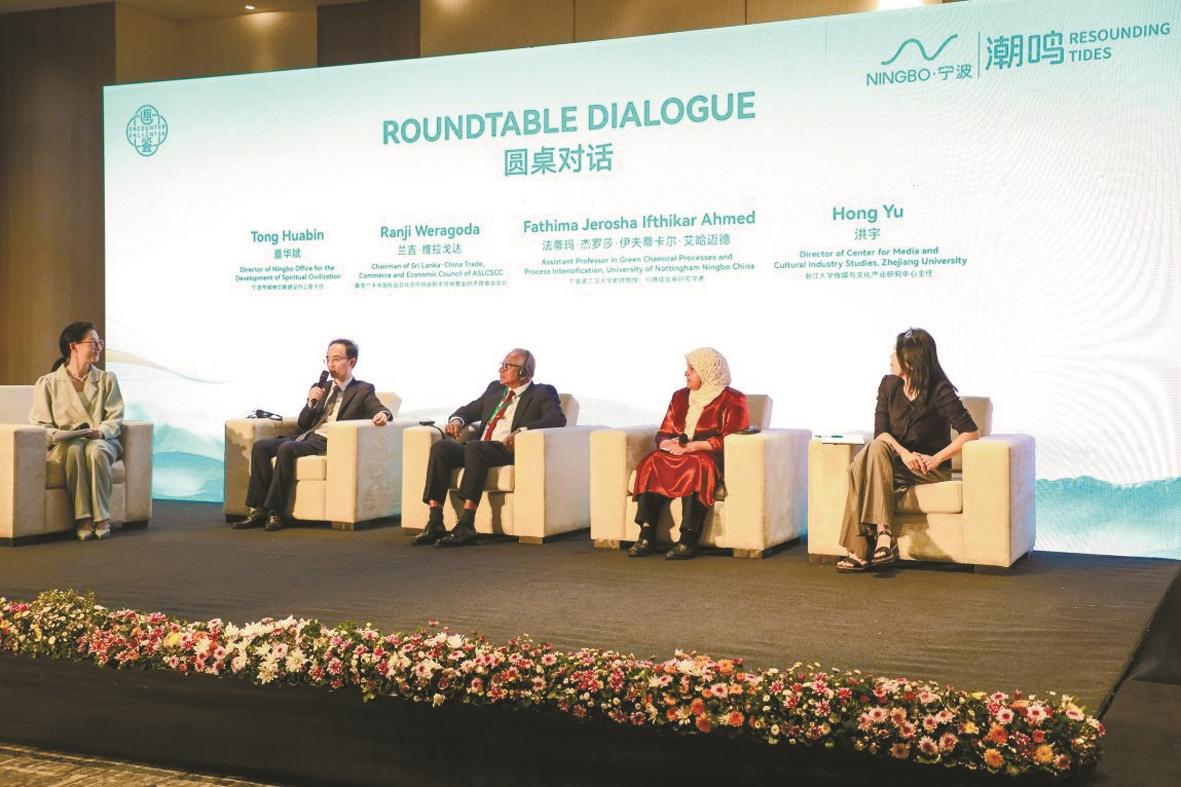
At the "Encounter and Enlighten: Ningbo & Colombo Dialogue" exchange event, Dr. Fathima Jerosha Ifthikar Ahmed, Assistant Professor in Green Chemical Processes and Process Intensification at the University of Nottingham Ningbo China (UNNC), shared her insights into the green transformation of port cities, drawing on years of research and life in Ningbo.
Born in Sri Lanka, educated in China, and now pursuing research in sustainable chemical engineering at UNNC, Jerosha returned to her homeland not simply as a visiting scholar, but as an invited representative from Ningbo. Together with experts from China and Sri Lanka, she discussed how port cities can pursue greener and more sustainable futures.
"I was deeply impressed this time," she said with a smile. "In the past, I usually attended international events in China. This time, I returned to Sri Lanka from Ningbo as a guest. Sharing my research journey back home made me realize that I am not only a scientist, but also a bridge connecting two countries and two port cities."
A City That Redefined "Green"
Jerosha first came to China more than a decade ago to pursue her doctoral studies. After completing both her PhD and postdoctoral research, she decided to continue her academic career in China and later joined the University of Nottingham Ningbo China several years ago.
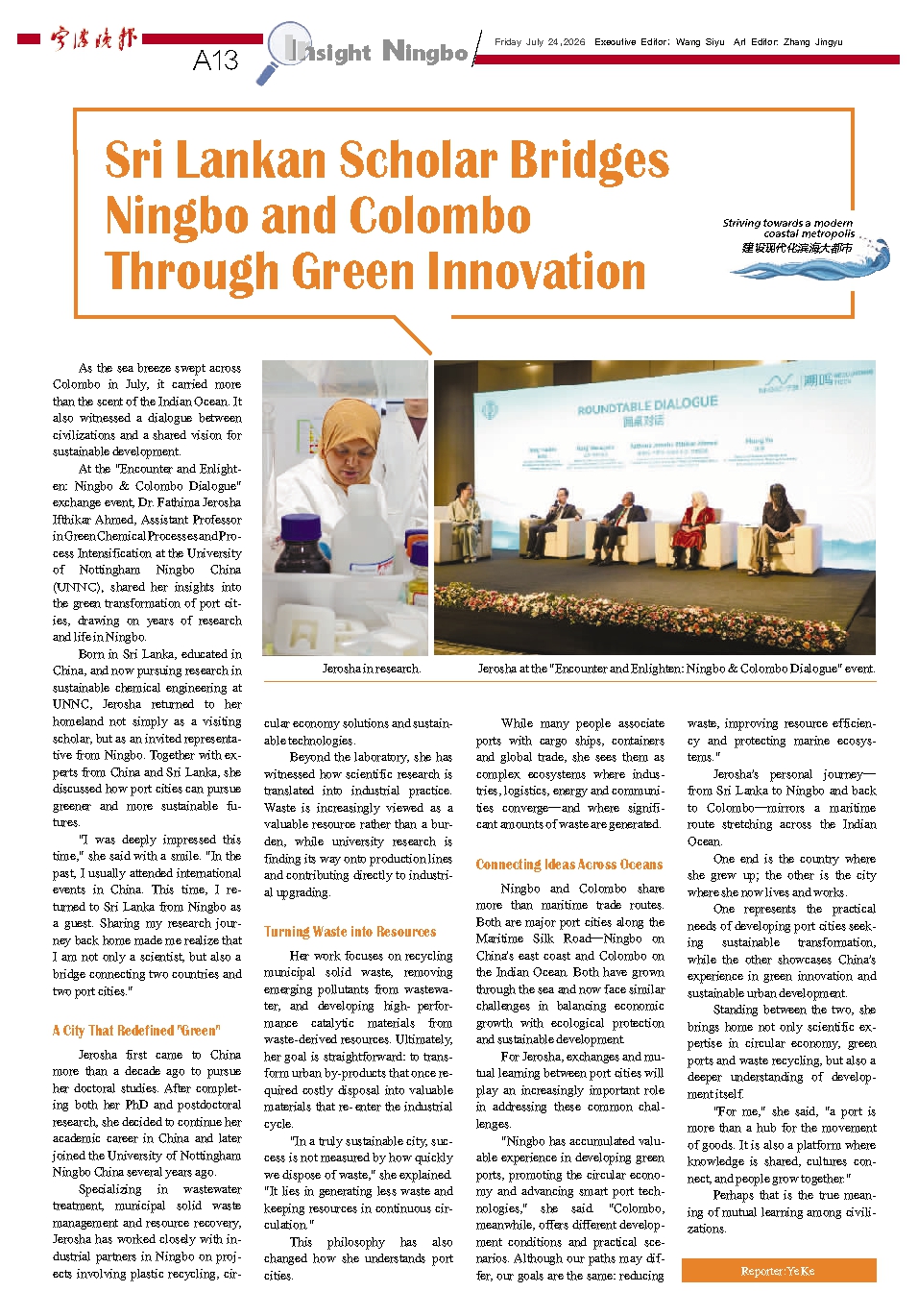
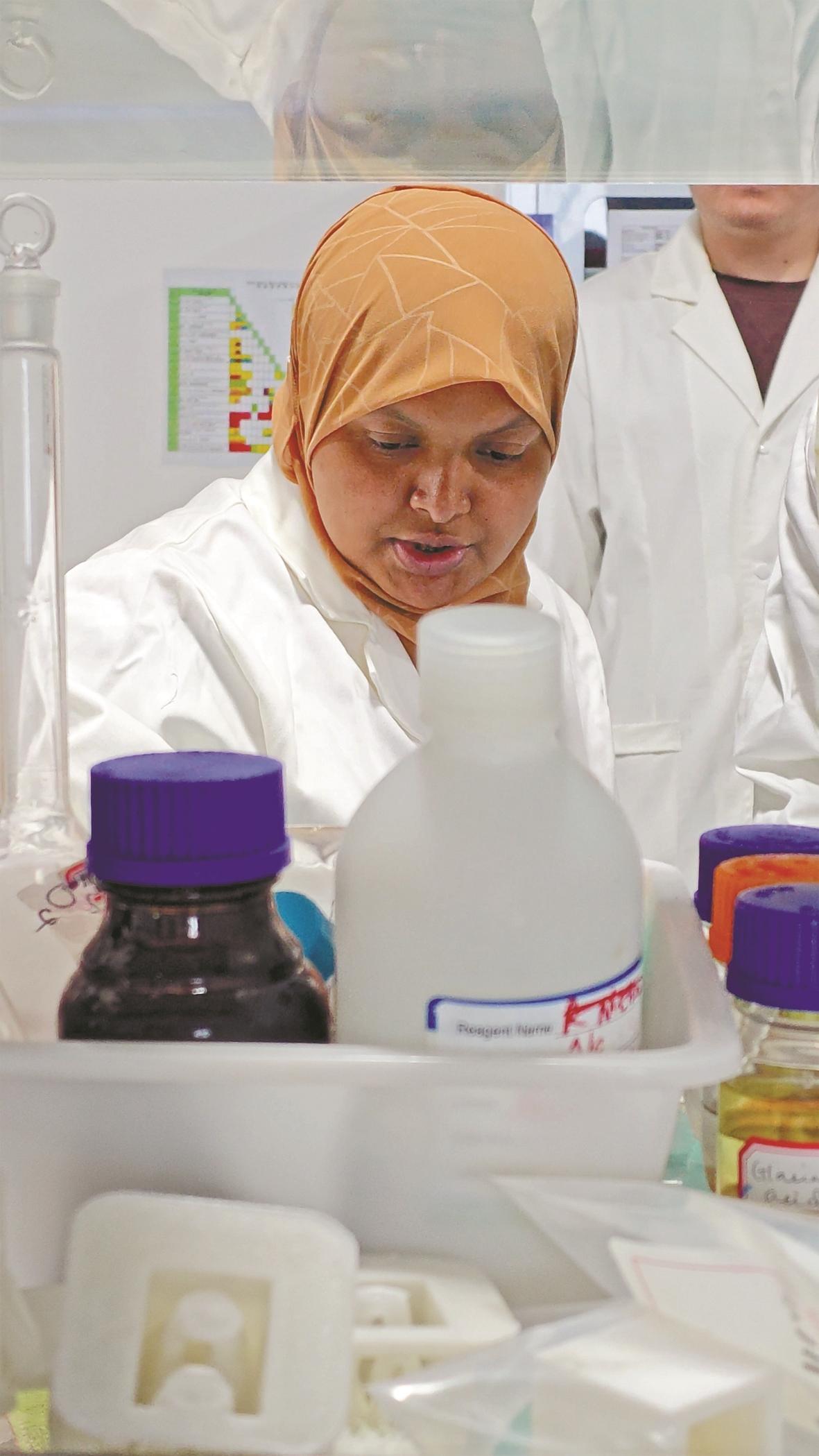
Specializing in wastewater treatment, municipal solid waste management and resource recovery, Jerosha has worked closely with industrial partners in Ningbo on projects involving plastic recycling, circular economy solutions and sustainable technologies.
Beyond the laboratory, she has witnessed how scientific research is translated into industrial practice. Waste is increasingly viewed as a valuable resource rather than a burden, while university research is finding its way onto production lines and contributing directly to industrial upgrading.
Turning Waste into Resources
Her work focuses on recycling municipal solid waste, removing emerging pollutants from wastewater, and developing high-performance catalytic materials from waste-derived resources. Ultimately, her goal is straightforward: to transform urban by-products that once required costly disposal into valuable materials that re-enter the industrial cycle.
"In a truly sustainable city, success is not measured by how quickly we dispose of waste," she explained. "It lies in generating less waste and keeping resources in continuous circulation."
This philosophy has also changed how she understands port cities.
While many people associate ports with cargo ships, containers and global trade, she sees them as complex ecosystems where industries, logistics, energy and communities converge—and where significant amounts of waste are generated.
Connecting Ideas Across Oceans
Ningbo and Colombo share more than maritime trade routes. Both are major port cities along the Maritime Silk Road—Ningbo on China's east coast and Colombo on the Indian Ocean. Both have grown through the sea and now face similar challenges in balancing economic growth with ecological protection and sustainable development.
For Jerosha, exchanges and mutual learning between port cities will play an increasingly important role in addressing these common challenges.
"Ningbo has accumulated valuable experience in developing green ports, promoting the circular economy and advancing smart port technologies," she said. "Colombo, meanwhile, offers different development conditions and practical scenarios. Although our paths may differ, our goals are the same: reducing waste, improving resource efficiency and protecting marine ecosystems."
Jerosha's personal journey—from Sri Lanka to Ningbo and back to Colombo—mirrors a maritime route stretching across the Indian Ocean.
One end is the country where she grew up; the other is the city where she now lives and works.
One represents the practical needs of developing port cities seeking sustainable transformation, while the other showcases China's experience in green innovation and sustainable urban development.
Standing between the two, she brings home not only scientific expertise in circular economy, green ports and waste recycling, but also a deeper understanding of development itself.
"For me," she said, "a port is more than a hub for the movement of goods. It is also a platform where knowledge is shared, cultures connect, and people grow together."
Perhaps that is the true meaning of mutual learning among civilizations.
Reporter:Ye Ke