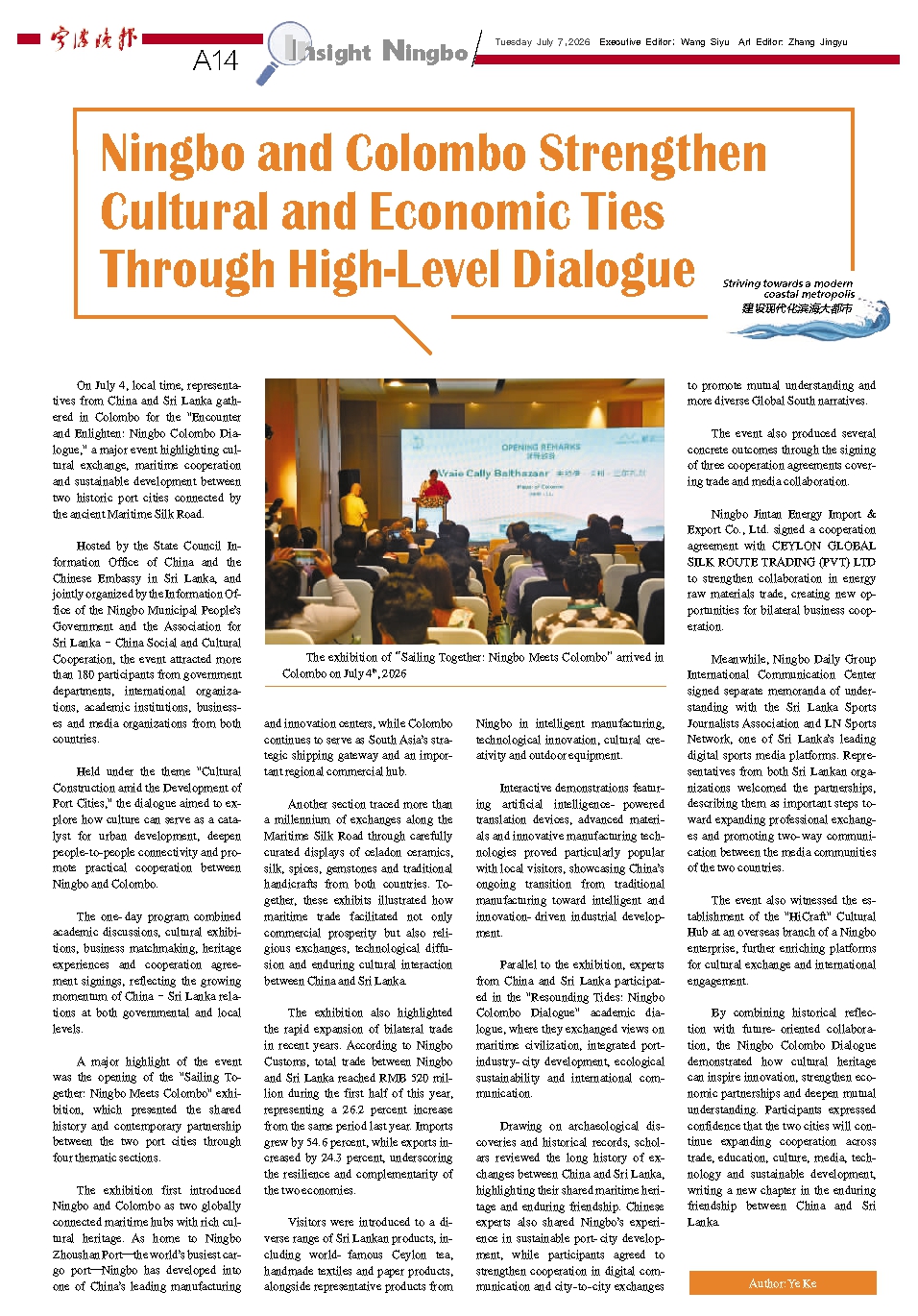


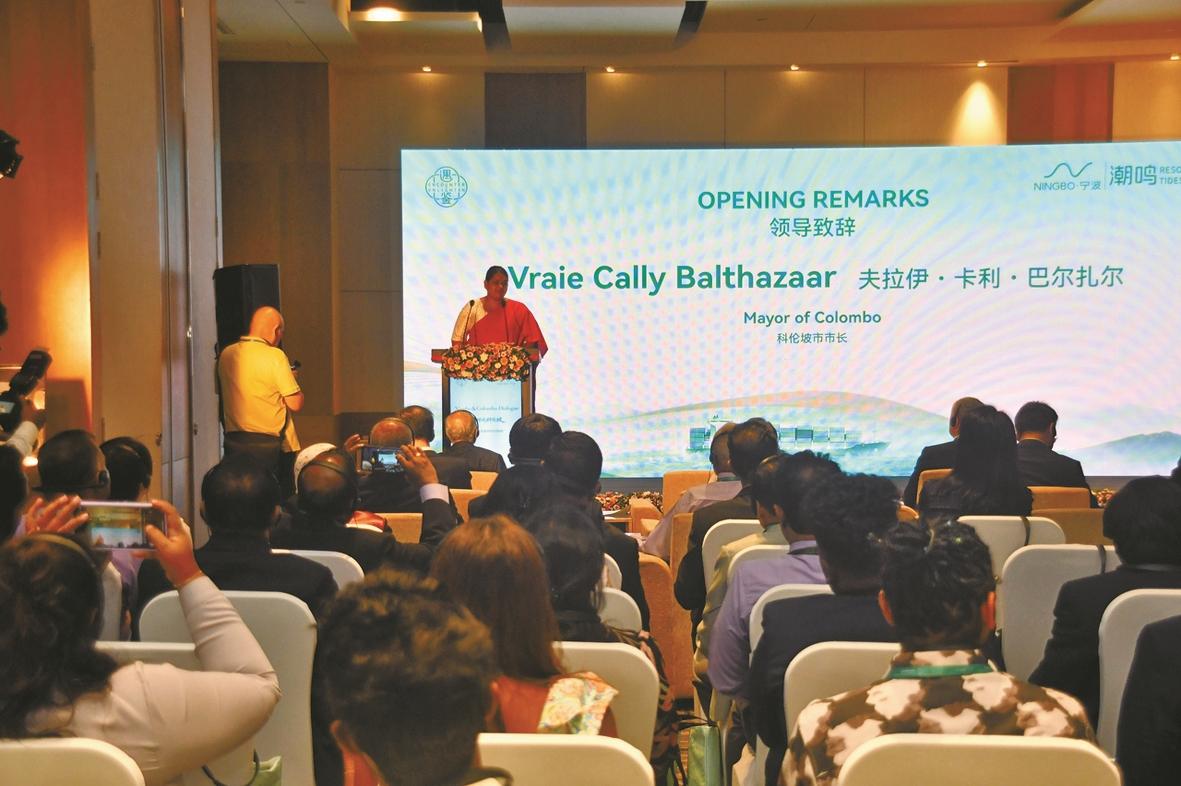
On July 4, local time, representatives from China and Sri Lanka gathered in Colombo for the "Encounter and Enlighten: Ningbo Colombo Dialogue," a major event highlighting cultural exchange, maritime cooperation and sustainable development between two historic port cities connected by the ancient Maritime Silk Road.
Hosted by the State Council Information Office of China and the Chinese Embassy in Sri Lanka, and jointly organized by the Information Office of the Ningbo Municipal People's Government and the Association for Sri Lanka–China Social and Cultural Cooperation, the event attracted more than 180 participants from government departments, international organizations, academic institutions, businesses and media organizations from both countries.
Held under the theme "Cultural Construction amid the Development of Port Cities," the dialogue aimed to explore how culture can serve as a catalyst for urban development, deepen people-to-people connectivity and promote practical cooperation between Ningbo and Colombo.
The one-day program combined academic discussions, cultural exhibitions, business matchmaking, heritage experiences and cooperation agreement signings, reflecting the growing momentum of China–Sri Lanka relations at both governmental and local levels.
A major highlight of the event was the opening of the "Sailing Together: Ningbo Meets Colombo" exhibition, which presented the shared history and contemporary partnership between the two port cities through four thematic sections.
The exhibition first introduced Ningbo and Colombo as two globally connected maritime hubs with rich cultural heritage. As home to Ningbo Zhoushan Port—the world's busiest cargo port—Ningbo has developed into one of China's leading manufacturing and innovation centers, while Colombo continues to serve as South Asia's strategic shipping gateway and an important regional commercial hub.
Another section traced more than a millennium of exchanges along the Maritime Silk Road through carefully curated displays of celadon ceramics, silk, spices, gemstones and traditional handicrafts from both countries. Together, these exhibits illustrated how maritime trade facilitated not only commercial prosperity but also religious exchanges, technological diffusion and enduring cultural interaction between China and Sri Lanka.
The exhibition also highlighted the rapid expansion of bilateral trade in recent years. According to Ningbo Customs, total trade between Ningbo and Sri Lanka reached RMB 520 million during the first half of this year, representing a 26.2 percent increase from the same period last year. Imports grew by 54.6 percent, while exports increased by 24.3 percent, underscoring the resilience and complementarity of the two economies.
Visitors were introduced to a diverse range of Sri Lankan products, including world-famous Ceylon tea, handmade textiles and paper products, alongside representative products from Ningbo in intelligent manufacturing, technological innovation, cultural creativity and outdoor equipment.
Interactive demonstrations featuring artificial intelligence-powered translation devices, advanced materials and innovative manufacturing technologies proved particularly popular with local visitors, showcasing China's ongoing transition from traditional manufacturing toward intelligent and innovation-driven industrial development.
Parallel to the exhibition, experts from China and Sri Lanka participated in the "Resounding Tides: Ningbo Colombo Dialogue" academic dialogue, where they exchanged views on maritime civilization, integrated port-industry-city development, ecological sustainability and international communication.
Drawing on archaeological discoveries and historical records, scholars reviewed the long history of exchanges between China and Sri Lanka, highlighting their shared maritime heritage and enduring friendship. Chinese experts also shared Ningbo's experience in sustainable port-city development, while participants agreed to strengthen cooperation in digital communication and city-to-city exchanges to promote mutual understanding and more diverse Global South narratives.
The event also produced several concrete outcomes through the signing of three cooperation agreements covering trade and media collaboration.
Ningbo Jintan Energy Import & Export Co., Ltd. signed a cooperation agreement with CEYLON GLOBAL SILK ROUTE TRADING (PVT) LTD to strengthen collaboration in energy raw materials trade, creating new opportunities for bilateral business cooperation.
Meanwhile, Ningbo Daily Group International Communication Center signed separate memoranda of understanding with the Sri Lanka Sports Journalists Association and LN Sports Network, one of Sri Lanka's leading digital sports media platforms. Representatives from both Sri Lankan organizations welcomed the partnerships, describing them as important steps toward expanding professional exchanges and promoting two-way communication between the media communities of the two countries.
The event also witnessed the establishment of the "HiCraft" Cultural Hub at an overseas branch of a Ningbo enterprise, further enriching platforms for cultural exchange and international engagement.
By combining historical reflection with future-oriented collaboration, the Ningbo Colombo Dialogue demonstrated how cultural heritage can inspire innovation, strengthen economic partnerships and deepen mutual understanding. Participants expressed confidence that the two cities will continue expanding cooperation across trade, education, culture, media, technology and sustainable development, writing a new chapter in the enduring friendship between China and Sri Lanka.
Author: Ye Ke