

During the plum rain season, Ningbo's rainfall follows its own unpredictable rhythm. Sometimes it falls as a lingering drizzle that tests your patience; other times it comes in a short, sharp burst. And then, as the old saying goes, "it rains when you open your door, and clears up by lunchtime."
This timeless folk saying captures the rhythm of the rainy season — morning showers that give way to afternoon sunshine. Few people know that this vivid piece of local wisdom was recorded and translated by a British scholar more than 150 years ago, who then brought it across the oceans to Western readers.
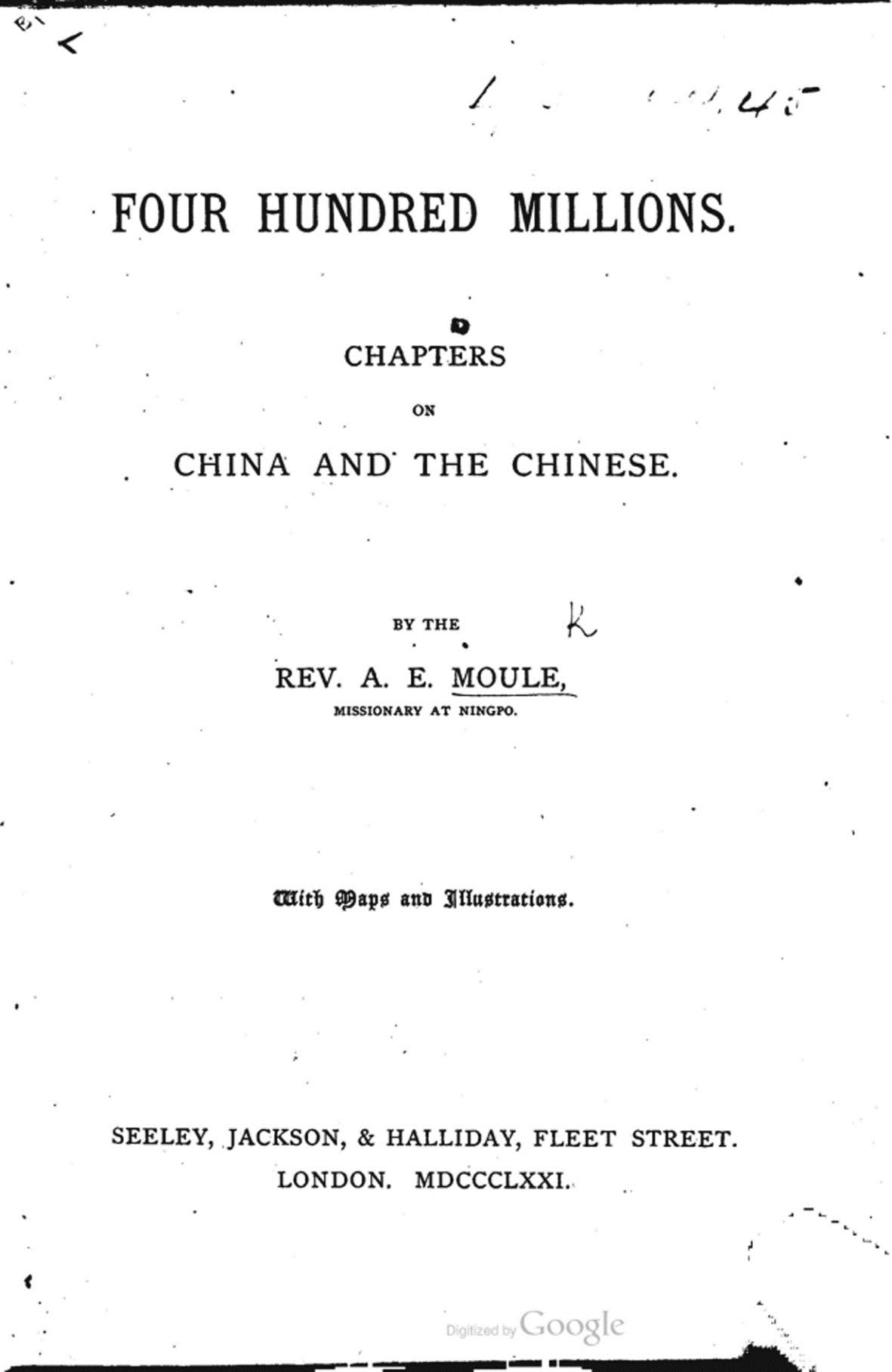
In his 1871 book Four Hundred Millions: Chapters on China and the Chinese (also rendered as Four Hundred Millions), published in London, Moule devoted an entire chapter to systematically introducing and translating Chinese proverbs.
He rendered the proverb as "If it rains when you open your door, it will be sunny by the time breakfast is over," and carefully recorded its Ningbo pronunciation in romanized script: "K'æ meng yü, Væn 'eo zing."
Moule carefully documented these and many other proverbs familiar to every Ningbo native—for example: "All's well when once the heart is right; what use these cabbage-stumps to bite?""Earth bears no rootless plant on hill or plain; no human life but has some hidden root of gain." And "A rest-shed by the weary road, 'tis good, while blows the cooling breeze; but call it not a dwelling-place, a life-long home for tranquil ease."
Four Hundred Millions is the earliest known work in Western literature to systematically introduce and translate Ningbo proverbs.
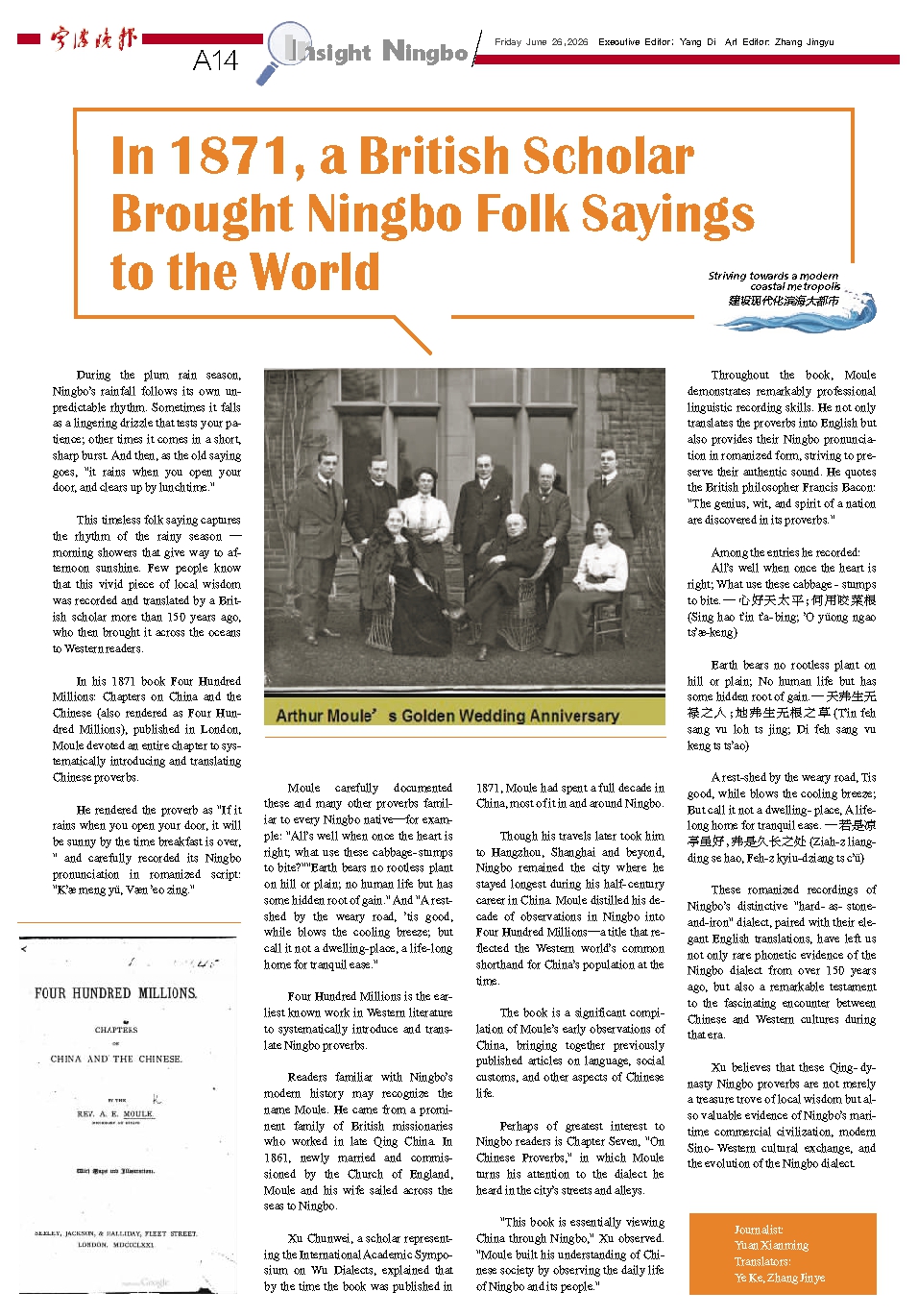
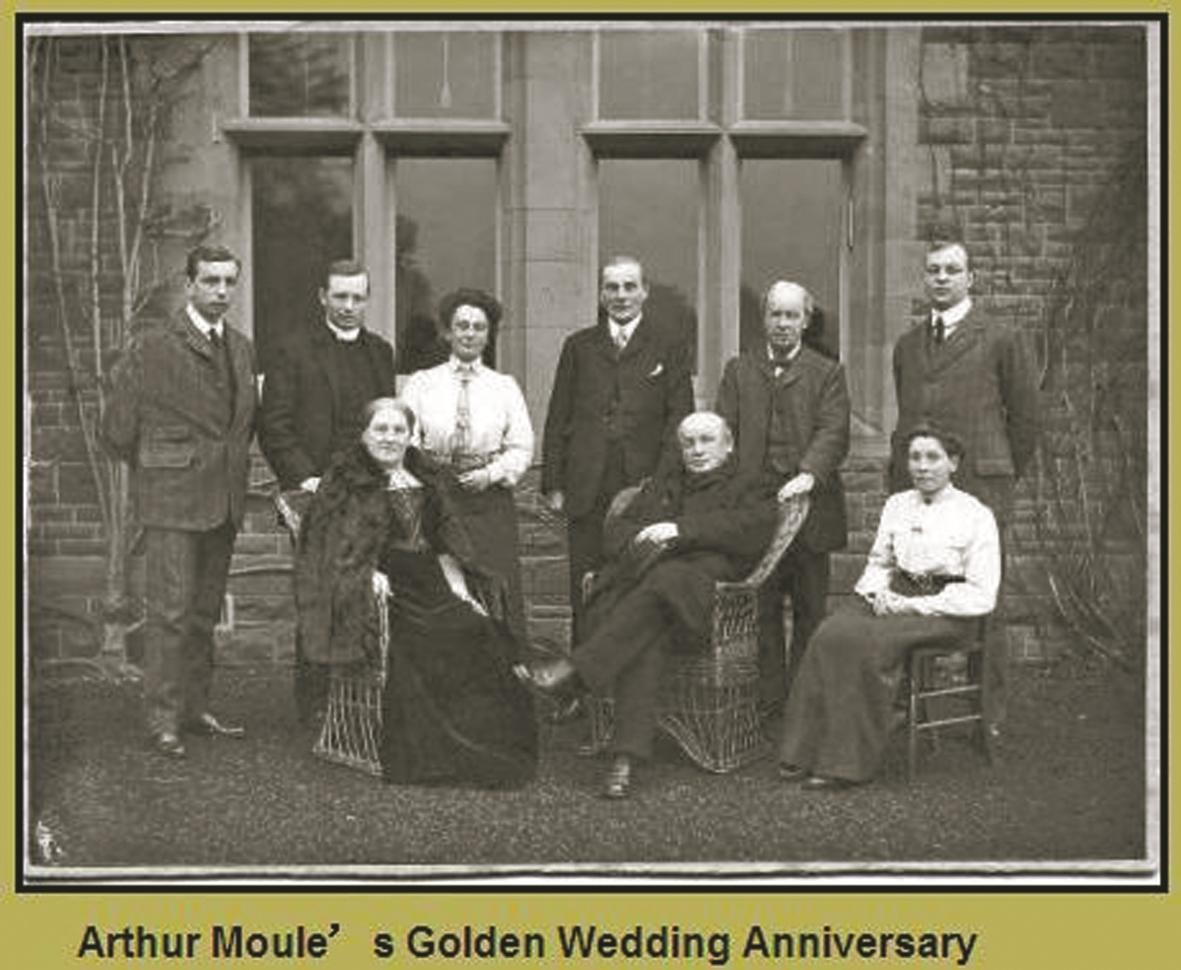
Readers familiar with Ningbo's modern history may recognize the name Moule. He came from a prominent family of British missionaries who worked in late Qing China. In 1861, newly married and commissioned by the Church of England, Moule and his wife sailed across the seas to Ningbo.
Xu Chunwei, a scholar representing the International Academic Symposium on Wu Dialects, explained that by the time the book was published in 1871, Moule had spent a full decade in China, most of it in and around Ningbo.
Though his travels later took him to Hangzhou, Shanghai and beyond, Ningbo remained the city where he stayed longest during his half-century career in China. Moule distilled his decade of observations in Ningbo into Four Hundred Millions—a title that reflected the Western world's common shorthand for China's population at the time.
The book is a significant compilation of Moule's early observations of China, bringing together previously published articles on language, social customs, and other aspects of Chinese life.
Perhaps of greatest interest to Ningbo readers is Chapter Seven, "On Chinese Proverbs," in which Moule turns his attention to the dialect he heard in the city's streets and alleys.
"This book is essentially viewing China through Ningbo," Xu observed. "Moule built his understanding of Chinese society by observing the daily life of Ningbo and its people."
Throughout the book, Moule demonstrates remarkably professional linguistic recording skills. He not only translates the proverbs into English but also provides their Ningbo pronunciation in romanized form, striving to preserve their authentic sound. He quotes the British philosopher Francis Bacon: "The genius, wit, and spirit of a nation are discovered in its proverbs."
Among the entries he recorded:
All's well when once the heart is right; What use these cabbage - stumps to bite.— 心好天太平;何用咬菜根 (Sing hao t'in t'a-bing; 'O yüong ngao ts'æ-keng)
Earth bears no rootless plant on hill or plain; No human life but has some hidden root of gain.— 天弗生无禄之人;地弗生无根之草 (T'in feh sang vu loh ts jing; Di feh sang vu keng ts ts'ao)
A rest-shed by the weary road, Tis good, while blows the cooling breeze; But call it not a dwelling- place, A life-long home for tranquil ease. — 若是凉亭虽好,弗是久长之处 (Ziah-z liang-ding se hao, Feh-z kyiu-dziang ts c'ü)
These romanized recordings of Ningbo's distinctive "hard-as-stone-and-iron" dialect, paired with their elegant English translations, have left us not only rare phonetic evidence of the Ningbo dialect from over 150 years ago, but also a remarkable testament to the fascinating encounter between Chinese and Western cultures during that era.
Xu believes that these Qing-dynasty Ningbo proverbs are not merely a treasure trove of local wisdom but also valuable evidence of Ningbo's maritime commercial civilization, modern Sino-Western cultural exchange, and the evolution of the Ningbo dialect.
Journalist:
Yuan Xianming
Translators:
Ye Ke, Zhang Jinye