
From June 14 to 16, a Ningbo delegation embarked on a study tour of Hong Kong and Macao. This marked another outbound learning trip beyond Zhejiang Province, following previous visits to Shanghai, Nanjing and Hefei.
Over three packed days, the delegation paid intensive visits to enterprises, universities and institutions, held exchange forums with representatives of the Ningbo Business Community in Hong Kong and Macao, and met with relevant officials in the two SARs. The tight schedule featured in-depth investigations and extensive exchanges.
Travelling thousands of kilometers from the Yangtze River Delta to the Guangdong-Hong Kong-Macao Greater Bay Area, the delegation sought not only hands-on experience and valuable insights but also forward-looking practical cooperation opportunities.
At the start of the 15th Five-Year Plan period, Ningbo faces urgent tasks to shore up weaknesses and unlock new high-quality development momentum, including advancing high-end industrial upgrading, supporting enterprises' global expansion, and upgrading producer services.
Perched between mountains and sea, the Hong Kong University of Science and Technology (HKUST) boasts a striking red sundial sculpture at its plaza, resembling a soaring fiery phoenix with outstretched wings. This year marks the 35th anniversary of HKUST's founding. Established in 1991 amid Hong Kong's economic transformation, the university upholds the core ethos of "Anything is possible; miracles can be created".
Accompanied by university leaders, the delegation toured multiple research laboratories. At the State Key Laboratory of Molecular Neuroscience, they learned about cutting-edge blood diagnostic technology for Alzheimer's disease and whole-brain gene-editing systems. At the Hong Kong Generative AI Research Centre (HKGAI), they were briefed on its development framework tailored to Hong Kong's local linguistic and cultural context.
Universities and research institutes serve as fertile ground for basic research and original innovation. Within just a few decades, HKUST has incubated 1,800 tech enterprises, including unicorns and listed firms such as DJI and Googol Technology, earning it a reputation as Hong Kong's most entrepreneurship-driven university.
At the University Council Chamber, the delegation held face-to-face talks with the project team of Harbour Innovation Centre, which has set up operations in Ningbo. Over the past two years, the center has launched 20 high-tech firms in Ningbo founded by HKUST alumni and researchers, covering intelligent manufacturing, new materials and biomedicine.
Stellerus Technology Limited, based in Ningbo Hi-Tech Zone, was founded by HKUST graduates. "We chose Ningbo for its robust manufacturing base and abundant application scenarios," its founding team noted. The firm's self-developed space-air-ground integrated perception network combines exclusive satellite data with physics-guided AI large models to deliver precise kilometer-level 3D wind field forecasting.
Unlike the past, when talented innovators had to venture afar for opportunities, Ningbo—a major economic hub—offers a robust manufacturing capacity, abundant real-world application scenarios, mature mechanisms for translating research outcomes, and efficient government services, forming an ideal incubation ecosystem for high-caliber research achievements from home and abroad.
The Ningbo-Hong Kong Innovation and Technology Centre, launched at the 2026 Ningbo-Hong Kong Economic Cooperation Forum, leverages complementary industrial strengths of the two cities. Operated as an integrated dual-site platform with hubs in Hong Kong and Ningbo, it builds a full industrial chain covering talent recruitment, startup incubation and industrialization.
The delegation also explored new avenues for central-local cooperation with China Resources Group, advancing collaboration in modern services including port and logistics, property operation, financial investment, medical care, cultural tourism and wellness. Both sides will strengthen ties with innovation platforms in Ningbo to commercialize core technological breakthroughs.
Only by consistently fostering top-tier innovation ecosystems and enabling free, efficient flow of innovation resources can Ningbo live up to national expectations and contribute to overall national development.
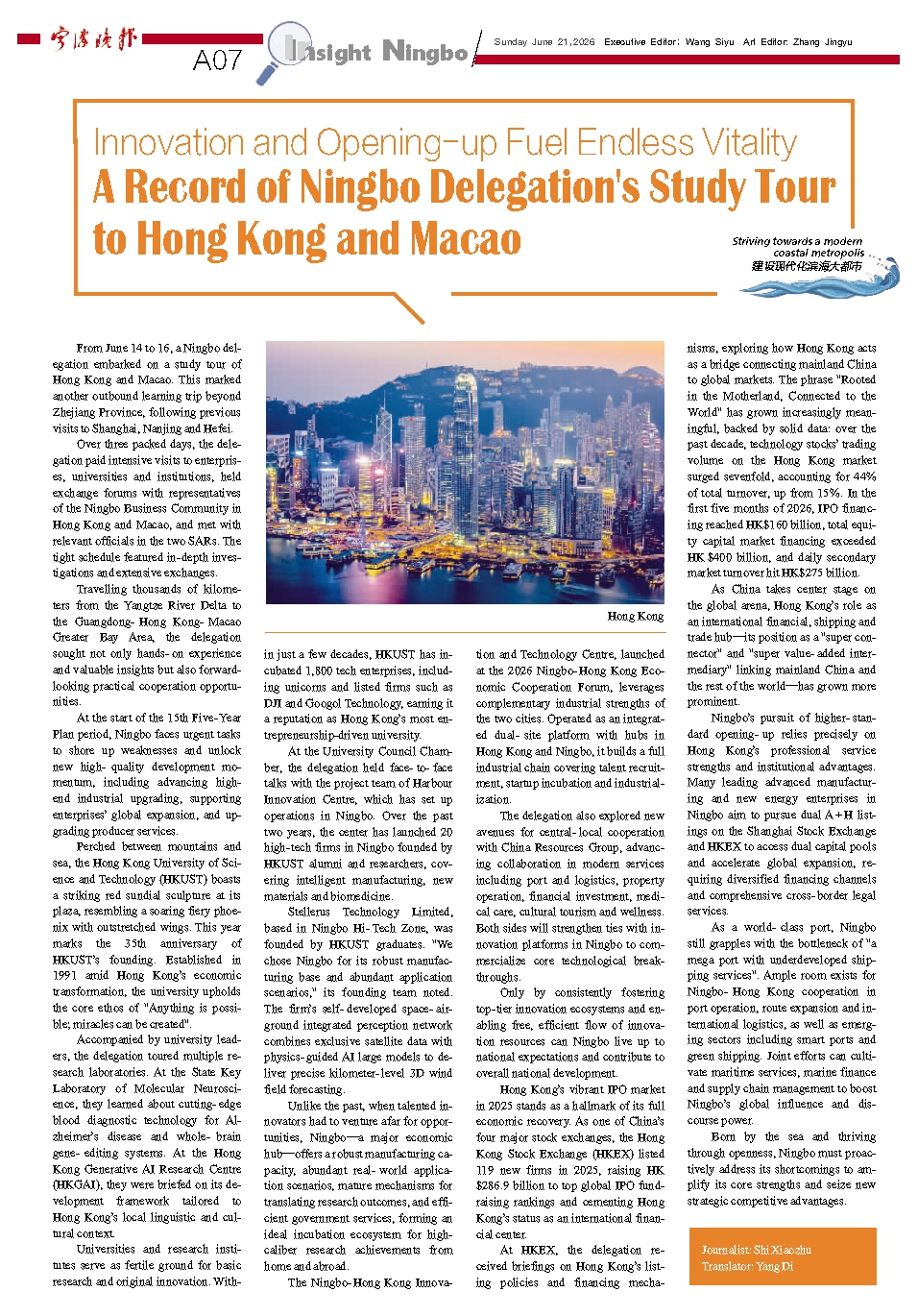
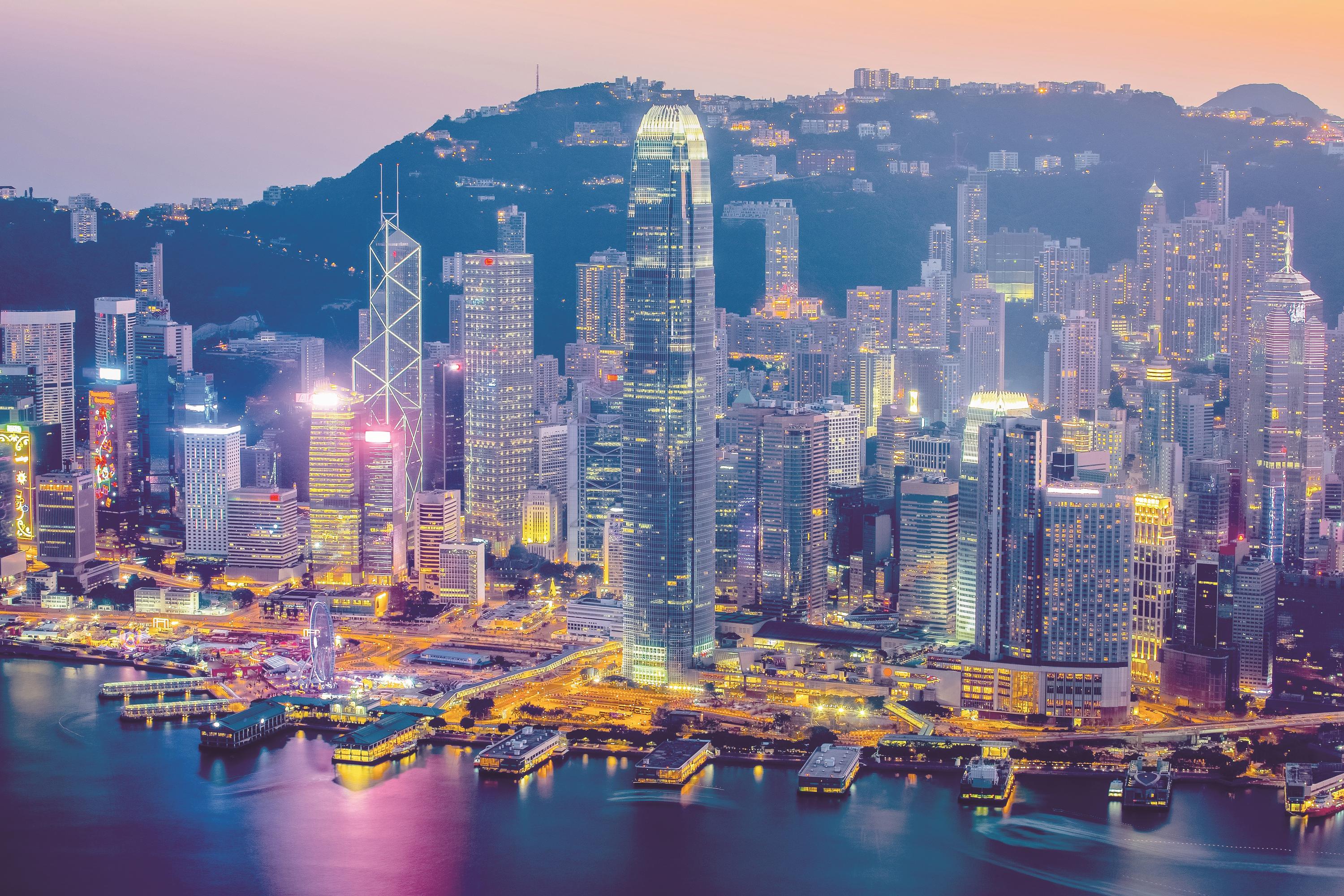
Hong Kong's vibrant IPO market in 2025 stands as a hallmark of its full economic recovery. As one of China's four major stock exchanges, the Hong Kong Stock Exchange (HKEX) listed 119 new firms in 2025, raising HK$286.9 billion to top global IPO fundraising rankings and cementing Hong Kong's status as an international financial center.
At HKEX, the delegation received briefings on Hong Kong's listing policies and financing mechanisms, exploring how Hong Kong acts as a bridge connecting mainland China to global markets. The phrase "Rooted in the Motherland, Connected to the World" has grown increasingly meaningful, backed by solid data: over the past decade, technology stocks' trading volume on the Hong Kong market surged sevenfold, accounting for 44% of total turnover, up from 15%. In the first five months of 2026, IPO financing reached HK$160 billion, total equity capital market financing exceeded HK$400 billion, and daily secondary market turnover hit HK$275 billion.
As China takes center stage on the global arena, Hong Kong's role as an international financial, shipping and trade hub—its position as a "super connector" and "super value-added intermediary" linking mainland China and the rest of the world—has grown more prominent.
Ningbo's pursuit of higher-standard opening-up relies precisely on Hong Kong's professional service strengths and institutional advantages. Many leading advanced manufacturing and new energy enterprises in Ningbo aim to pursue dual A+H listings on the Shanghai Stock Exchange and HKEX to access dual capital pools and accelerate global expansion, requiring diversified financing channels and comprehensive cross-border legal services.
As a world-class port, Ningbo still grapples with the bottleneck of "a mega port with underdeveloped shipping services". Ample room exists for Ningbo-Hong Kong cooperation in port operation, route expansion and international logistics, as well as emerging sectors including smart ports and green shipping. Joint efforts can cultivate maritime services, marine finance and supply chain management to boost Ningbo's global influence and discourse power.
Born by the sea and thriving through openness, Ningbo must proactively address its shortcomings to amplify its core strengths and seize new strategic competitive advantages.
Journalist: Shi Xiaozhu
Translator: Yang Di