

The National Theater of Tajikistan, a major cultural landmark in Central Asia, is approaching completion. Behind this flagship national project is Zhejiang Dafeng Industry Co., Ltd., a company from Ningbo, China, which has provided the theatre’s complete stage machinery, lighting, audio, video, and seating systems.
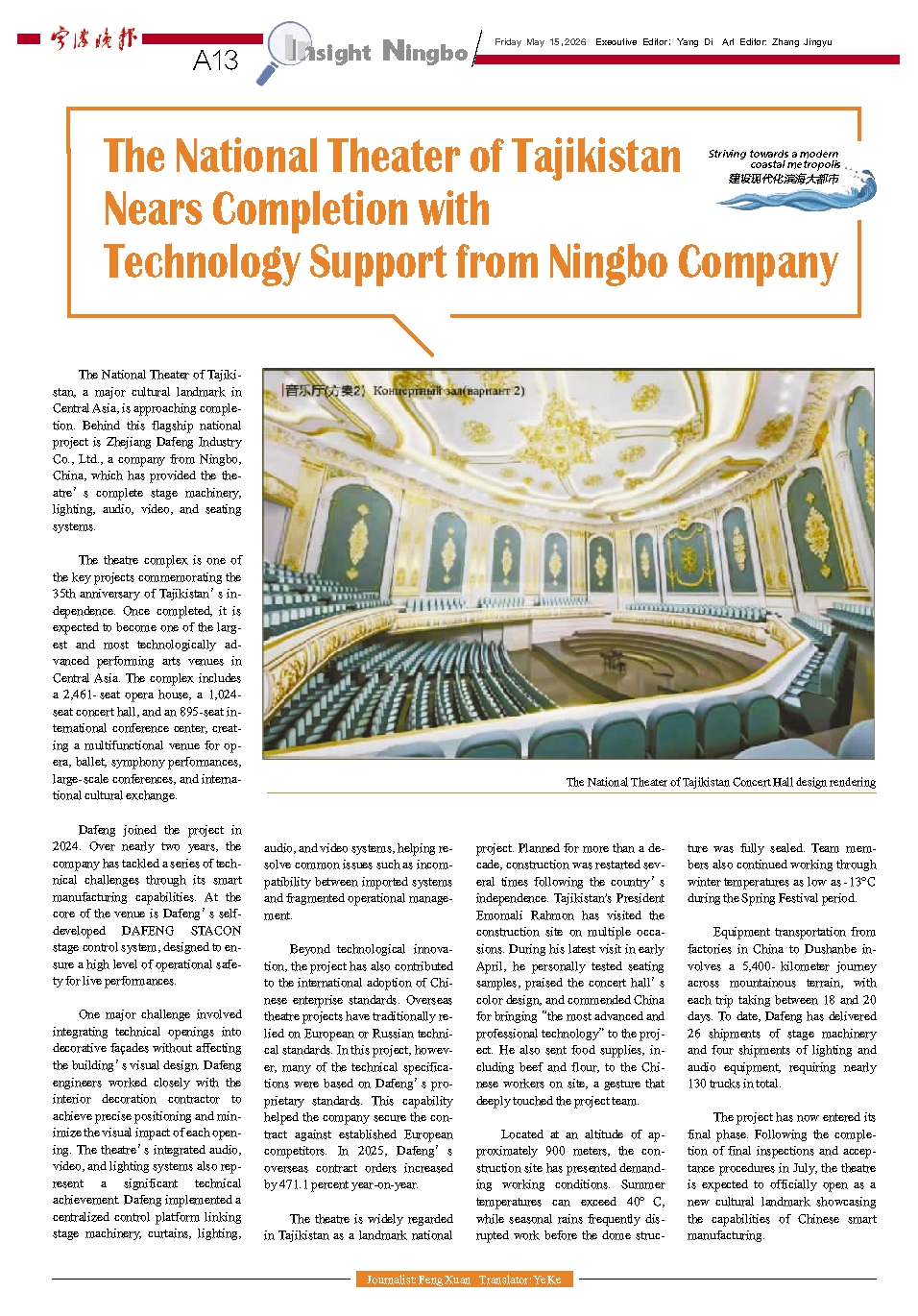
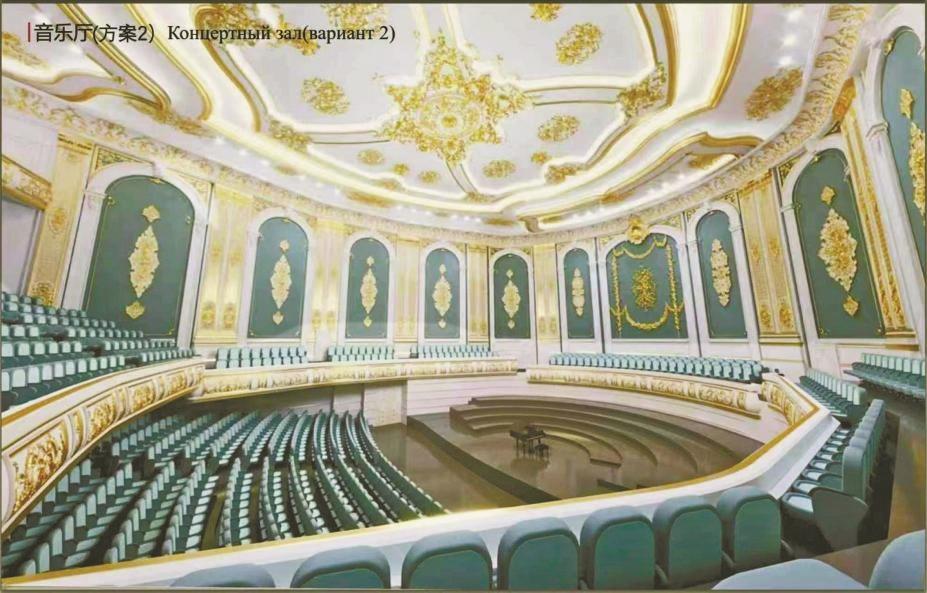
The theatre complex is one of the key projects commemorating the 35th anniversary of Tajikistan’s independence. Once completed, it is expected to become one of the largest and most technologically advanced performing arts venues in Central Asia. The complex includes a 2,461-seat opera house, a 1,024-seat concert hall, and an 895-seat international conference center, creating a multifunctional venue for opera, ballet, symphony performances, large-scale conferences, and international cultural exchange.
Dafeng joined the project in 2024. Over nearly two years, the company has tackled a series of technical challenges through its smart manufacturing capabilities. At the core of the venue is Dafeng’s self-developed DAFENG STACON stage control system, designed to ensure a high level of operational safety for live performances.
One major challenge involved integrating technical openings into decorative façades without affecting the building’s visual design. Dafeng engineers worked closely with the interior decoration contractor to achieve precise positioning and minimize the visual impact of each opening. The theatre’s integrated audio, video, and lighting systems also represent a significant technical achievement. Dafeng implemented a centralized control platform linking stage machinery, curtains, lighting, audio, and video systems, helping resolve common issues such as incompatibility between imported systems and fragmented operational management.
Beyond technological innovation, the project has also contributed to the international adoption of Chinese enterprise standards. Overseas theatre projects have traditionally relied on European or Russian technical standards. In this project, however, many of the technical specifications were based on Dafeng’s proprietary standards. This capability helped the company secure the contract against established European competitors. In 2025, Dafeng’s overseas contract orders increased by 471.1 percent year-on-year.
The theatre is widely regarded in Tajikistan as a landmark national project. Planned for more than a decade, construction was restarted several times following the country’s independence. Tajikistan's President Emomali Rahmon has visited the construction site on multiple occasions. During his latest visit in early April, he personally tested seating samples, praised the concert hall’s color design, and commended China for bringing “the most advanced and professional technology” to the project. He also sent food supplies, including beef and flour, to the Chinese workers on site, a gesture that deeply touched the project team.
Located at an altitude of approximately 900 meters, the construction site has presented demanding working conditions. Summer temperatures can exceed 40°C, while seasonal rains frequently disrupted work before the dome structure was fully sealed. Team members also continued working through winter temperatures as low as -13°C during the Spring Festival period.
Equipment transportation from factories in China to Dushanbe involves a 5,400-kilometer journey across mountainous terrain, with each trip taking between 18 and 20 days. To date, Dafeng has delivered 26 shipments of stage machinery and four shipments of lighting and audio equipment, requiring nearly 130 trucks in total.
The project has now entered its final phase. Following the completion of final inspections and acceptance procedures in July, the theatre is expected to officially open as a new cultural landmark showcasing the capabilities of Chinese smart manufacturing.