
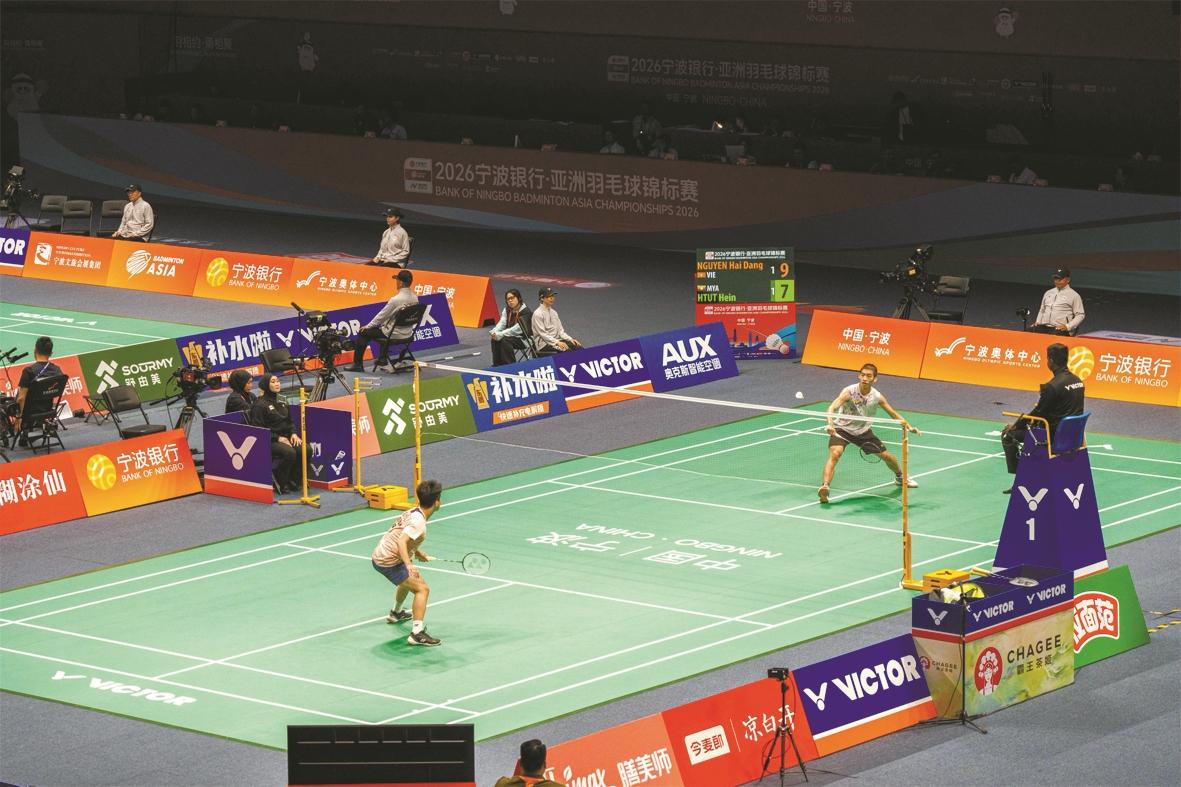
By the time the 2026 Asia Badminton Championships reached the quarterfinal stage on Friday, the mood inside the Ningbo Olympic Sports Center had shifted from anticipation to intensity.
What opened on April 7 as a broad gathering of 285 players from 23 countries and regions has, over the course of several days, narrowed into something more exacting. The margins are thinner now. The rallies are longer. And the stakes — though officially tied to ranking points and continental titles — stretch well beyond Ningbo.
For many of Asia's top players, this tournament is less a destination than a proving ground.
With the Thomas Cup and Uber Cup set to begin later this month in Denmark, the championships have taken on an added layer of urgency. Lineups are being tested. Partnerships refined. Form, perhaps most critically, is being measured under pressure.
"There's no substitute for matches like these," one coach said courtside earlier this week, as a tightly contested doubles match stretched into a decisive third game. "You learn more here than in weeks of training."
A Home Tournament,
and Its Expectations
For China, competing in Ningbo has brought both advantage and expectation. The host nation has entered the tournament with a full-strength squad, a reflection of both its depth and its ambitions — not only to claim titles this week, but to defend its dual crowns at the Thomas and Uber Cups.
At the center of that effort in men's singles is Shi Yuqi, the top seed and one of the sport's most recognizable figures in Asia. His presence has drawn steady attention from local fans, many of whom have filled the arena from the opening rounds onward. But expectation, in badminton as in any sport, can be a double-edged force.
Shi has moved through the early rounds with composure, his game marked by a balance of patience and controlled aggression. Around him, a cohort of Chinese players — including Li Shifeng, Weng Hongyang and Lu Guangzu — has advanced with similar intent, each match serving as both competition and rehearsal.
In women's singles, the dynamic is no less compelling. Wang Zhiyi, the reigning Asian champion, has returned to the tournament with the quiet assurance of a defending titleholder. Her progress through the draw has been measured, her performances reflecting the consistency that has come to define her game.
Alongside her, Han Yue and Gao Fangjie have offered further evidence of China's depth in the discipline. For a team preparing to defend the Uber Cup, such depth may prove decisive.
A Regional Field
a Global Standard
Though China's presence has been central, the championships have underscored the broader strength of badminton across Asia. Players from across the region have arrived in Ningbo not merely to compete, but to contend.
Among them is An Se-young of South Korea, whose consistency and court coverage have made her one of the most formidable players in the women's game. From Thailand, Kunlavut Vitidsarn has brought his own blend of speed and tactical awareness, advancing into the later rounds with confidence.
Elsewhere, pairs such as South Korea's Kim Won-ho and Seo Seung-jae have reinforced the depth of the doubles field, where experience and adaptability often outweigh raw power.
Organized by the Badminton Asia, the tournament carries the designation of a "Super 1000" event — the highest tier of continental competition. That status is reflected not only in the quality of the field, but in the intensity of the matches themselves.
By the time the quarterfinals arrived on April 10, few matches were decided easily. Leads shifted. Momentum swung. And in many cases, outcomes hinged on a handful of points — a missed return, a perfectly placed drop shot, a moment's hesitation.
Beyond the Court
Outside the lines of play, the championships have taken on a broader character, shaped in part by their setting.
This is the third consecutive year that Ningbo has hosted the event, a continuity that has allowed the city to refine both organization and atmosphere. The arena itself has become more than a venue; it is a stage for a carefully constructed experience.
Between matches, the lights dim and shift, giving way to choreographed displays that blend sport with spectacle. On some evenings, robotic performers share the floor with young dancers, their movements synchronized in ways that echo the precision seen in the matches themselves. Traditional cultural elements — including displays of intangible heritage — are woven into the program, offering a reminder that sport, here, exists within a broader cultural frame.
Even the tournament trophy reflects this sensibility. Crafted using a traditional bone-and-wood inlay technique, it incorporates motifs of clouds, seabirds and waves — symbols drawn from Ningbo's maritime identity and its position at the confluence of three rivers.
In the plaza outside the arena, a fan carnival unfolds throughout the week, drawing spectators into an environment that blends the aesthetics of a port city with the energy of a major sporting event. For some, the experience extends beyond the matches themselves.
The Final Stretch
Yet for the players still in contention, such surroundings quickly recede.
What remains is the immediate task: the next match, the next point, the next decision made in fractions of a second.
The tournament will move into its semifinal stage on April 11, with finals scheduled for April 12. By then, the field will have narrowed further, leaving only those who have managed to navigate both the physical and psychological demands of the week.
For some, a title in Ningbo would mark a defining achievement. For others, it would serve as confirmation — a sign that preparations for the challenges ahead are on track.
Because beyond this week lies another stage, larger and more demanding. The Thomas and Uber Cups, with their team dynamics and national stakes, will test not only individual ability but collective resilience.
In that sense, Ningbo is both an ending and a beginning.
Matches here will conclude. Trophies will be awarded. But the questions that matter most — about form, about readiness, about who can rise when it counts — will carry forward.
And for now, inside the arena, those questions are being asked point by point, rally by rally, in the steady, unrelenting rhythm of elite badminton.
By Pan Wenjie