

Peach blossoms all around, as the spring breeze carries runners forward.
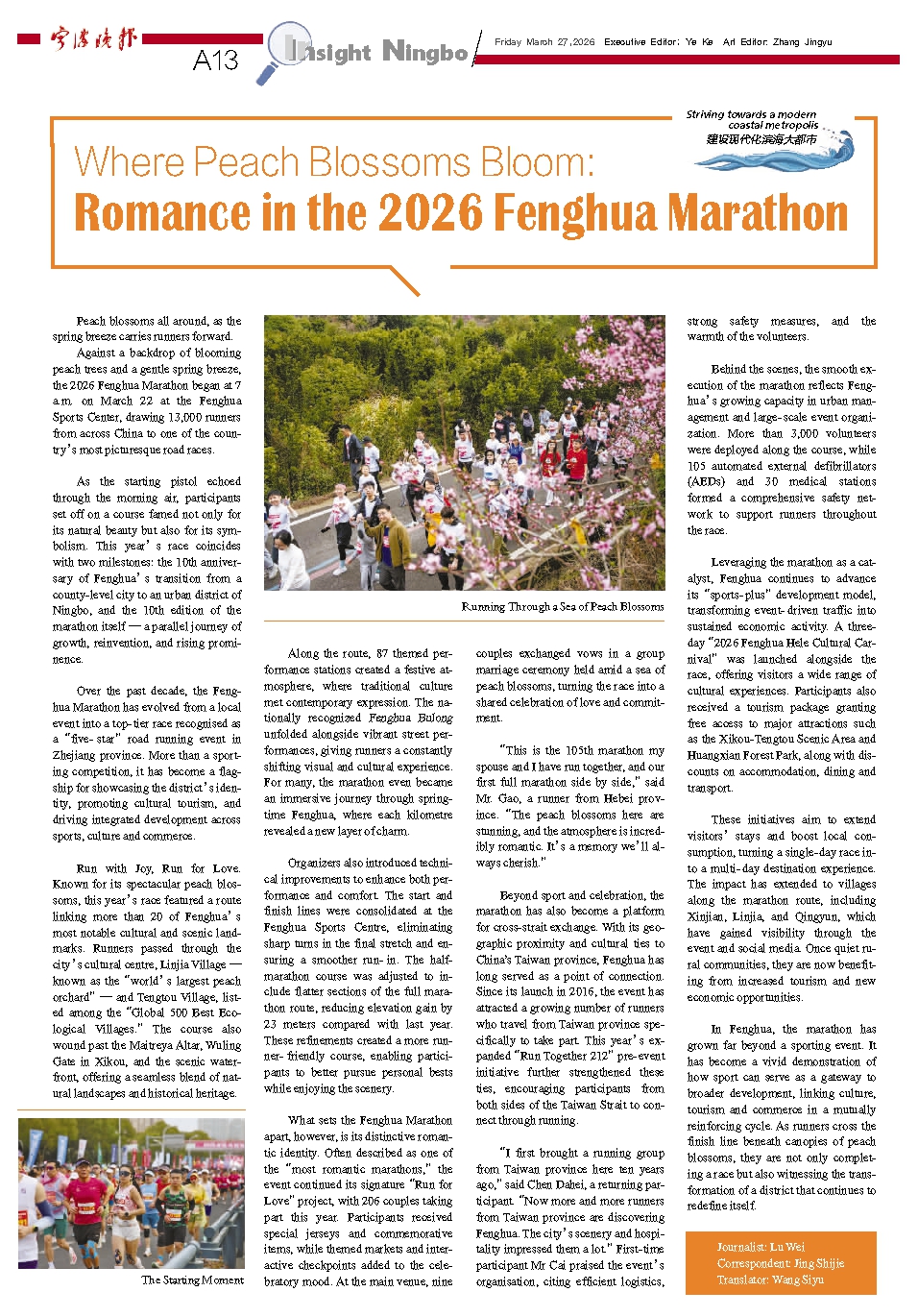
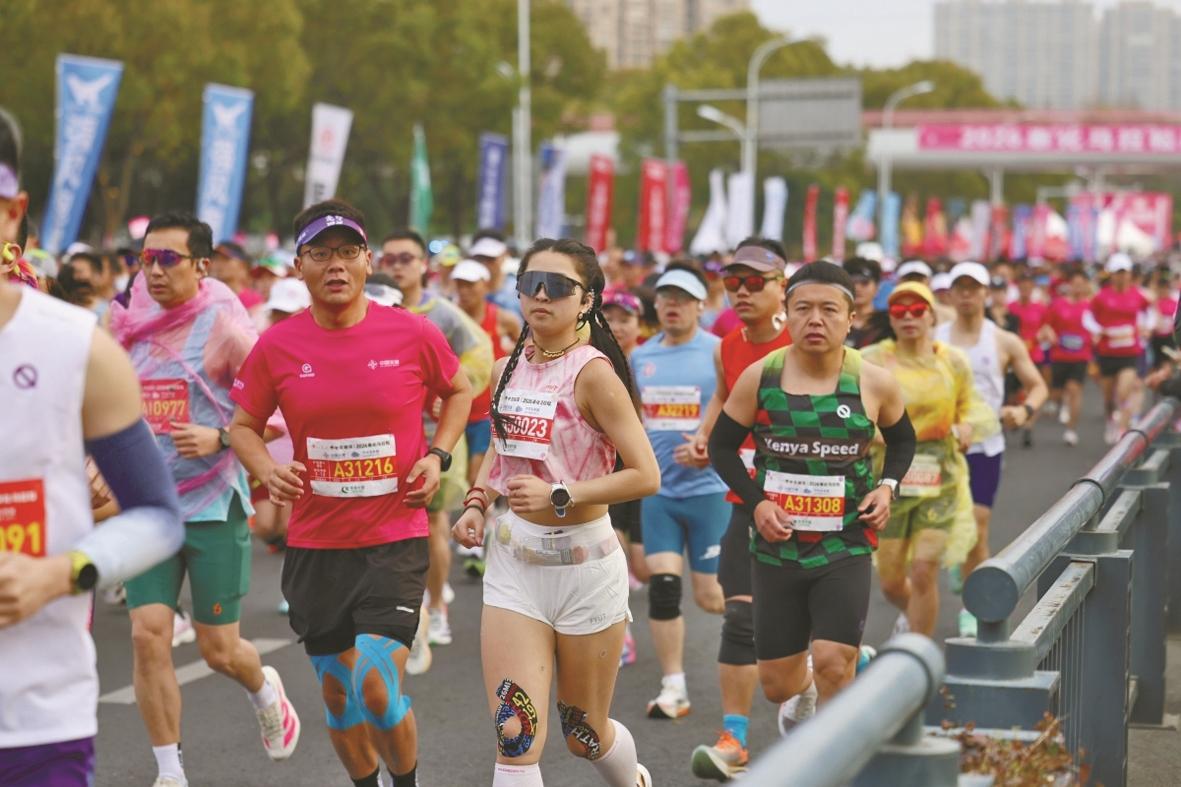
Against a backdrop of blooming peach trees and a gentle spring breeze, the 2026 Fenghua Marathon began at 7 a.m. on March 22 at the Fenghua Sports Center, drawing 13,000 runners from across China to one of the country’s most picturesque road races.
As the starting pistol echoed through the morning air, participants set off on a course famed not only for its natural beauty but also for its symbolism. This year’s race coincides with two milestones: the 10th anniversary of Fenghua’s transition from a county-level city to an urban district of Ningbo, and the 10th edition of the marathon itself — a parallel journey of growth, reinvention, and rising prominence.
Over the past decade, the Fenghua Marathon has evolved from a local event into a top-tier race recognised as a “five-star” road running event in Zhejiang province. More than a sporting competition, it has become a flagship for showcasing the district’s identity, promoting cultural tourism, and driving integrated development across sports, culture and commerce.
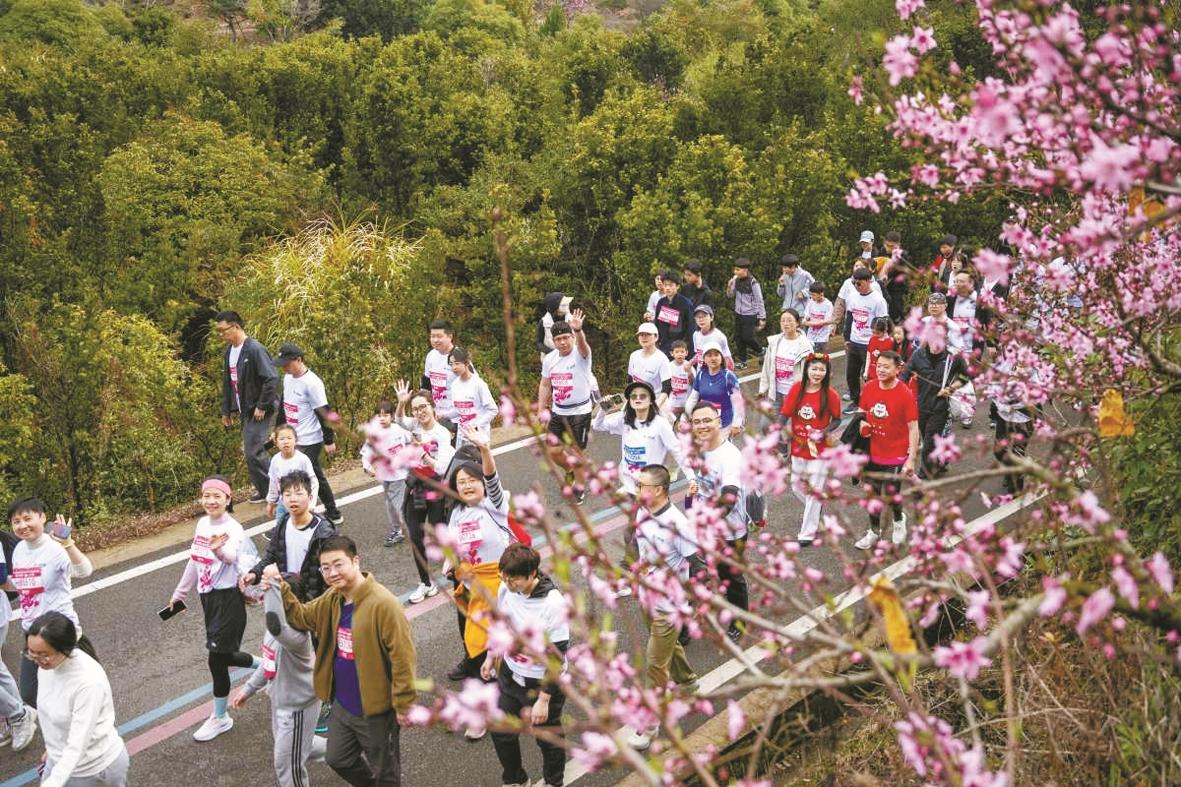
Run with Joy, Run for Love. Known for its spectacular peach blossoms, this year’s race featured a route linking more than 20 of Fenghua’s most notable cultural and scenic landmarks. Runners passed through the city’s cultural centre, Linjia Village — known as the “world’s largest peach orchard” — and Tengtou Village, listed among the “Global 500 Best Ecological Villages.” The course also wound past the Maitreya Altar, Wuling Gate in Xikou, and the scenic waterfront, offering a seamless blend of natural landscapes and historical heritage.
Along the route, 87 themed performance stations created a festive atmosphere, where traditional culture met contemporary expression. The nationally recognized Fenghua Bulong unfolded alongside vibrant street performances, giving runners a constantly shifting visual and cultural experience. For many, the marathon even became an immersive journey through springtime Fenghua, where each kilometre revealed a new layer of charm.
Organizers also introduced technical improvements to enhance both performance and comfort. The start and finish lines were consolidated at the Fenghua Sports Centre, eliminating sharp turns in the final stretch and ensuring a smoother run-in. The half-marathon course was adjusted to include flatter sections of the full marathon route, reducing elevation gain by 23 meters compared with last year. These refinements created a more runner-friendly course, enabling participants to better pursue personal bests while enjoying the scenery.
What sets the Fenghua Marathon apart, however, is its distinctive romantic identity. Often described as one of the “most romantic marathons,” the event continued its signature “Run for Love” project, with 206 couples taking part this year. Participants received special jerseys and commemorative items, while themed markets and interactive checkpoints added to the celebratory mood. At the main venue, nine couples exchanged vows in a group marriage ceremony held amid a sea of peach blossoms, turning the race into a shared celebration of love and commitment.
“This is the 105th marathon my spouse and I have run together, and our first full marathon side by side,” said Mr. Gao, a runner from Hebei province. “The peach blossoms here are stunning, and the atmosphere is incredibly romantic. It’s a memory we’ll always cherish.”
Beyond sport and celebration, the marathon has also become a platform for cross-strait exchange. With its geographic proximity and cultural ties to China's Taiwan province, Fenghua has long served as a point of connection. Since its launch in 2016, the event has attracted a growing number of runners who travel from Taiwan province specifically to take part. This year’s expanded “Run Together 212” pre-event initiative further strengthened these ties, encouraging participants from both sides of the Taiwan Strait to connect through running.
“I first brought a running group from Taiwan province here ten years ago,” said Chen Dahei, a returning participant. “Now more and more runners from Taiwan province are discovering Fenghua. The city’s scenery and hospitality impressed them a lot.” First-time participant Mr Cai praised the event’s organisation, citing efficient logistics, strong safety measures, and the warmth of the volunteers.
Behind the scenes, the smooth execution of the marathon reflects Fenghua’s growing capacity in urban management and large-scale event organization. More than 3,000 volunteers were deployed along the course, while 105 automated external defibrillators (AEDs) and 30 medical stations formed a comprehensive safety network to support runners throughout the race.
Leveraging the marathon as a catalyst, Fenghua continues to advance its “sports-plus” development model, transforming event-driven traffic into sustained economic activity. A three-day “2026 Fenghua Hele Cultural Carnival” was launched alongside the race, offering visitors a wide range of cultural experiences. Participants also received a tourism package granting free access to major attractions such as the Xikou-Tengtou Scenic Area and Huangxian Forest Park, along with discounts on accommodation, dining and transport.
These initiatives aim to extend visitors’ stays and boost local consumption, turning a single-day race into a multi-day destination experience. The impact has extended to villages along the marathon route, including Xinjian, Linjia, and Qingyun, which have gained visibility through the event and social media. Once quiet rural communities, they are now benefiting from increased tourism and new economic opportunities.
In Fenghua, the marathon has grown far beyond a sporting event. It has become a vivid demonstration of how sport can serve as a gateway to broader development, linking culture, tourism and commerce in a mutually reinforcing cycle. As runners cross the finish line beneath canopies of peach blossoms, they are not only completing a race but also witnessing the transformation of a district that continues to redefine itself.
Journalist: Lu Wei
Correspondent: Jing Shijie
Translator: Wang Siyu