
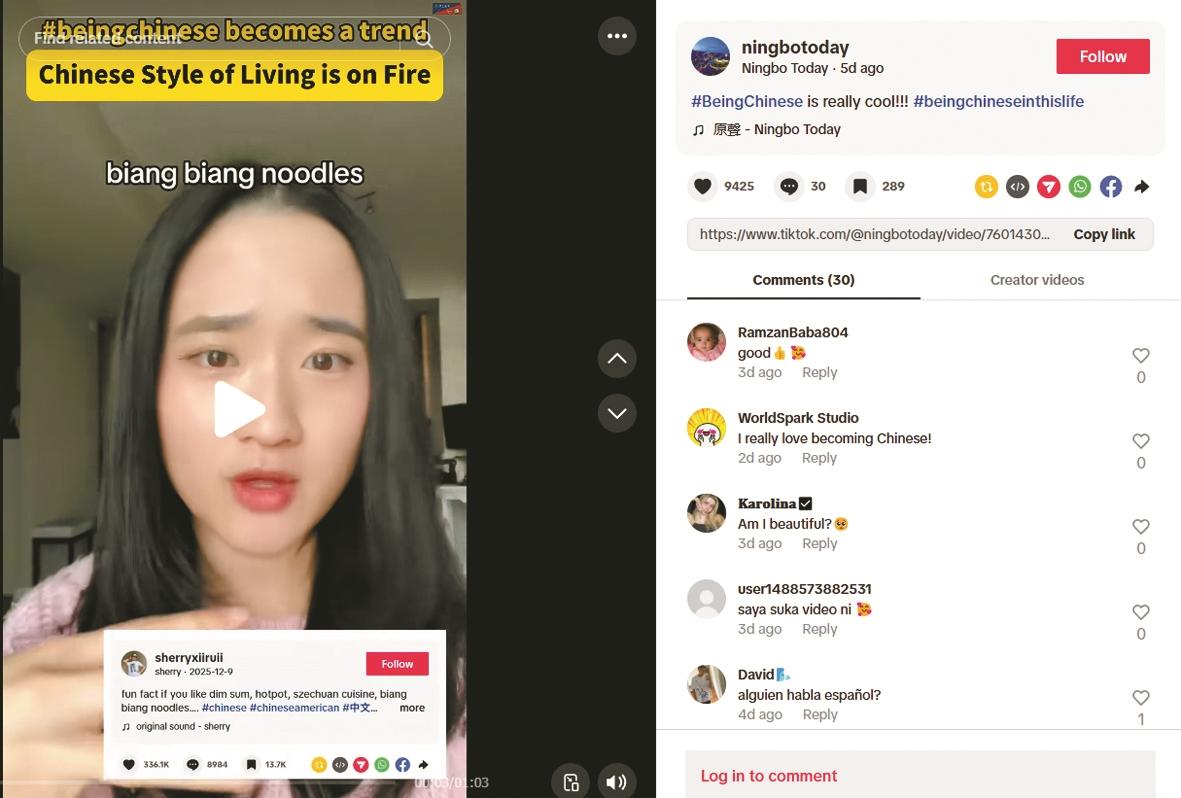

On TikTok, a short video titled "Being Chinese Is Really Cool!" has quietly crossed a million views. Produced by the Ningbo Daily Group International Communication Center, it taps into an unexpected global fascination: not geopolitics, not pandas or martial arts, but the everyday habits of ordinary Chinese life. Foreign viewers comment with curiosity and admiration. Some joke that they are "becoming Chinese." Others insist they already have.
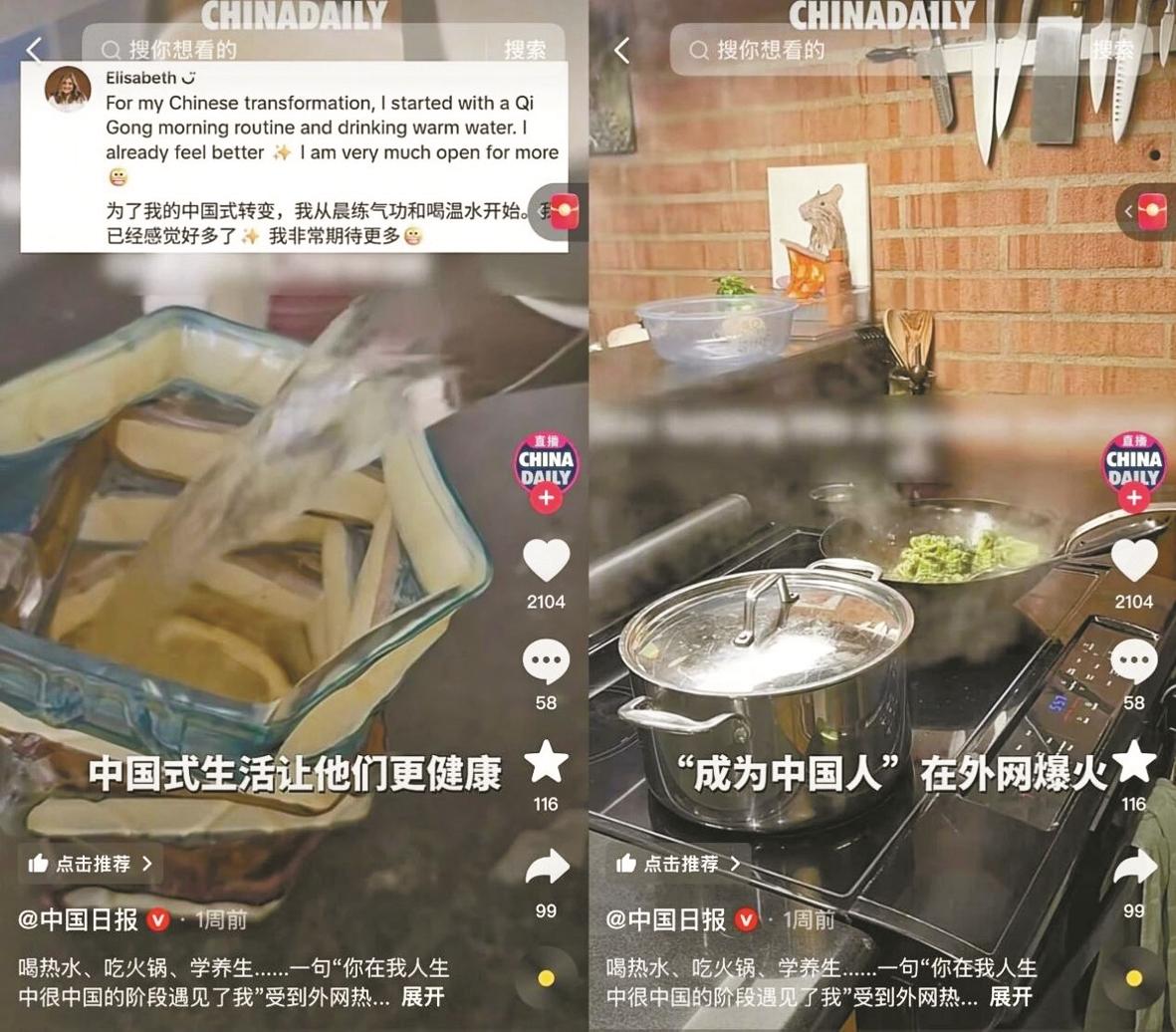
In recent months, international social media platforms have seen a surge of videos in which foreign users proudly document their adoption of "Chinese-style living." They sip hot water throughout the day, simmer soups and congee at home, practice Baduanjin exercises in the morning, and speak reverently of "Eastern wisdom" as a guide to health and balance. A popular line circulating online reads: "I'm glad I met you during such a 'Chinese' phase of my life."
The tone is affectionate, even aspirational. And it has struck a chord.
On Chinese social platforms, the trend has boomeranged back. Domestic users have begun "fact-checking" foreign interpretations of Chinese daily life, sharing their own routines and debating what counts as truly authentic. Memes and inside jokes have followed. What began as imitation has turned into dialogue.
At its core, the trend reflects a deeper change in how China is being encountered abroad: not through headlines, but through habits.
Take health for instance. In the United States, several wellness influencers have reframed the long-mocked Chinese admonition to "drink more hot water" as a practical lifestyle upgrade. One American posted that switching from iced drinks to hot water and ginger tea eased a stomach condition she had struggled with for years. Others swear by slow-cooked porridge for digestion or turn to traditional exercises for stress relief. On TikTok, lists titled "My Chinese Living Checklist" rack up views, offering step-by-step guides to routines once dismissed as quaint or old-fashioned.
Food has become another entry point. Foreign users frequently repost videos by Chinese food creators, recreating congee recipes in their own kitchens and sharing results with a global audience. One Chinese-American blogger ignited a viral wave by announcing, tongue firmly in cheek, "Starting tomorrow, you're going to become Chinese." Millions watched. The comments section filled with variations of the same refrain: "I'm already becoming Chinese."
Together, these videos have formed a loose but lively online subculture — one that celebrates Chinese daily life not as spectacle, but as something worth adopting. Influencers from around the world now specialize in showcasing "Chinese routines," building followings around small, repeatable practices rather than grand cultural symbols.
Travel has played a role, too. Some users point to China's 144-hour transit visa policy, which allowed them to experience the country firsthand. They arrived curious, even skeptical, and left surprised. What began as mimicry turned into sustained interest when they found that these practices — dietary habits, rhythms of daily life, digital conveniences — genuinely improved their well-being.
One American commenter put it bluntly: "Being Chinese seems cool — and healthy." Such remarks may be casual, but they point to a subtle recalibration of perception. When culture travels through lived practice rather than ideology, it lands more softly — and often more persuasively.
Conversations unfold around sleep schedules, diet, work-life balance, and family habits. Differences are noted, but rarely weaponized. What binds participants is a shared search for a better way to live.
The global resonance of Chinese daily life speaks to common anxieties of modern existence: how to slow down, how to care for the body, how to live with greater sustainability and warmth in today's world.
As the Spring Festival draws near, the “Becoming Chinese” trend has expanded beyond daily habits into festive fashion, cuisine, and traditional crafts. Overseas enthusiasts are now donning red clothing and accessories, attempting intangible cultural heritage workshops, and recreating celebratory dishes.
In Ningbo, this wave of cultural curiosity is playing out locally. Expats drawn to the “Becoming Chinese” trend are visiting neighborhoods and rural communities to celebrate their first Spring Festival alongside Chinese neighbors. They join in traditional crafts, sample festival foods, and soak in the holiday atmosphere — experiences that go beyond online mimicry and give tangible shape to their playful claim of “Becoming Chinese.” These real-world encounters show how the viral trend is evolving into a living cultural exchange, linking online fascination with authentic participation in Chinese life.
As the world comes to know China through a cup of hot water, China, too, sees itself more clearly reflected in that gaze. And in these ordinary, quietly meaningful encounters, the conversation between civilizations moves forward — not with fanfare, but with familiarity, toward a wider and more human horizon.
Source:
Zhejiang Xuanchuan,Yongpai
Translators:
Pan Wenjie, He Xinrui (intern)