


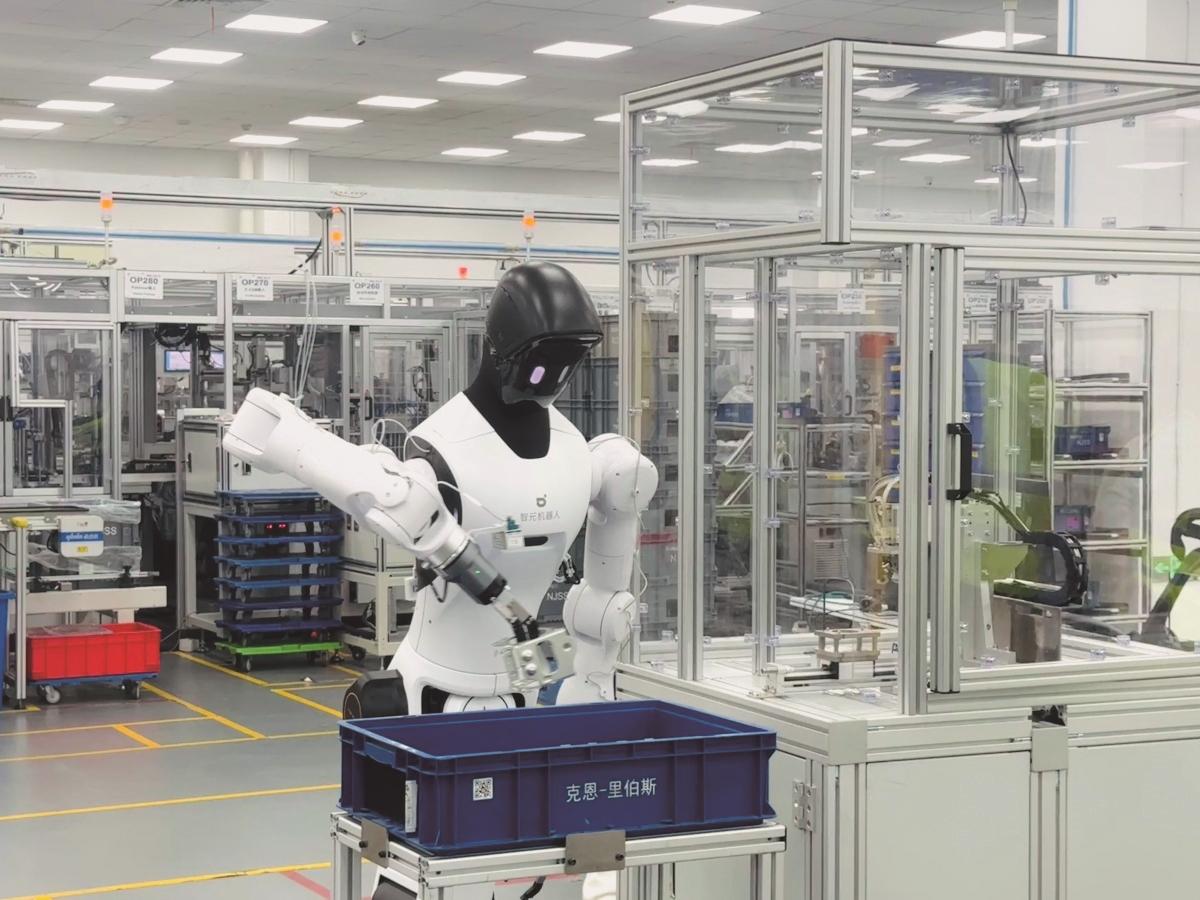
Humanoid robots developed in Ningbo are moving from research and testing into real-world industrial operations, with recent deployments in both overseas and domestic factories highlighting steady progress in embodied-intelligence and intelligent manufacturing.
At a production base operated by European home appliance manufacturer BEKO in Türkiye, the "Navigator 2" NAVIAI humanoid robot has been performing factory tasks continuously for four months. The robot was developed by the Zhejiang Humanoid Robot Innovation Center, which is based in Ningbo, east China's Zhejiang Province.
Inside the BEKO factory, the robot moves autonomously across the production floor, navigating between workstations involved in refrigerator manufacturing and inspection. At one station, it approaches a refrigerator's touchscreen interface and executes commands using a high-precision, lightweight humanoid arm. The touch accuracy of the robot reaches up to 0.1 millimeters, enabling it to interact reliably with electronic control panels. After completing touchscreen operations, the robot proceeds to another workstation, where it opens refrigerator doors and carries out a series of quality inspection tasks in a stable and orderly manner.
According to the Zhejiang Humanoid Robot Innovation Center, the sustained operation of Navigator 2 at the BEKO production base represents an early example of a domestically developed humanoid robot with autonomous decision-making capabilities being applied in an overseas industrial environment. The deployment demonstrates the robot's ability to function continuously within a real factory setting rather than under laboratory conditions.
The Zhejiang Humanoid Robot Innovation Center relocated to Ningbo two years ago. Since then, it has focused on research into key technologies related to humanoid embodied-intelligence robots, as well as product development and the promotion of industry applications. Over this period, the center has released three generations of humanoid robot products. These robots have already been deployed across multiple application scenarios within China, reflecting gradual expansion from research to practical use.
"The overseas deployment provided valuable experience in managing cross-border projects and adapting robotic systems to different industrial environments," a representative of the center said. The center plans to continue refining its products and service systems to support wider applications of domestically developed humanoid robots in global industrial settings.
While Ningbo-developed humanoid robots are gaining experience overseas, similar progress is also taking place on factory floors within China. On December 24, a humanoid embodied-intelligence robot known as “G2” began operating at a workstation inside the production facility of Ningbo Pia Automation's factory.
At Pia Automation's factory, G2 is used in the production of seatbelt products. The robot performs a key step in the manufacturing process by grasping aluminum components and placing them onto a tapping machine to create internal threads. This step had previously been completed manually by human workers.
According to the company, the original production rhythm for this workstation was about 18 seconds per cycle, meaning that one complete grasping and placement operation took approximately 18 seconds. After G2 was introduced, the same workstation achieved a production rhythm as fast as 12 seconds. The robot uses its claw-like end effector to handle the aluminum parts with precision, enabling faster and more consistent execution of the task.
Unlike traditional "machine replacement" approaches, where industrial robots are programmed to perform a single fixed operation using customized hardware and rigid control logic, humanoid embodied-intelligence robots such as G2 are designed to rely on built-in specialized models. These models allow the robot to gradually learn how to handle different types of components, product models, and work requirements.
As a result, humanoid embodied-intelligence robots can adapt to varying production conditions and respond to changes in tasks more flexibly. Over time, the robot can handle different operating scenarios in a way similar to an experienced worker who has accumulated practical knowledge on the production line.
He Chuan, Global R&D Director of Pia Automation, said that the company expects the G2 humanoid robot to become a regular part of its production line as early as January next year. He described the deployment as an important step forward for embodied-intelligence in the field of intelligent manufacturing.
In the past, intelligent manufacturing systems typically required factories to design fixed procedures and install specialized equipment to complete specific tasks. Such systems were efficient but lacked flexibility. According to He, the introduction of humanoid embodied-intelligence robots allows production lines to gain greater adaptability, enabling them to handle multiple tasks and changing requirements without extensive reconfiguration.
He further explained that humanoid embodied-intelligence robots can be regarded as flexible building blocks that can be deployed at different workstations and applied across a broader range of scenarios. This flexibility makes them suitable for a wider variety of manufacturing tasks and working environments.
Together, the overseas deployment of Navigator 2 and the domestic factory application of G2 illustrate the gradual integration of Ningbo-developed humanoid robots into real manufacturing processes. Rather than focusing on demonstration or experimental use, these robots are being tested through sustained operation on production lines, where reliability, precision, and adaptability are essential.
The two cases also reflect different stages of humanoid robot application. In Türkiye, Navigator 2 is performing inspection and interaction tasks in a home appliance manufacturing environment, while in China, G2 is directly involved in a key production process for automotive safety components. Both deployments emphasize stable operation and practical performance rather than symbolic or showcase functions.
As embodied-intelligence technologies continue to develop, Ningbo-produced humanoid robots are increasingly entering industrial settings, both domestically and internationally. These applications provide real-world data and operational experience that may inform future improvements in robot design, software models, and deployment strategies.
For now, the robots are working alongside human workers, handling specific tasks within clearly defined workflows. Their presence reflects ongoing efforts by Ningbo-based research centers and manufacturing enterprises to explore how humanoid robots can be integrated into modern production systems in a practical and measured way.
Journalists: Yin Cong, Zhang Heng,
Yang Ruijia, Sheng Tianzhou
Correspondents: Cui Ning,
Hong Yingying
Translator: Pan Wenjie