

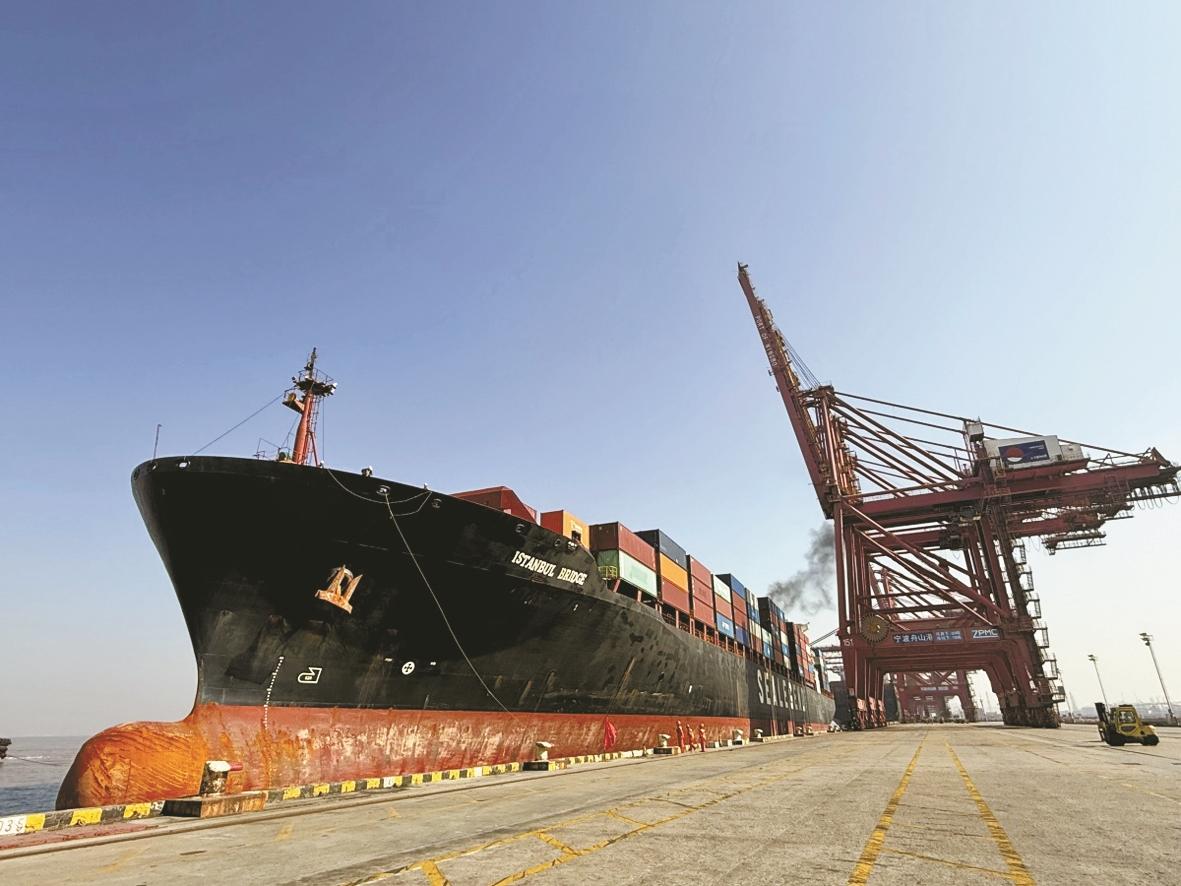
On December 6, after roughly two months at sea and more than ten port calls along the way, Istanbul Bridge, the first vessel on the China–Europe Arctic container express route successfully completed its maiden voyage and arrived at Ningbo Zhoushan Port.
The inaugural voyage of the new route has effectively opened a “third corridor” for China–Europe trade, a milestone in the effort to build out the core passage of the emerging “Ice Silk Road.”
The Istanbul Bridge, the vessel chosen for the maiden journey, carries a full-load capacity of 4,890 TEUs and is now the largest container ship ever to traverse the Arctic Ocean.
“The successful round trip of the Istanbul Bridge demonstrates that large container ships can safely and sustainably navigate the Northeast Passage,” the ship’s captain, Zhong Desheng, said.
The vessel left Ningbo Zhoushan Port on September 23, navigated the Arctic Northeast Passage, and reached its first European stop, Felixstowe in the United Kingdom, in just 20 days.
It then continued to Hamburg on October 15 and Gdansk on October 19, before completing all cargo operations in Rotterdam.
The route’s launch followed three years of preparation. Teams upgraded ship hardware, trained crew members for polar conditions, and refined meteorological and ice-navigation systems—steps that laid the groundwork for a viable Arctic trade corridor.
The challenges were significant: complex and shifting ice formations, unpredictable seas, and frequent, blinding fog. With a route that crossed 12 time zones, the crew also faced disrupted sleep cycles and the strain of extended polar travel.
To manage those risks, the team analyzed ice and weather patterns ahead of time, made real-time course adjustments, implemented strict rest schedules, and relied on polar-knowledge training and psychological support. The combination helped the crew navigate daunting conditions and complete the journey safely.
At each of the four European ports, Chinese and international partners coordinated smoothly. Local port authorities, pilots, and agents praised both the success of the voyage and the reliability of the new route.
While sailing up the Elbe River toward Hamburg, Captain Zhong recalled, a riverside plaza announced the ship’s maiden Arctic voyage over loudspeakers. When the announcement ended, the plaza played China’s national anthem. “It was a moment of immense pride,” he said.
As Zhong sees it, Ningbo Zhoushan Port, which served as both the departure point and the voyage’s final stop, was essential to the mission. Its full suite of port services, fast cargo handling, and end-to-end support ensured the success of the maiden journey.
Sea Legend Line Limited, the vessel’s operator, plans to move toward seasonal, more regular service on the China–Europe Arctic Express by 2026.
The company says it plans to focus on building a high-standard polar fleet, training a new generation of skilled polar mariners, and advancing the long-term development of this newly opened route in the coming years.
Journalists: Jin Lu, Sun Yuzhuo
Translator: Pan Wenjie