

By Jin Yuhan
The 16th Smart City and Intelligent Economy Expo was held in Ningbo from September 11 to 13. At this year's Expo, humanoid robots were doing far more than running and jumping. They assembled auto parts, sewed pockets onto jeans, loaded and unloaded raw materials, demonstrating how quickly the technology is developing into real-world industrial applications.
Humanoid Robots Take on Real-World Jobs
At the booth of Zhejiang Humanoid Robot Innovation Center Co., Ltd., the WA1 humanoid robot demonstrated its ability to handle multiple steps in garment production, from picking up fabric and aligning trouser pockets to coordinating sewing and stacking finished pieces. Working alongside sewing equipment, it can carry out the entire process—from identifying and grasping materials to positioning them for sewing—with the consistency needed for long, demanding shifts on an industrial production line.
"We have already introduced this pilot production line at several textile and apparel companies in China. It has been tested and shown to successfully perform individual tasks in specific production scenarios," said Ren Yecheng, a key account manager at the Zhejiang Humanoid Robot Innovation Center.
"Our competitive edge comes from years of experience in the sewing machine industry," said Qin Zhenhao, director of government and corporate business at Zhejiang Aitu Embodied Intelligence Technology Co., Ltd. He said Aitu's parent company, Jack Technology, has been a leading player in the industry for years and now accounts for nearly 40% of the global sewing machine market.
Drawing on its own big data and ongoing work in embodied intelligence since 2020, Zhejiang Aitu's humanoid robot can grasp and sew flexible fabrics and has completed pilot verification in China, Vietnam, Thailand and Brazil. In the second half of this year, the company also plans to work with Ningbo companies to roll out new applications for smart production lines, helping textile and apparel manufacturers upgrade their production processes through digital technologies and automation.
"Ningbo offers a wealth of opportunities for practical applications. We will accelerate the adoption of embodied intelligent robots in manufacturing and work with Ningbo companies to expand the industrial applications of these technologies," Qin said.
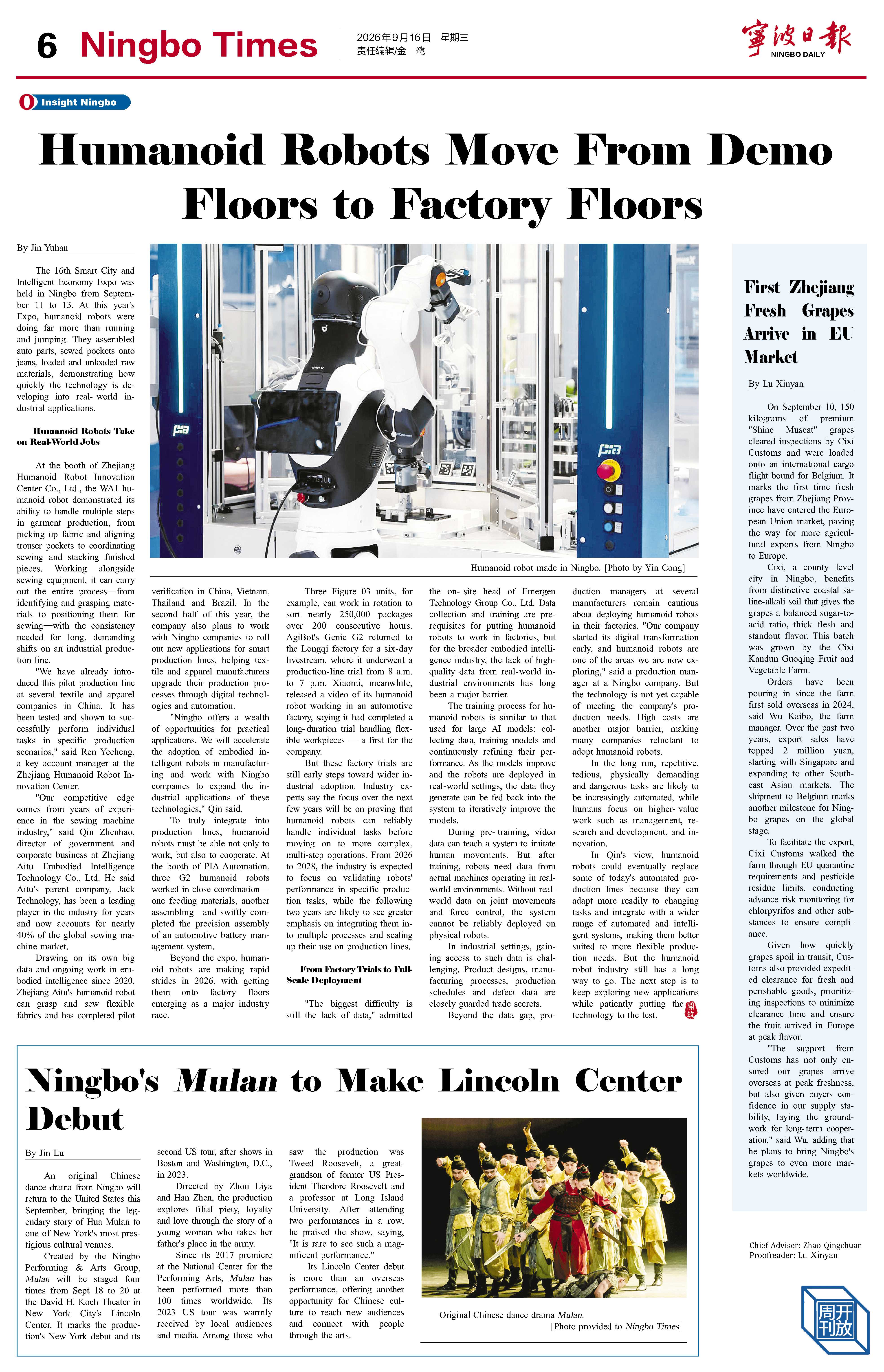
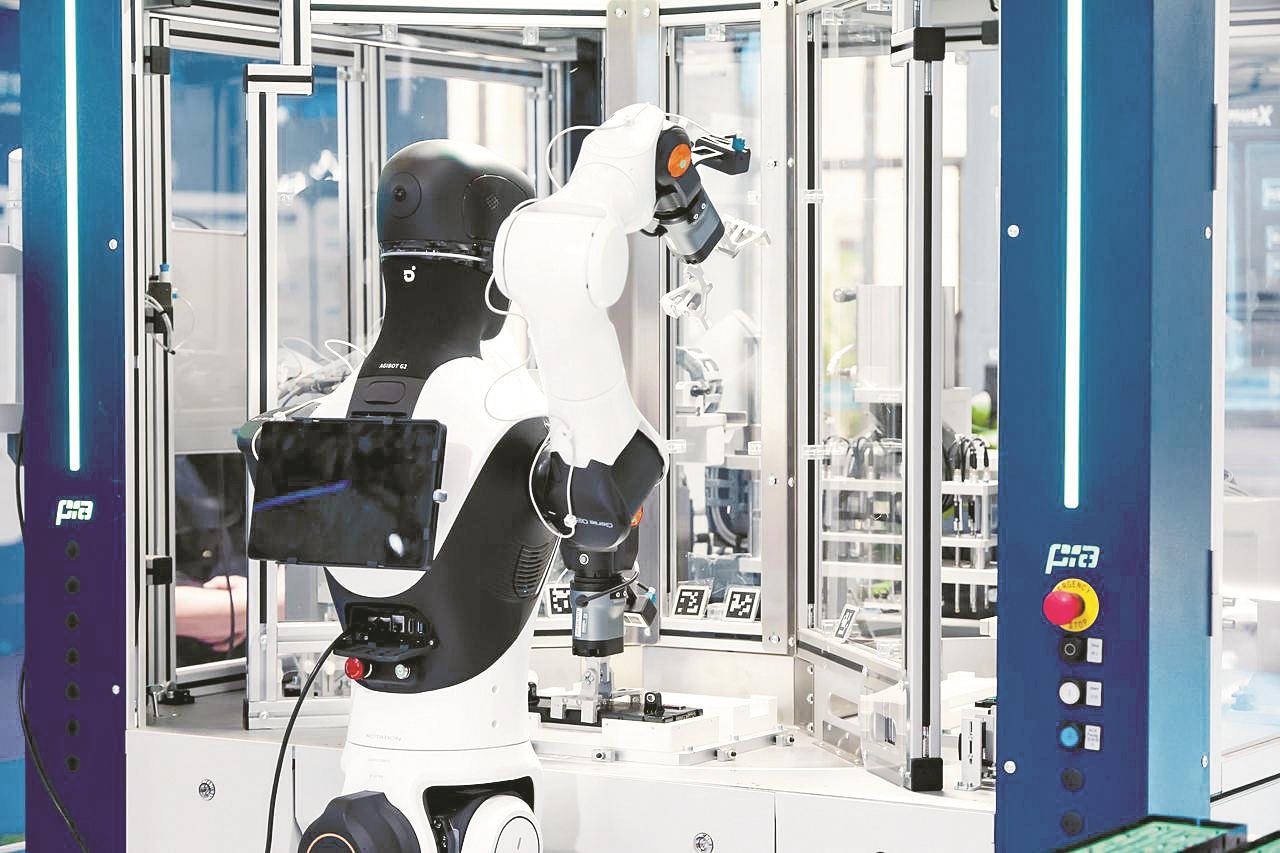
To truly integrate into production lines, humanoid robots must be able not only to work, but also to cooperate. At the booth of PIA Automation, three G2 humanoid robots worked in close coordination—one feeding materials, another assembling—and swiftly completed the precision assembly of an automotive battery management system.
Beyond the expo, humanoid robots are making rapid strides in 2026, with getting them onto factory floors emerging as a major industry race.
Three Figure 03 units, for example, can work in rotation to sort nearly 250,000 packages over 200 consecutive hours. AgiBot's Genie G2 returned to the Longqi factory for a six-day livestream, where it underwent a production-line trial from 8 a.m. to 7 p.m. Xiaomi, meanwhile, released a video of its humanoid robot working in an automotive factory, saying it had completed a long-duration trial handling flexible workpieces — a first for the company.
But these factory trials are still early steps toward wider industrial adoption. Industry experts say the focus over the next few years will be on proving that humanoid robots can reliably handle individual tasks before moving on to more complex, multi-step operations. From 2026 to 2028, the industry is expected to focus on validating robots' performance in specific production tasks, while the following two years are likely to see greater emphasis on integrating them into multiple processes and scaling up their use on production lines.
From Factory Trials to Full-Scale Deployment
"The biggest difficulty is still the lack of data," admitted the on-site head of Emergen Technology Group Co., Ltd. Data collection and training are prerequisites for putting humanoid robots to work in factories, but for the broader embodied intelligence industry, the lack of high-quality data from real-world industrial environments has long been a major barrier.
The training process for humanoid robots is similar to that used for large AI models: collecting data, training models and continuously refining their performance. As the models improve and the robots are deployed in real-world settings, the data they generate can be fed back into the system to iteratively improve the models.
During pre-training, video data can teach a system to imitate human movements. But after training, robots need data from actual machines operating in real-world environments. Without real-world data on joint movements and force control, the system cannot be reliably deployed on physical robots.
In industrial settings, gaining access to such data is challenging. Product designs, manufacturing processes, production schedules and defect data are closely guarded trade secrets.
Beyond the data gap, production managers at several manufacturers remain cautious about deploying humanoid robots in their factories. "Our company started its digital transformation early, and humanoid robots are one of the areas we are now exploring," said a production manager at a Ningbo company. But the technology is not yet capable of meeting the company's production needs. High costs are another major barrier, making many companies reluctant to adopt humanoid robots.
In the long run, repetitive, tedious, physically demanding and dangerous tasks are likely to be increasingly automated, while humans focus on higher-value work such as management, research and development, and innovation.
In Qin's view, humanoid robots could eventually replace some of today's automated production lines because they can adapt more readily to changing tasks and integrate with a wider range of automated and intelligent systems, making them better suited to more flexible production needs. But the humanoid robot industry still has a long way to go. The next step is to keep exploring new applications while patiently putting the technology to the test.