

By Jin Yuhan
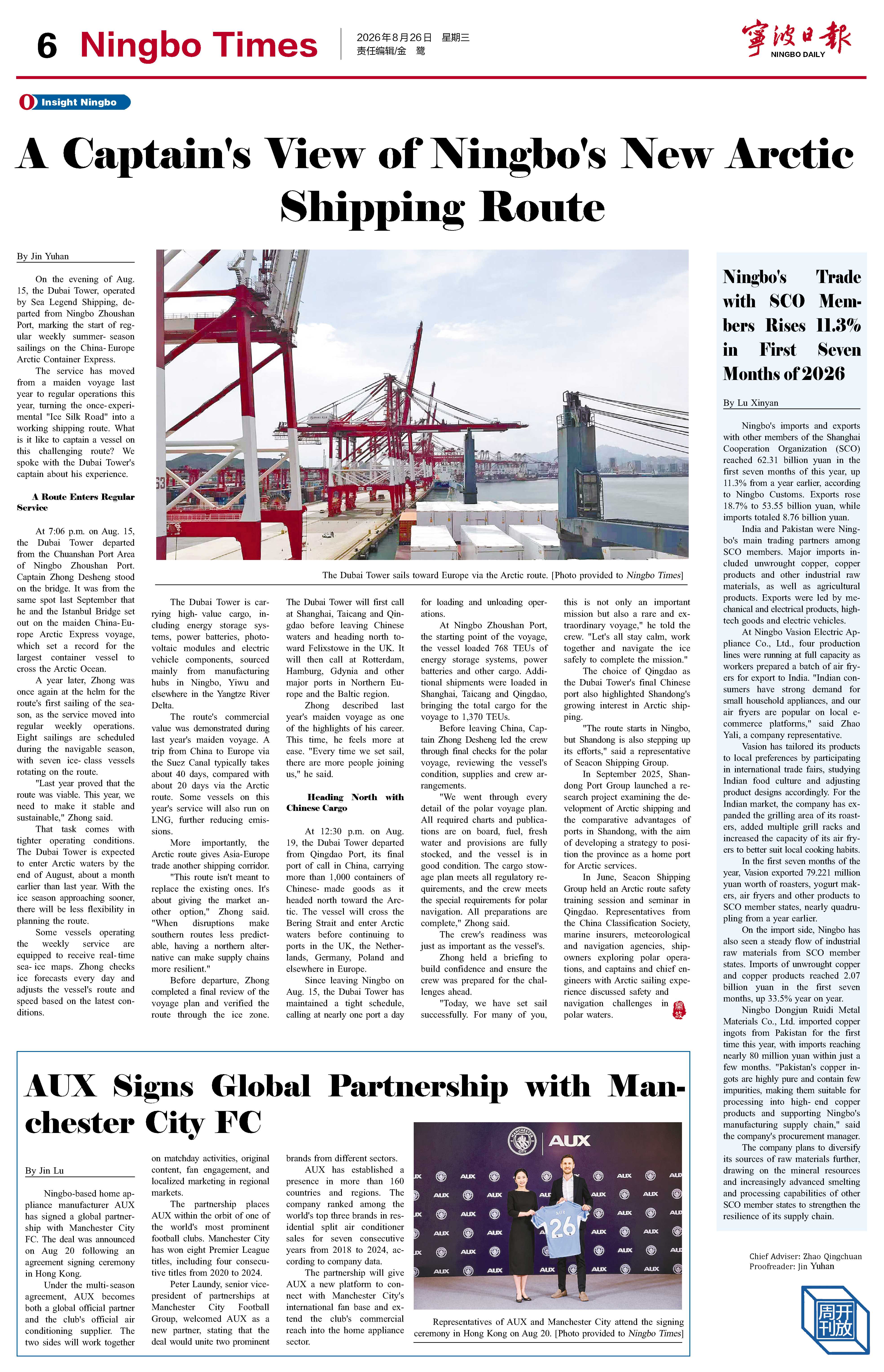
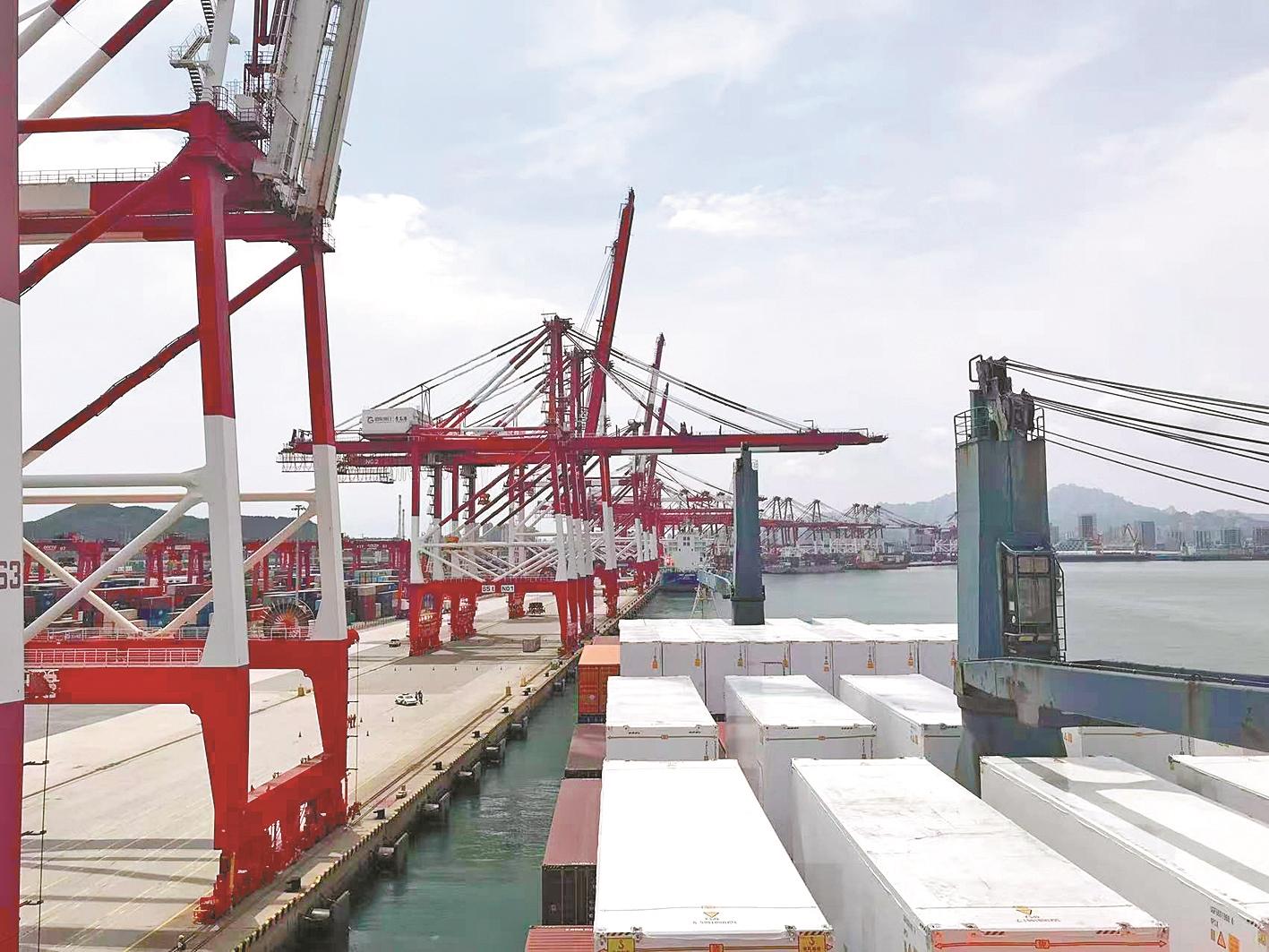
On the evening of Aug. 15, the Dubai Tower, operated by Sea Legend Shipping, departed from Ningbo Zhoushan Port, marking the start of regular weekly summer-season sailings on the China-Europe Arctic Container Express.
The service has moved from a maiden voyage last year to regular operations this year, turning the once-experimental "Ice Silk Road" into a working shipping route. What is it like to captain a vessel on this challenging route? We spoke with the Dubai Tower's captain about his experience.
A Route Enters Regular Service
At 7:06 p.m. on Aug. 15, the Dubai Tower departed from the Chuanshan Port Area of Ningbo Zhoushan Port. Captain Zhong Desheng stood on the bridge. It was from the same spot last September that he and the Istanbul Bridge set out on the maiden China-Europe Arctic Express voyage, which set a record for the largest container vessel to cross the Arctic Ocean.
A year later, Zhong was once again at the helm for the route's first sailing of the season, as the service moved into regular weekly operations. Eight sailings are scheduled during the navigable season, with seven ice-class vessels rotating on the route.
"Last year proved that the route was viable. This year, we need to make it stable and sustainable," Zhong said.
That task comes with tighter operating conditions. The Dubai Tower is expected to enter Arctic waters by the end of August, about a month earlier than last year. With the ice season approaching sooner, there will be less flexibility in planning the route.
Some vessels operating the weekly service are equipped to receive real-time sea-ice maps. Zhong checks ice forecasts every day and adjusts the vessel's route and speed based on the latest conditions.
The Dubai Tower is carrying high-value cargo, including energy storage systems, power batteries, photovoltaic modules and electric vehicle components, sourced mainly from manufacturing hubs in Ningbo, Yiwu and elsewhere in the Yangtze River Delta.
The route's commercial value was demonstrated during last year's maiden voyage. A trip from China to Europe via the Suez Canal typically takes about 40 days, compared with about 20 days via the Arctic route. Some vessels on this year's service will also run on LNG, further reducing emissions.
More importantly, the Arctic route gives Asia-Europe trade another shipping corridor.
"This route isn't meant to replace the existing ones. It's about giving the market another option," Zhong said. "When disruptions make southern routes less predictable, having a northern alternative can make supply chains more resilient."
Before departure, Zhong completed a final review of the voyage plan and verified the route through the ice zone. The Dubai Tower will first call at Shanghai, Taicang and Qingdao before leaving Chinese waters and heading north toward Felixstowe in the UK. It will then call at Rotterdam, Hamburg, Gdynia and other major ports in Northern Europe and the Baltic region.
Zhong described last year's maiden voyage as one of the highlights of his career. This time, he feels more at ease. "Every time we set sail, there are more people joining us," he said.
Heading North with Chinese Cargo
At 12:30 p.m. on Aug. 19, the Dubai Tower departed from Qingdao Port, its final port of call in China, carrying more than 1,000 containers of Chinese-made goods as it headed north toward the Arctic. The vessel will cross the Bering Strait and enter Arctic waters before continuing to ports in the UK, the Netherlands, Germany, Poland and elsewhere in Europe.
Since leaving Ningbo on Aug. 15, the Dubai Tower has maintained a tight schedule, calling at nearly one port a day for loading and unloading operations.
At Ningbo Zhoushan Port, the starting point of the voyage, the vessel loaded 768 TEUs of energy storage systems, power batteries and other cargo. Additional shipments were loaded in Shanghai, Taicang and Qingdao, bringing the total cargo for the voyage to 1,370 TEUs.
Before leaving China, Captain Zhong Desheng led the crew through final checks for the polar voyage, reviewing the vessel's condition, supplies and crew arrangements.
"We went through every detail of the polar voyage plan. All required charts and publications are on board, fuel, fresh water and provisions are fully stocked, and the vessel is in good condition. The cargo stowage plan meets all regulatory requirements, and the crew meets the special requirements for polar navigation. All preparations are complete," Zhong said.
The crew's readiness was just as important as the vessel's.
Zhong held a briefing to build confidence and ensure the crew was prepared for the challenges ahead.
"Today, we have set sail successfully. For many of you, this is not only an important mission but also a rare and extraordinary voyage," he told the crew. "Let's all stay calm, work together and navigate the ice safely to complete the mission."
The choice of Qingdao as the Dubai Tower's final Chinese port also highlighted Shandong's growing interest in Arctic shipping.
"The route starts in Ningbo, but Shandong is also stepping up its efforts," said a representative of Seacon Shipping Group.
In September 2025, Shandong Port Group launched a research project examining the development of Arctic shipping and the comparative advantages of ports in Shandong, with the aim of developing a strategy to position the province as a home port for Arctic services.
In June, Seacon Shipping Group held an Arctic route safety training session and seminar in Qingdao. Representatives from the China Classification Society, marine insurers, meteorological and navigation agencies, shipowners exploring polar operations, and captains and chief engineers with Arctic sailing experience discussed safety and navigation challenges in polar waters.