

By Zhao Yu
Ningbo's economy maintained steady growth in the first half of 2026, with its GDP rising 5.4% year on year, according to figures released on July 23.
While growth eased from earlier in the year, the slowdown was smaller than both the national and Zhejiang provincial averages. "Given the current global geopolitical environment, these results were hard-won," said Xu Haiyan, deputy director of the Ningbo Municipal Statistics Bureau.
The latest figures suggest the city's economy remained resilient in the first half of the year, with growth stabilizing, new sources of momentum gaining strength and economic fundamentals continuing to improve.
Industry Continues to Anchor Growth
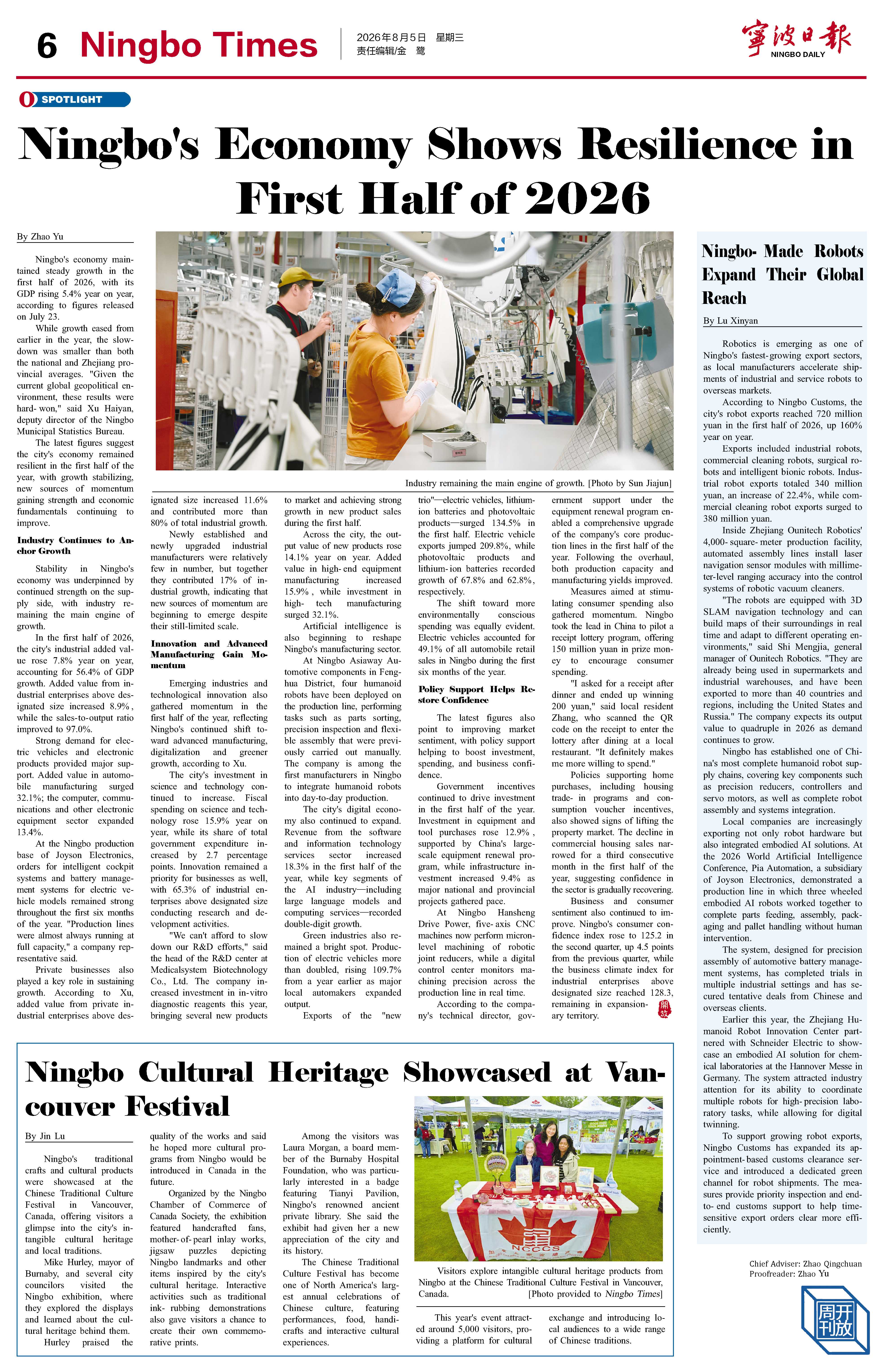
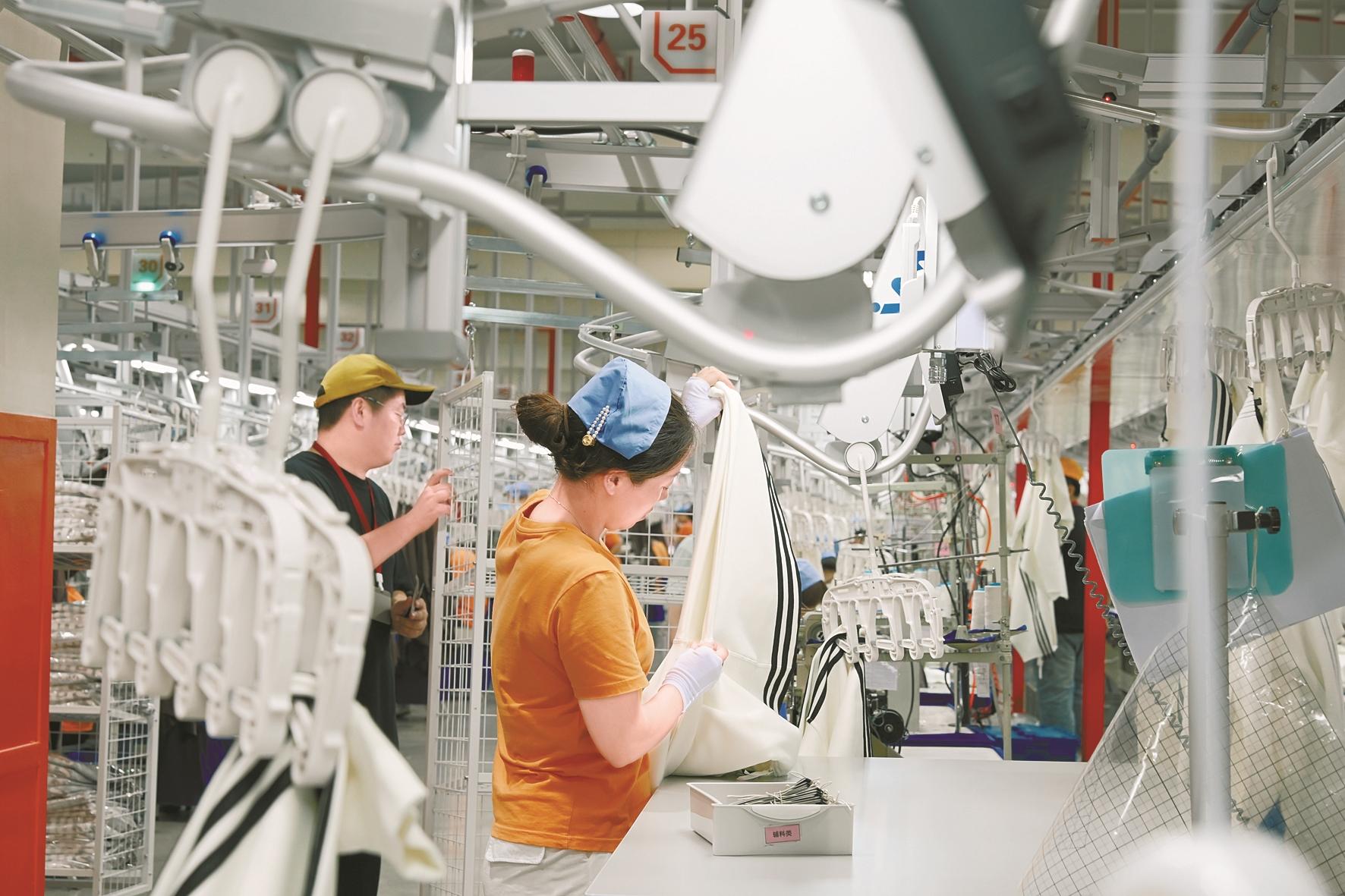
Stability in Ningbo's economy was underpinned by continued strength on the supply side, with industry remaining the main engine of growth.
In the first half of 2026, the city's industrial added value rose 7.8% year on year, accounting for 56.4% of GDP growth. Added value from industrial enterprises above designated size increased 8.9%, while the sales-to-output ratio improved to 97.0%.
Strong demand for electric vehicles and electronic products provided major support. Added value in automobile manufacturing surged 32.1%; the computer, communications and other electronic equipment sector expanded 13.4%.
At the Ningbo production base of Joyson Electronics, orders for intelligent cockpit systems and battery management systems for electric vehicle models remained strong throughout the first six months of the year. "Production lines were almost always running at full capacity," a company representative said.
Private businesses also played a key role in sustaining growth. According to Xu, added value from private industrial enterprises above designated size increased 11.6% and contributed more than 80% of total industrial growth.
Newly established and newly upgraded industrial manufacturers were relatively few in number, but together they contributed 17% of industrial growth, indicating that new sources of momentum are beginning to emerge despite their still-limited scale.
Innovation and Advanced Manufacturing Gain Momentum
Emerging industries and technological innovation also gathered momentum in the first half of the year, reflecting Ningbo's continued shift toward advanced manufacturing, digitalization and greener growth, according to Xu.
The city's investment in science and technology continued to increase. Fiscal spending on science and technology rose 15.9% year on year, while its share of total government expenditure increased by 2.7 percentage points. Innovation remained a priority for businesses as well, with 65.3% of industrial enterprises above designated size conducting research and development activities.
"We can't afford to slow down our R&D efforts," said the head of the R&D center at Medicalsystem Biotechnology Co., Ltd. The company increased investment in in-vitro diagnostic reagents this year, bringing several new products to market and achieving strong growth in new product sales during the first half.
Across the city, the output value of new products rose 14.1% year on year. Added value in high-end equipment manufacturing increased 15.9%, while investment in high-tech manufacturing surged 32.1%.
Artificial intelligence is also beginning to reshape Ningbo's manufacturing sector.
At Ningbo Asiaway Automotive components in Fenghua District, four humanoid robots have been deployed on the production line, performing tasks such as parts sorting, precision inspection and flexible assembly that were previously carried out manually. The company is among the first manufacturers in Ningbo to integrate humanoid robots into day-to-day production.
The city's digital economy also continued to expand. Revenue from the software and information technology services sector increased 18.3% in the first half of the year, while key segments of the AI industry—including large language models and computing services—recorded double-digit growth.
Green industries also remained a bright spot. Production of electric vehicles more than doubled, rising 109.7% from a year earlier as major local automakers expanded output.
Exports of the "new trio"—electric vehicles, lithium-ion batteries and photovoltaic products—surged 134.5% in the first half. Electric vehicle exports jumped 209.8%, while photovoltaic products and lithium-ion batteries recorded growth of 67.8% and 62.8%, respectively.
The shift toward more environmentally conscious spending was equally evident. Electric vehicles accounted for 49.1% of all automobile retail sales in Ningbo during the first six months of the year.
Policy Support Helps Restore Confidence
The latest figures also point to improving market sentiment, with policy support helping to boost investment, spending, and business confidence.
Government incentives continued to drive investment in the first half of the year. Investment in equipment and tool purchases rose 12.9%, supported by China's large-scale equipment renewal program, while infrastructure investment increased 9.4% as major national and provincial projects gathered pace.
At Ningbo Hansheng Drive Power, five-axis CNC machines now perform micron-level machining of robotic joint reducers, while a digital control center monitors machining precision across the production line in real time.
According to the company's technical director, government support under the equipment renewal program enabled a comprehensive upgrade of the company's core production lines in the first half of the year. Following the overhaul, both production capacity and manufacturing yields improved.
Measures aimed at stimulating consumer spending also gathered momentum. Ningbo took the lead in China to pilot a receipt lottery program, offering 150 million yuan in prize money to encourage consumer spending.
"I asked for a receipt after dinner and ended up winning 200 yuan," said local resident Zhang, who scanned the QR code on the receipt to enter the lottery after dining at a local restaurant. "It definitely makes me more willing to spend."
Policies supporting home purchases, including housing trade-in programs and consumption voucher incentives, also showed signs of lifting the property market. The decline in commercial housing sales narrowed for a third consecutive month in the first half of the year, suggesting confidence in the sector is gradually recovering.
Business and consumer sentiment also continued to improve. Ningbo's consumer confidence index rose to 125.2 in the second quarter, up 4.5 points from the previous quarter, while the business climate index for industrial enterprises above designated size reached 128.3, remaining in expansionary territory.