
By Jin Yuhan
As embodied AI moves into commercial use, Ningbo companies are proving that some of the biggest opportunities lie in highly specialized tasks. From factory production lines to public spaces, locally developed embodied AI robots are demonstrating how the technology is moving beyond prototypes and into real-world deployment.
Here's a look at several Ningbo-developed robots and the roles they are beginning to play in industry and everyday life.
Learning the Skills of a Master Tailor
My name is "Sewing Jack", and I was built in Ningbo. Every morning at 9 AM, I report for work inside the Embodied Intelligence Validation Center at Zhejiang Humanoid Robot Innovation Center in Haishu District. My daily routine is fairly straightforward: pick up fabric, align it, feed it into the machine, cut, and repeat.
For experienced tailors, these are skills honed over years on the factory floor. For me, they're the skills I was designed to learn.
The company that created me was established in Ningbo at the end of 2023 and officially began operations in March 2024. It is led by Professor Xiong Rong of Zhejiang University, who has spent nearly 26 years researching robotics.
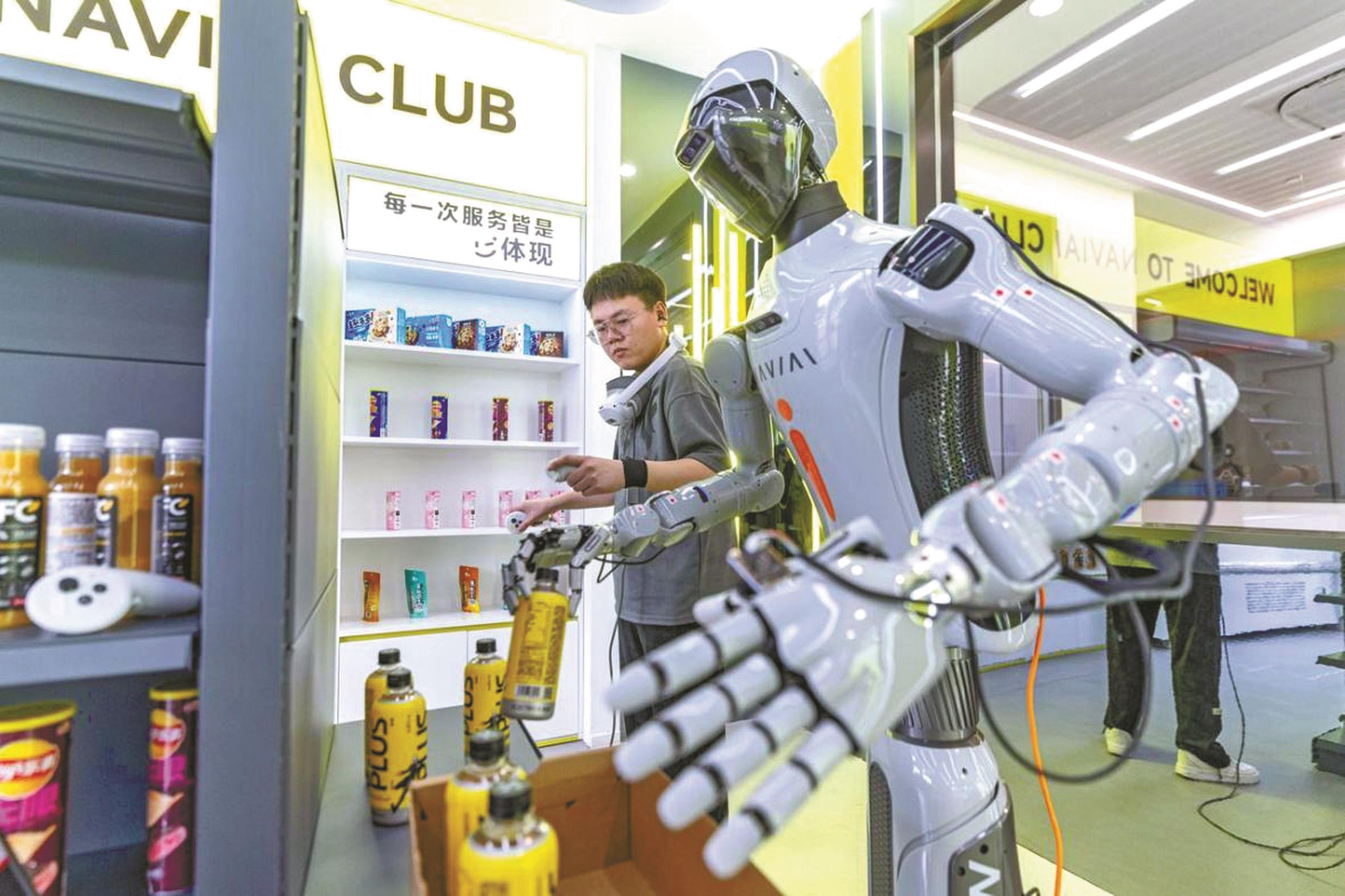
Last September, my developers gave me a major upgrade—new hardware, new software and, as they like to say, a new "brain". I'm 1.8 meters tall, built to handle uneven terrain, and can walk at speeds of up to 9 km/h. My computing unit sits inside my torso, while my favorite feature is undoubtedly my hands. Weighing just 400 grams, they're equipped with tactile sensing technology and designed to perform up to 300,000 operating cycles.
I'm not the only robot on the training floor. Two NAVIAI i2 robots work nearby. One is older than me, a collaboration between the Center and SUPCON Technology. The other one is younger; it spends its days tightening screws. Across from us is NAVIAI WA1, a laboratory robot that measures chemical reagents and performs testing with remarkable patience.
Although our jobs differ, we all share the same mission: industrial manufacturing. According to Professor Xiong's team, that's exactly why the center was established in Ningbo. The city's vast manufacturing sector provides a wide range of real industrial environments where robots like us can be trained, tested and improved.
Today, about 42% of the components used in me and my robotic coworkers come from suppliers in Ningbo.
Industry observers have dubbed 2025 the first year of embodied AI commercialization. While some robots have attracted attention with flashy demonstrations, my colleagues and I have been focused on something less glamorous: learning to do factory work.
We've already achieved operational precision of 0.03 millimeters and a 99.99% success rate on Huawei production lines. Our next assignment is even more challenging. At garment factories, we'll learn to separate layers of fabric, smooth wrinkles and align materials—tasks that remain difficult for automated systems.
My training is almost complete. Soon, I'll graduate from the testing center and head to work full time. Around 2,000 robots like me are expected to be deployed at factories in Taizhou.
The Robot That Never Leaves the Pool
I'm a pool cleaning robot.Unlike human workers, I don't need to surface for air or take breaks. Once I enter the water, I can keep working around the clock.
My creators at Ningbo Wancheng Intelligent Technology Co., Ltd. have always had a clear philosophy: forget flashy demonstrations—focus on real underwater environments and solve real problems.
That means my job description is simple: clean better. The team has spent years improving the abilities that matter most in a pool: suction power, waterproof sealing, cable management, wall-climbing capability and cleaning efficiency. I can collect underwater debris, pump water automatically, filter surface contaminants and even support water-feature functions.
The approach appears to be paying off. In the first half of this year, my sales already exceeded the total for all of last year, with growing demand from both Chinese and international markets.
Before robots like me entered the scene, the high-end pool cleaning market was largely dominated by overseas brands, often with hefty price tags. The team at Wancheng decided there was room for a Chinese alternative—one that could offer stronger performance and better value.
The journey was far from easy. It took three to four years of development and more than 10 million yuan before I became ready for the market. Engineers repeatedly refined my structure, materials, sealing systems and functions through countless rounds of testing.
My earliest version had a useful skill: climbing ceramic tile walls. But it struggled when it encountered smoother surfaces such as glass. So the engineers went back to the drawing board.They arrived at an outdoor test pool early every morning, adjusting my weight distribution and propulsion system again and again. More than a dozen chassis designs were tested and discarded before the team settled on a front-and-rear differentiated wheel structure that improved my mobility.
The upgrades continued. After redesigning my materials and running durability tests for three years, my improved rubber components can remain stable without deformation, allowing me to climb vertical cement, acrylic and glass surfaces at a 90-degree angle.
Then came another challenge: tangled cables.The team spent another three years developing a 360-degree underwater anti-tangle swivel joint, a core technology designed to keep me moving freely even in complex underwater environments.
This week, a major US customer visited our factory for an in-person evaluation. After examining my performance, the company expressed strong interest and is expected to place large orders.
You might think pool cleaning is a niche business. In reality, it is a sizeable global market.The worldwide swimming pool market is valued at more than 10 billion yuan, growing at an annual rate of about 17 percent. My job may be humble, but the market I serve is anything but small.