

By Jin Yuhan
Journalists from media outlets across Europe and Asia recently visited Ningbo on a reporting tour focused on the city's manufacturing sector and industrial transformation.
The delegation included reporters from the United Kingdom, France, Italy, Japan and Singapore. Their coverage has generated more than 500 reports, offering international audiences a closer look at Ningbo's economic development, industrial upgrading and growing global connections.
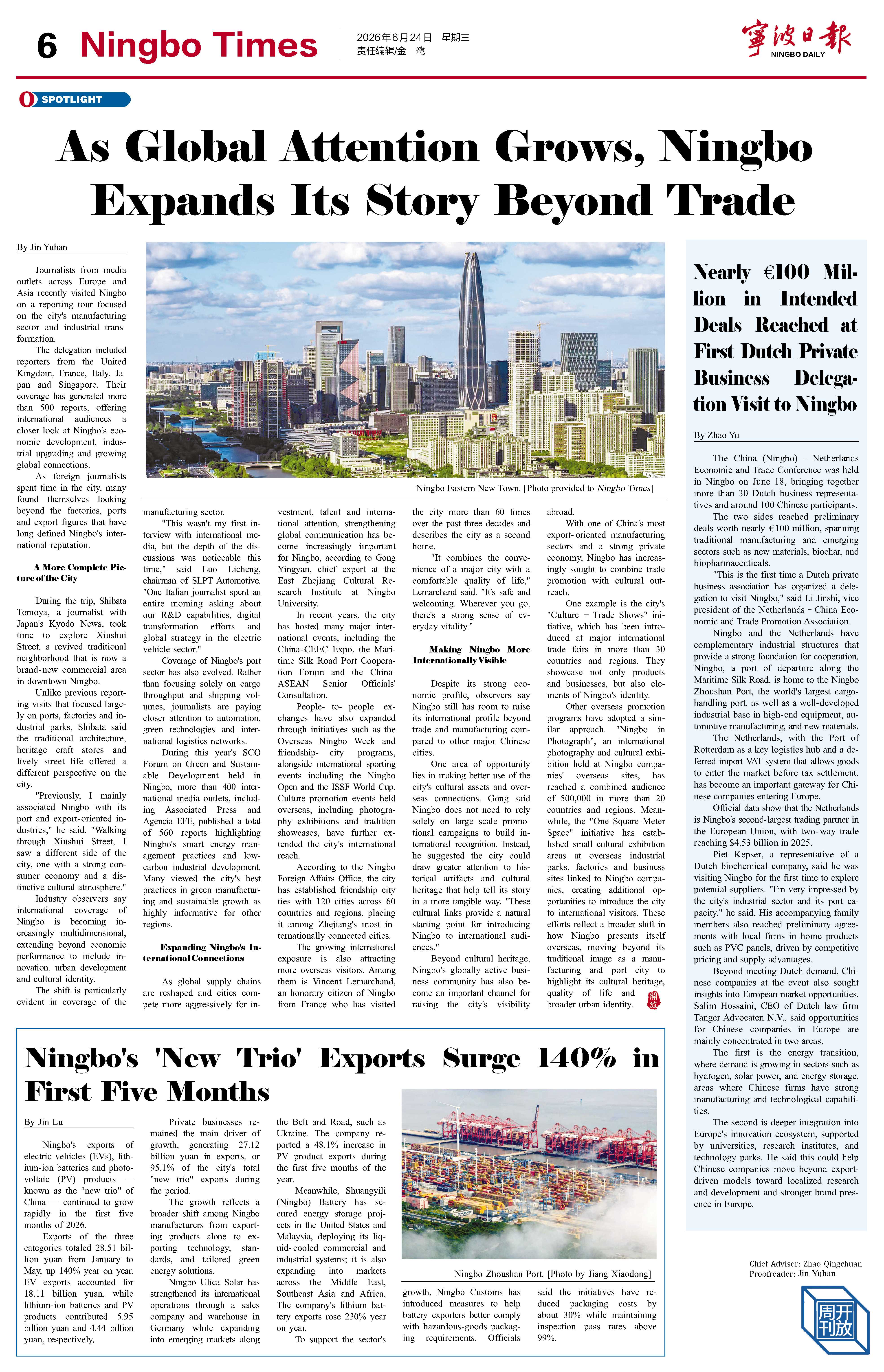
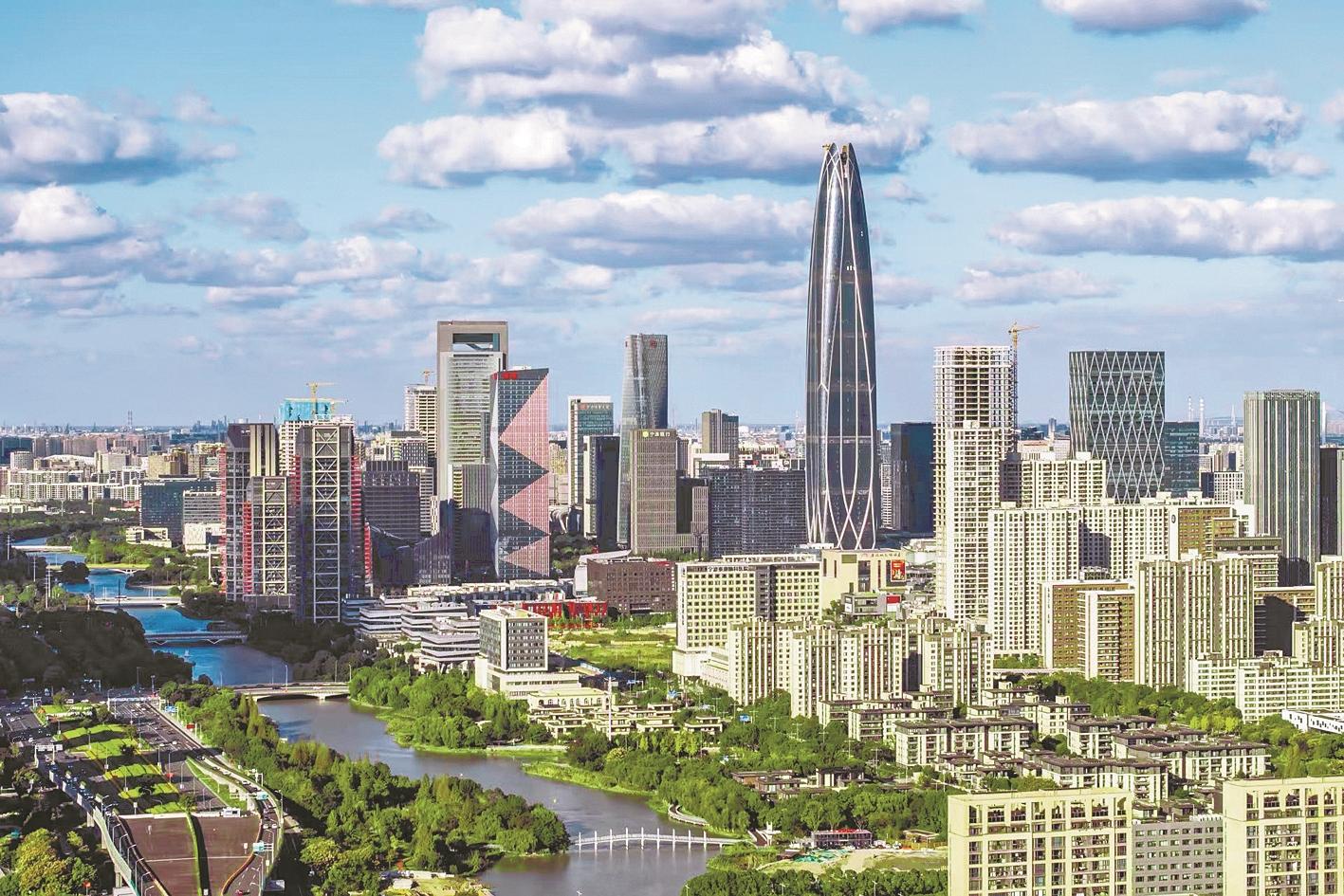
As foreign journalists spent time in the city, many found themselves looking beyond the factories, ports and export figures that have long defined Ningbo's international reputation.
A More Complete Picture of the City
During the trip, Shibata Tomoya, a journalist with Japan's Kyodo News, took time to explore Xiushui Street, a revived traditional neighborhood that is now a brand-new commercial area in downtown Ningbo.
Unlike previous reporting visits that focused largely on ports, factories and industrial parks, Shibata said the traditional architecture, heritage craft stores and lively street life offered a different perspective on the city.
"Previously, I mainly associated Ningbo with its port and export-oriented industries," he said. "Walking through Xiushui Street, I saw a different side of the city, one with a strong consumer economy and a distinctive cultural atmosphere."
Industry observers say international coverage of Ningbo is becoming increasingly multidimensional, extending beyond economic performance to include innovation, urban development and cultural identity.
The shift is particularly evident in coverage of the manufacturing sector.
"This wasn't my first interview with international media, but the depth of the discussions was noticeable this time," said Luo Licheng, chairman of SLPT Automotive. "One Italian journalist spent an entire morning asking about our R&D capabilities, digital transformation efforts and global strategy in the electric vehicle sector."
Coverage of Ningbo's port sector has also evolved. Rather than focusing solely on cargo throughput and shipping volumes, journalists are paying closer attention to automation, green technologies and international logistics networks.
During this year's SCO Forum on Green and Sustainable Development held in Ningbo, more than 400 international media outlets, including Associated Press and Agencia EFE, published a total of 560 reports highlighting Ningbo's smart energy management practices and low-carbon industrial development. Many viewed the city's best practices in green manufacturing and sustainable growth as highly informative for other regions.
Expanding Ningbo's International Connections
As global supply chains are reshaped and cities compete more aggressively for investment, talent and international attention, strengthening global communication has become increasingly important for Ningbo, according to Gong Yingyan, chief expert at the East Zhejiang Cultural Research Institute at Ningbo University.
In recent years, the city has hosted many major international events, including the China-CEEC Expo, the Maritime Silk Road Port Cooperation Forum and the China-ASEAN Senior Officials' Consultation.
People-to-people exchanges have also expanded through initiatives such as the Overseas Ningbo Week and friendship-city programs, alongside international sporting events including the Ningbo Open and the ISSF World Cup. Culture promotion events held overseas, including photography exhibitions and tradition showcases, have further extended the city's international reach.
According to the Ningbo Foreign Affairs Office, the city has established friendship city ties with 120 cities across 60 countries and regions, placing it among Zhejiang's most internationally connected cities.
The growing international exposure is also attracting more overseas visitors. Among them is Vincent Lemarchand, an honorary citizen of Ningbo from France who has visited the city more than 60 times over the past three decades and describes the city as a second home.
"It combines the convenience of a major city with a comfortable quality of life," Lemarchand said. "It's safe and welcoming. Wherever you go, there's a strong sense of everyday vitality."
Making Ningbo More Internationally Visible
Despite its strong economic profile, observers say Ningbo still has room to raise its international profile beyond trade and manufacturing compared to other major Chinese cities.
One area of opportunity lies in making better use of the city's cultural assets and overseas connections. Gong said Ningbo does not need to rely solely on large-scale promotional campaigns to build international recognition. Instead, he suggested the city could draw greater attention to historical artifacts and cultural heritage that help tell its story in a more tangible way. "These cultural links provide a natural starting point for introducing Ningbo to international audiences."
Beyond cultural heritage, Ningbo's globally active business community has also become an important channel for raising the city's visibility abroad.
With one of China's most export-oriented manufacturing sectors and a strong private economy, Ningbo has increasingly sought to combine trade promotion with cultural outreach.
One example is the city's "Culture + Trade Shows" initiative, which has been introduced at major international trade fairs in more than 30 countries and regions. They showcase not only products and businesses, but also elements of Ningbo's identity.
Other overseas promotion programs have adopted a similar approach. "Ningbo in Photograph", an international photography and cultural exhibition held at Ningbo companies' overseas sites, has reached a combined audience of 500,000 in more than 20 countries and regions. Meanwhile, the "One-Square-Meter Space" initiative has established small cultural exhibition areas at overseas industrial parks, factories and business sites linked to Ningbo companies, creating additional opportunities to introduce the city to international visitors. These efforts reflect a broader shift in how Ningbo presents itself overseas, moving beyond its traditional image as a manufacturing and port city to highlight its cultural heritage, quality of life and broader urban identity.