

By Jin Yuhan
Nearly 30 journalists from media outlets in Europe and Asia, along with reporters from Chinese state media, visited Ningbo from June 2 to 3 for a reporting tour focused on the city's manufacturing sector and global expansion.
The delegation included journalists from the UK, France, Italy, Japan and Singapore, as well as Xinhua News Agency and CGTN. They visited a range of local companies across the city.
During the trip, reporters asked company executives about intensifying competition in global manufacturing, rising trade barriers, and the pace of technological upgrading. Executives said local firms are pursuing differentiated strategies to stay ahead as they adapt to new challenges, including faster R&D cycles, rising trade barriers, and fierce competition in the global manufacturing landscape.
Competing Beyond Price
"How can companies avoid competing solely on price when every sector is facing intense competition, especially in auto parts?" a visiting journalist asked during a tour of SLPT Automotive.
For Luo Licheng, chairman of SLPT Automotive, the answer lies in innovation. "Price competition exists in every industry. The automotive market remains enormous. We believe in transforming innovation into product value."
To stay ahead, the company is upgrading traditional product lines while using the latest technologies to manufacture electric car parts. The strategy, Luo said, is to differentiate through innovation rather than compete on price alone.
Consinee Group has taken a different approach. In the highly competitive textile industry, the company has strengthened its position by focusing on quality control and supply chain management. "The business environment has been challenging this year, and many companies in the industry have seen orders decline," said Xue Zhengli, president of Consinee Group. "But our order books remain full, and we continue to receive a steady stream of high-value orders."
According to Xue, the company oversees quality from the source, selecting premium cashmere directly from the best pastoral regions and maintaining strict standards throughout production. Combined with years of brand-building in international markets, that reputation has helped the company attract large orders from clients around the world.
Going Global Beyond Exports
As global trade becomes increasingly unpredictable, a recurring question from both Chinese and international journalists was how Ningbo manufacturers are moving beyond the traditional model of making products in China and selling them overseas, while reducing their exposure to market volatility.
For Wang Xianggui, chairman of Soundking Group, actively going global has been an effective way to gain access to new technology, expand distribution networks, and build up the company's international profile.
When the global financial crisis hit Europe and the US in 2008, several long-established British sound equipment brands were hit hard. Soundking moved quickly, acquiring three well-known British manufacturers within a matter of months.
Today, overseas markets account for 65% of the company's sales. Its products are used in professional performance venues around the world, and the company has served as an official sound system supplier for both the Beijing Olympics and the Hangzhou Asian Games.
Other Ningbo manufacturers have pursued different strategies for going global.
In 2009, SLPT Automotive acquired a factory in Oklahoma, establishing a manufacturing base in North America. It later set up a global technology headquarters in Detroit and an R&D and sales center in Munich, Germany. The company now serves customers through production facilities in both China and the US.
Consinee Group uses Hong Kong as its global business hub, bringing together designers, investors and industry partners, while its manufacturing operations remain in Ningbo and its R&D center is based in Italy. The diversified footprint helps reduce exposure to policy and market fluctuations in Europe and North America.
According to Shibata Tomoya, a journalist with Japan's Kyodo News, an increasing number of Ningbo companies are moving beyond low-cost, single-product exports. Instead, they are pursuing globalization across multiple fronts, including brand building, technology development and overseas production capacity.
By spreading operations and resources across different markets, he said, leading companies are becoming better positioned to weather fluctuations in global trade while creating new avenues for growth.
Automation Reshapes Manufacturing Jobs
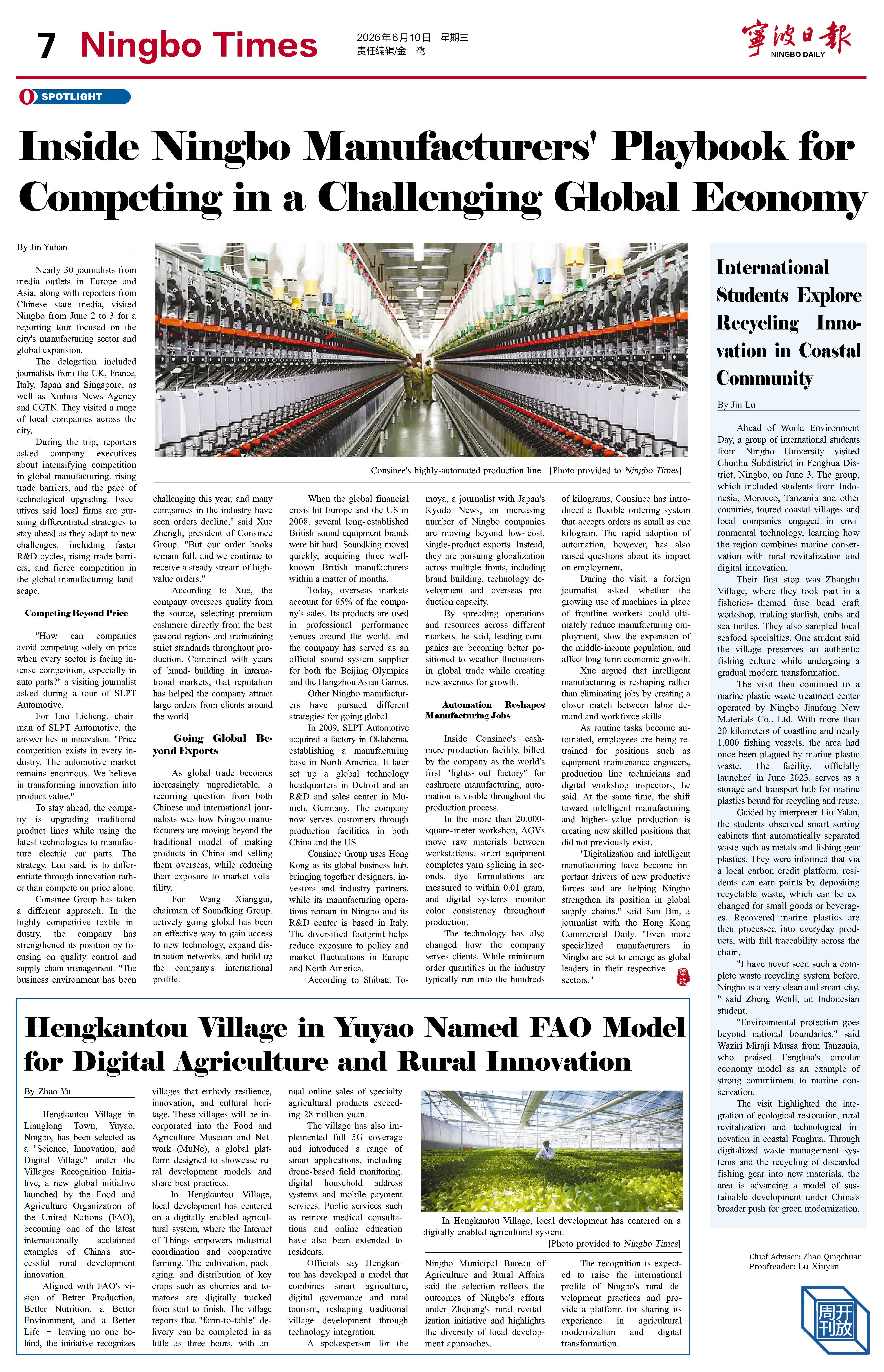
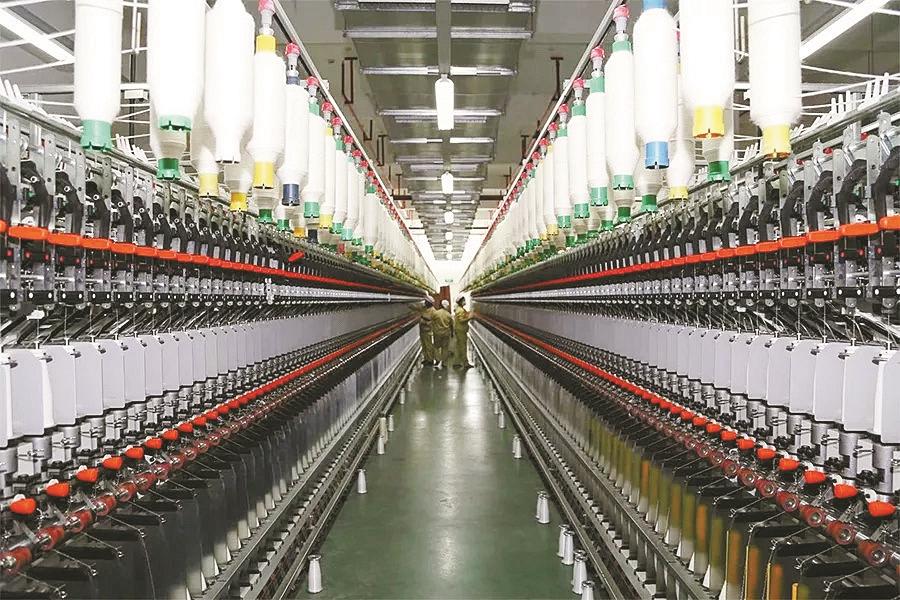
Inside Consinee's cashmere production facility, billed by the company as the world's first "lights-out factory" for cashmere manufacturing, automation is visible throughout the production process.
In the more than 20,000-square-meter workshop, AGVs move raw materials between workstations, smart equipment completes yarn splicing in seconds, dye formulations are measured to within 0.01 gram, and digital systems monitor color consistency throughout production.
The technology has also changed how the company serves clients. While minimum order quantities in the industry typically run into the hundreds of kilograms, Consinee has introduced a flexible ordering system that accepts orders as small as one kilogram. The rapid adoption of automation, however, has also raised questions about its impact on employment.
During the visit, a foreign journalist asked whether the growing use of machines in place of frontline workers could ultimately reduce manufacturing employment, slow the expansion of the middle-income population, and affect long-term economic growth.
Xue argued that intelligent manufacturing is reshaping rather than eliminating jobs by creating a closer match between labor demand and workforce skills.
As routine tasks become automated, employees are being retrained for positions such as equipment maintenance engineers, production line technicians and digital workshop inspectors, he said. At the same time, the shift toward intelligent manufacturing and higher-value production is creating new skilled positions that did not previously exist.
"Digitalization and intelligent manufacturing have become important drivers of new productive forces and are helping Ningbo strengthen its position in global supply chains," said Sun Bin, a journalist with the Hong Kong Commercial Daily. "Even more specialized manufacturers in Ningbo are set to emerge as global leaders in their respective sectors."