


By Jin Yuhan
Russian President Vladimir Putin paid a state visit to China from May 19 to 20, drawing international attention to China–Russia relations. The visit comes against the backdrop of deepening bilateral trade ties that are also shaping the outlook of foreign trade enterprises in Ningbo.
According to the latest data from China's Ministry of Commerce, China–Russia trade has exceeded $200 billion for three consecutive years, with China remaining Russia's largest trading partner for 16 consecutive years. Statistics from Ningbo Customs show that in the first four months of this year, the total import and export value between Ningbo Port and Russia reached 17.04 billion yuan, up 22% year-on-year.
Lighting the Way in Russia's Consumer Market
As a leading exporter of lighting products in Ningbo, Ningbo Yourlite Co., Ltd. specializes in LED luminaires, indoor and outdoor lighting, smart solar lighting, and small home appliances. The company first entered the Russian market via the Canton Fair in 1996, initially serving household lighting demand before expanding into applications for industrial and infrastructure projects.
"We work with leading Russian partners and tailor R&D to client requirements. With strong cost performance and consistent quality, our products have been well received on the market," said Bi Wenjun, general manager of Yourlite. He added that the company is expanding its portfolio in electrical and electronic products and expects exports to Russia to grow about 10% year-on-year this year.
Similarly, Ningbo Careline Electric Appliance Co., Ltd. has worked with clients to develop air fryers tailored for Russian consumers. Over the past four months, it has exported more than 200,000 units, worth 46.7 million yuan, a threefold increase year-on-year.
In recent years, Ningbo companies have played a dual role in Russia's consumer goods market, both as established suppliers filling market gaps and as early movers into new business models. Since 2022, following the Russia–Ukraine conflict and the withdrawal of several Western brands and suppliers, Russian importers have increasingly turned to alternative sourcing markets. Demand has grown for light industrial products such as home furnishings and consumer goods, as well as mid- to high-end branded products. Cross-border e-commerce has become an increasingly important sales channel for Russian consumers. These factors are translating into new opportunities for Ningbo exporters.
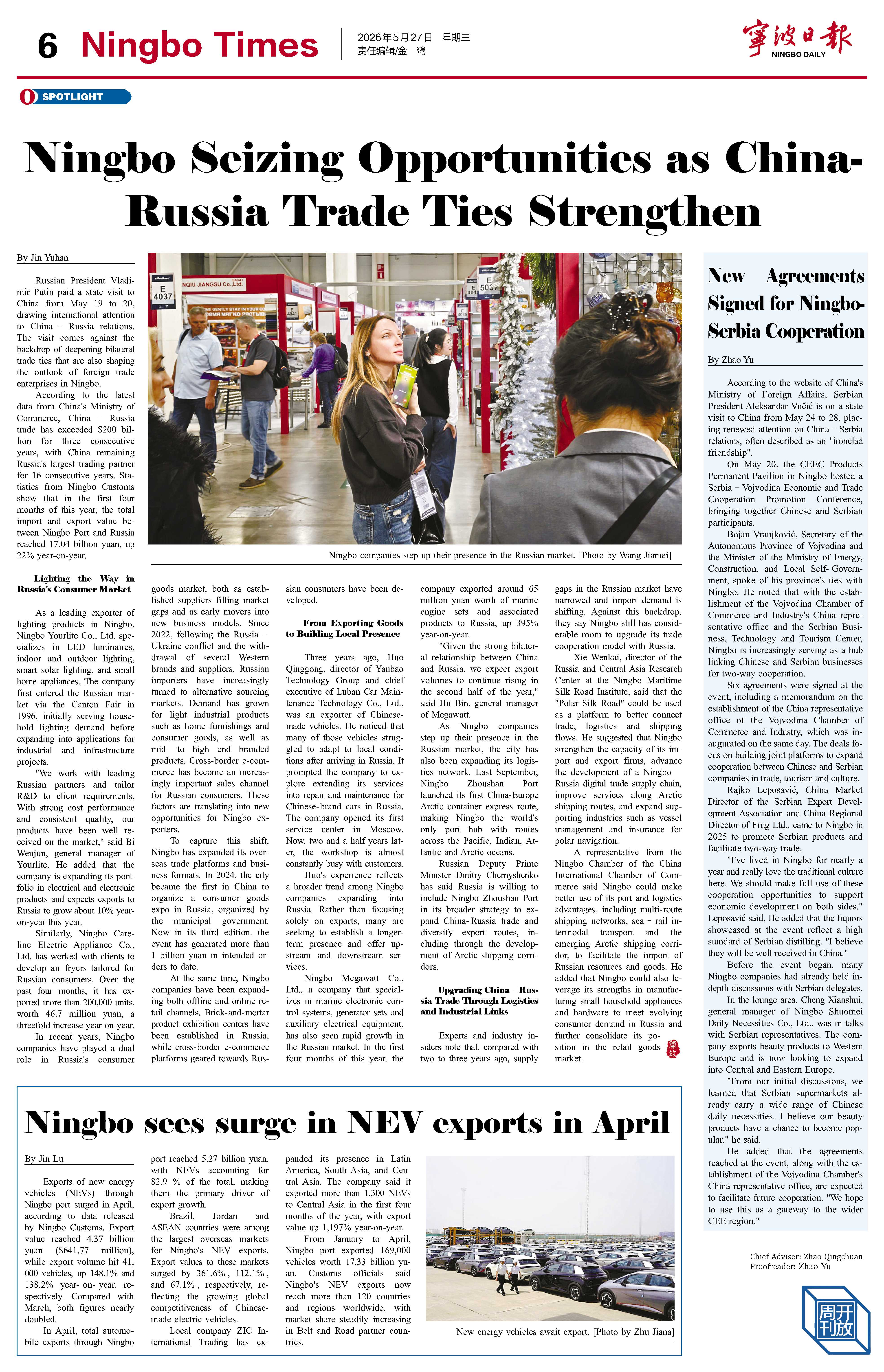
To capture this shift, Ningbo has expanded its overseas trade platforms and business formats. In 2024, the city became the first in China to organize a consumer goods expo in Russia, organized by the municipal government. Now in its third edition, the event has generated more than 1 billion yuan in intended orders to date.
At the same time, Ningbo companies have been expanding both offline and online retail channels. Brick-and-mortar product exhibition centers have been established in Russia, while cross-border e-commerce platforms geared towards Russian consumers have been developed.
From Exporting Goods to Building Local Presence
Three years ago, Huo Qinggong, director of Yanbao Technology Group and chief executive of Luban Car Maintenance Technology Co., Ltd., was an exporter of Chinese-made vehicles. He noticed that many of those vehicles struggled to adapt to local conditions after arriving in Russia. It prompted the company to explore extending its services into repair and maintenance for Chinese-brand cars in Russia. The company opened its first service center in Moscow. Now, two and a half years later, the workshop is almost constantly busy with customers.
Huo's experience reflects a broader trend among Ningbo companies expanding into Russia. Rather than focusing solely on exports, many are seeking to establish a longer-term presence and offer upstream and downstream services.
Ningbo Megawatt Co., Ltd., a company that specializes in marine electronic control systems, generator sets and auxiliary electrical equipment, has also seen rapid growth in the Russian market. In the first four months of this year, the company exported around 65 million yuan worth of marine engine sets and associated products to Russia, up 395% year-on-year.
"Given the strong bilateral relationship between China and Russia, we expect export volumes to continue rising in the second half of the year," said Hu Bin, general manager of Megawatt.
As Ningbo companies step up their presence in the Russian market, the city has also been expanding its logistics network. Last September, Ningbo Zhoushan Port launched its first China-Europe Arctic container express route, making Ningbo the world's only port hub with routes across the Pacific, Indian, Atlantic and Arctic oceans.
Russian Deputy Prime Minister Dmitry Chernyshenko has said Russia is willing to include Ningbo Zhoushan Port in its broader strategy to expand China-Russia trade and diversify export routes, including through the development of Arctic shipping corridors.
Upgrading China–Russia Trade Through Logistics and Industrial Links
Experts and industry insiders note that, compared with two to three years ago, supply gaps in the Russian market have narrowed and import demand is shifting. Against this backdrop, they say Ningbo still has considerable room to upgrade its trade cooperation model with Russia.
Xie Wenkai, director of the Russia and Central Asia Research Center at the Ningbo Maritime Silk Road Institute, said that the "Polar Silk Road" could be used as a platform to better connect trade, logistics and shipping flows. He suggested that Ningbo strengthen the capacity of its import and export firms, advance the development of a Ningbo–Russia digital trade supply chain, improve services along Arctic shipping routes, and expand supporting industries such as vessel management and insurance for polar navigation.
A representative from the Ningbo Chamber of the China International Chamber of Commerce said Ningbo could make better use of its port and logistics advantages, including multi-route shipping networks, sea–rail intermodal transport and the emerging Arctic shipping corridor, to facilitate the import of Russian resources and goods. He added that Ningbo could also leverage its strengths in manufacturing small household appliances and hardware to meet evolving consumer demand in Russia and further consolidate its position in the retail goods market.