

By Zhao Yu
On May 13, Ningbo released its foreign trade data for the first four months of the year. Total imports and exports reached 501.7 billion yuan, up 6.3% year-on-year. In April alone, foreign trade grew 6.9%.
By category, overall export growth remained steady, while trade in higher-value segments showed stronger momentum. Exports of electric vehicles, lithium-ion batteries and photovoltaic products—the "new three"—continued to expand rapidly, while imports of high-tech products also recorded notable gains.
Against a backdrop of geopolitical uncertainty and rising trade protectionism, the data suggests Ningbo's foreign trade is entering a phase of structural adjustment, with new growth drivers gaining prominence. This is a transformation that would take time to unfold.
According to Ningbo Customs, Ningbo's export value grew by 4.8% year-on-year in the first four months, up 2.3 percentage points from the first quarter, narrowing the gap with the national average growth rate.
For some exporters, however, external pressures remain acute. An export manager at a home appliance company said shipping costs to the Middle East have doubled, forcing some customers to cancel or delay orders. "In March, our export volume was cut in half," the manager said.
An electromechanical exporter described similarly weak demand in Europe and the US, after spending a month visiting clients. "Inventory turnover in Europe is particularly sluggish."
Official data reflects this uneven recovery. In the first four months, Ningbo exported 196.09 billion yuan of electromechanical products, up just 4.2% year-on-year.
By contrast, exports of the "new three" continued to expand rapidly. During the same period, shipments reached 21.75 billion yuan, up 144.2% year-on-year. Electric vehicles rose 223.6%, lithium-ion batteries 45.2%, and photovoltaic products 129.7%.
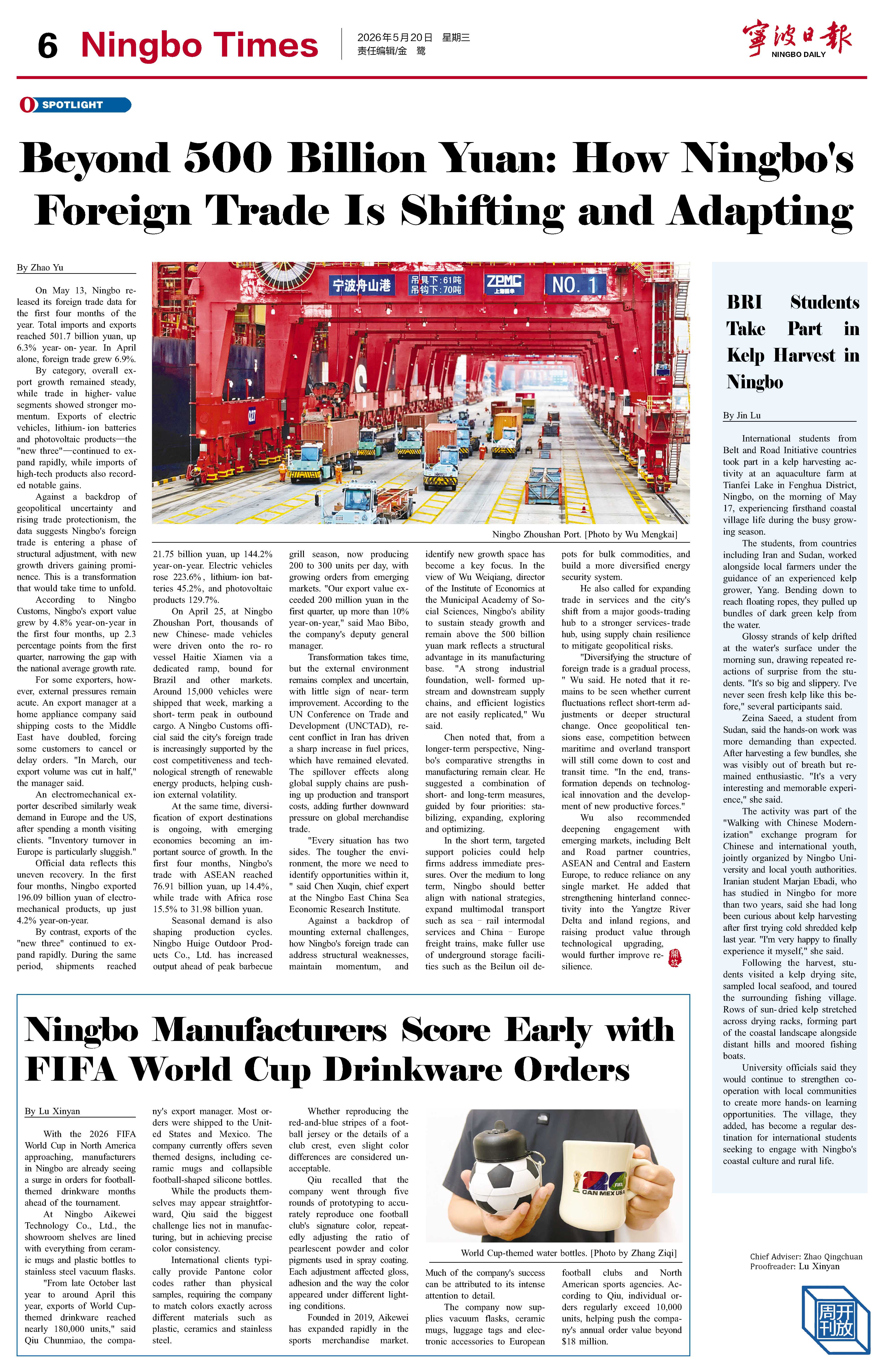
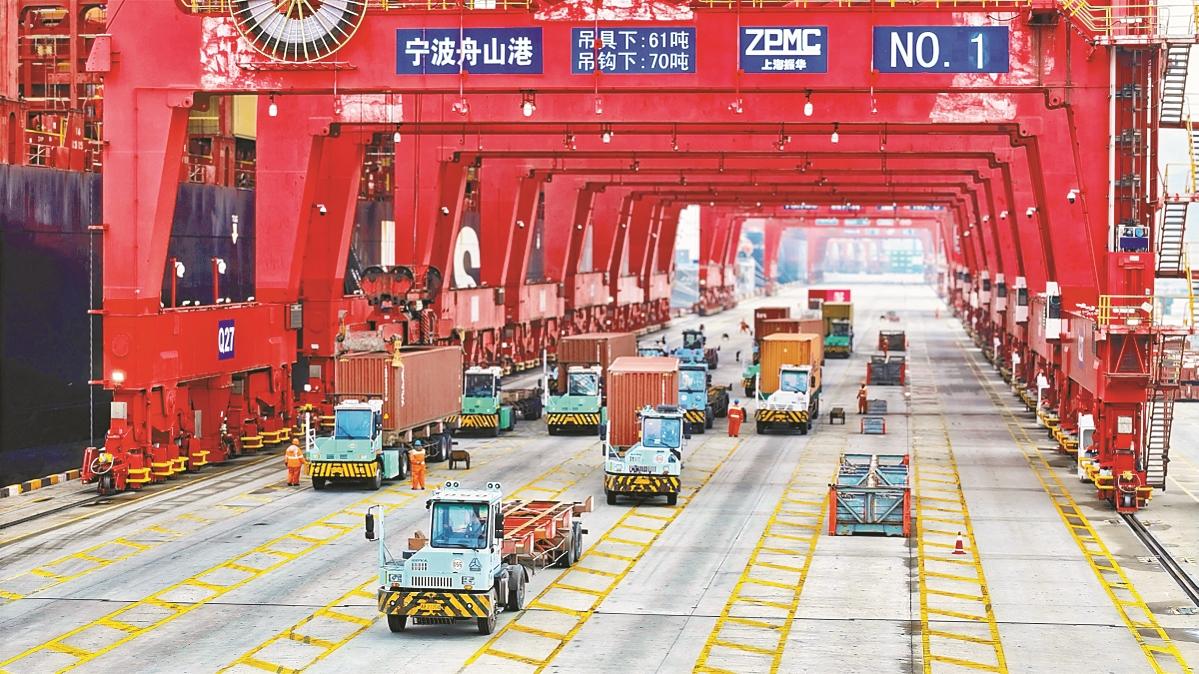
On April 25, at Ningbo Zhoushan Port, thousands of new Chinese-made vehicles were driven onto the ro-ro vessel Haitie Xiamen via a dedicated ramp, bound for Brazil and other markets. Around 15,000 vehicles were shipped that week, marking a short-term peak in outbound cargo. A Ningbo Customs official said the city's foreign trade is increasingly supported by the cost competitiveness and technological strength of renewable energy products, helping cushion external volatility.
At the same time, diversification of export destinations is ongoing, with emerging economies becoming an important source of growth. In the first four months, Ningbo's trade with ASEAN reached 76.91 billion yuan, up 14.4%, while trade with Africa rose 15.5% to 31.98 billion yuan.
Seasonal demand is also shaping production cycles. Ningbo Huige Outdoor Products Co., Ltd. has increased output ahead of peak barbecue grill season, now producing 200 to 300 units per day, with growing orders from emerging markets. "Our export value exceeded 200 million yuan in the first quarter, up more than 10% year-on-year," said Mao Bibo, the company's deputy general manager.
Transformation takes time, but the external environment remains complex and uncertain, with little sign of near-term improvement. According to the UN Conference on Trade and Development (UNCTAD), recent conflict in Iran has driven a sharp increase in fuel prices, which have remained elevated. The spillover effects along global supply chains are pushing up production and transport costs, adding further downward pressure on global merchandise trade.
"Every situation has two sides. The tougher the environment, the more we need to identify opportunities within it," said Chen Xuqin, chief expert at the Ningbo East China Sea Economic Research Institute.
Against a backdrop of mounting external challenges, how Ningbo's foreign trade can address structural weaknesses, maintain momentum, and identify new growth space has become a key focus. In the view of Wu Weiqiang, director of the Institute of Economics at the Municipal Academy of Social Sciences, Ningbo's ability to sustain steady growth and remain above the 500 billion yuan mark reflects a structural advantage in its manufacturing base. "A strong industrial foundation, well-formed upstream and downstream supply chains, and efficient logistics are not easily replicated," Wu said.
Chen noted that, from a longer-term perspective, Ningbo's comparative strengths in manufacturing remain clear. He suggested a combination of short- and long-term measures, guided by four priorities: stabilizing, expanding, exploring and optimizing.
In the short term, targeted support policies could help firms address immediate pressures. Over the medium to long term, Ningbo should better align with national strategies, expand multimodal transport such as sea–rail intermodal services and China–Europe freight trains, make fuller use of underground storage facilities such as the Beilun oil depots for bulk commodities, and build a more diversified energy security system.
He also called for expanding trade in services and the city's shift from a major goods-trading hub to a stronger services-trade hub, using supply chain resilience to mitigate geopolitical risks.
"Diversifying the structure of foreign trade is a gradual process," Wu said. He noted that it remains to be seen whether current fluctuations reflect short-term adjustments or deeper structural change. Once geopolitical tensions ease, competition between maritime and overland transport will still come down to cost and transit time. "In the end, transformation depends on technological innovation and the development of new productive forces."
Wu also recommended deepening engagement with emerging markets, including Belt and Road partner countries, ASEAN and Central and Eastern Europe, to reduce reliance on any single market. He added that strengthening hinterland connectivity into the Yangtze River Delta and inland regions, and raising product value through technological upgrading, would further improve resilience.