

By Zhao Yu
Data from the Ningbo Airport Immigration shows that last year, 40,300 foreign nationals entered through the airport, a year-on-year increase of 53.94%. The number of foreign nationals entering visa-free exceeded 17,000, growing at nearly three times the national average.
Unilateral visa exemptions, the 240-hour visa-free transit policies, and tax refunds for shopping have fueled rapid growth in China's inbound tourism market. The challenge now for cities like Ningbo is turning this influx of visitors into lasting economic impact.
Visa-Free Policy Boosts Inbound Travel
"It was so convenient—I completed the arrival card in just a few minutes, and now I can enter China without a visa," said Michelle, an American traveler, after arriving at Ningbo Airport on March 17 from Budapest.
Michelle was among the growing number of visitors benefiting from China's 240-hour transit visa-free policy. Under the policy, citizens from 55 countries with valid travel documents and confirmed onward tickets to a third destination can enter China without a visa. They are allowed to stay for up to 10 days, during which they may travel, conduct business, or visit family and friends within designated areas around the country.
Data show that inbound travelers to Ningbo last year came from 141 countries and regions. Visitors from the top five source countries—including Japan, India, and the United States—accounted for nearly half of the total. More than 40% of foreign arrivals entered under visa-free policies.
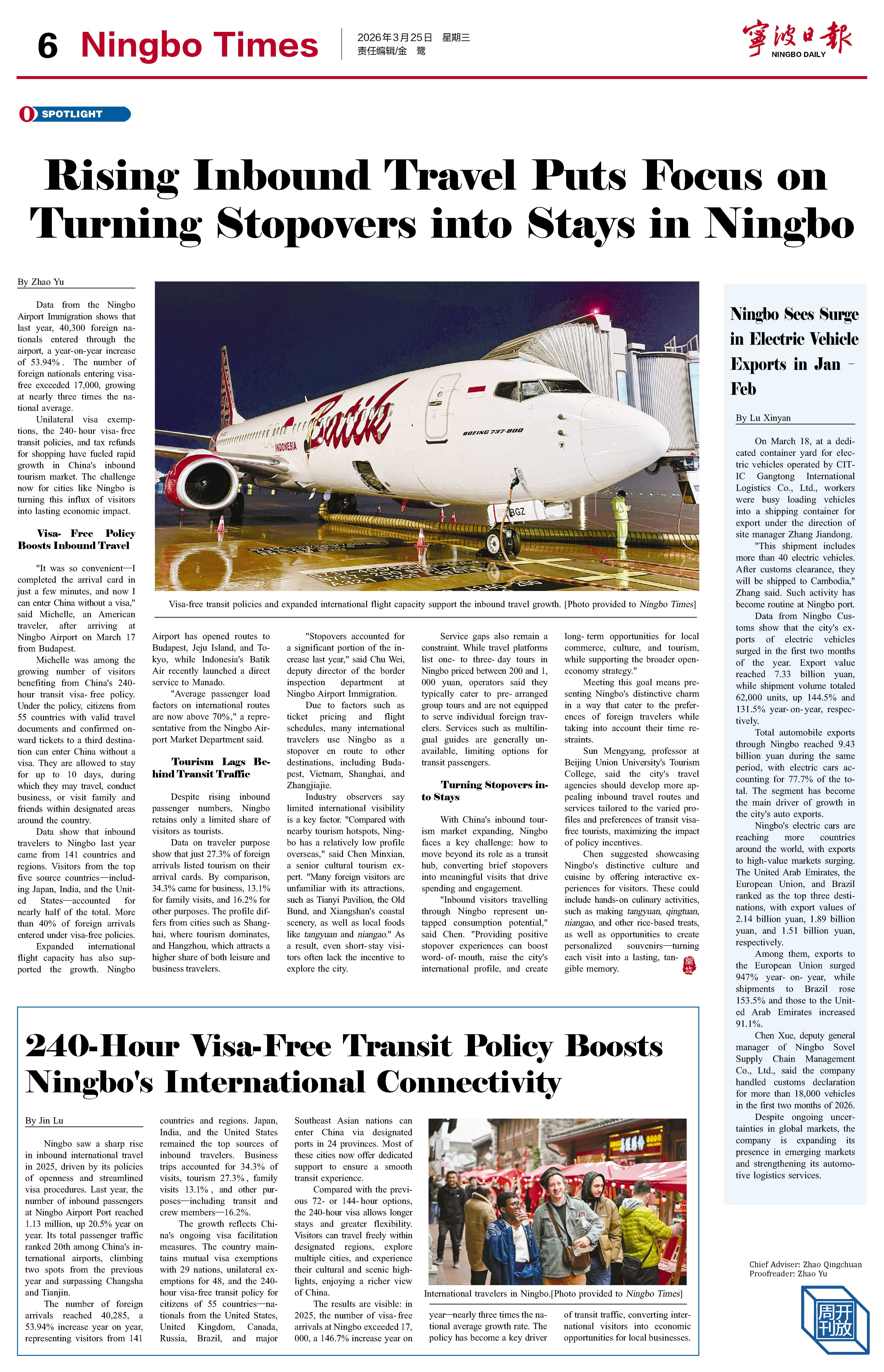
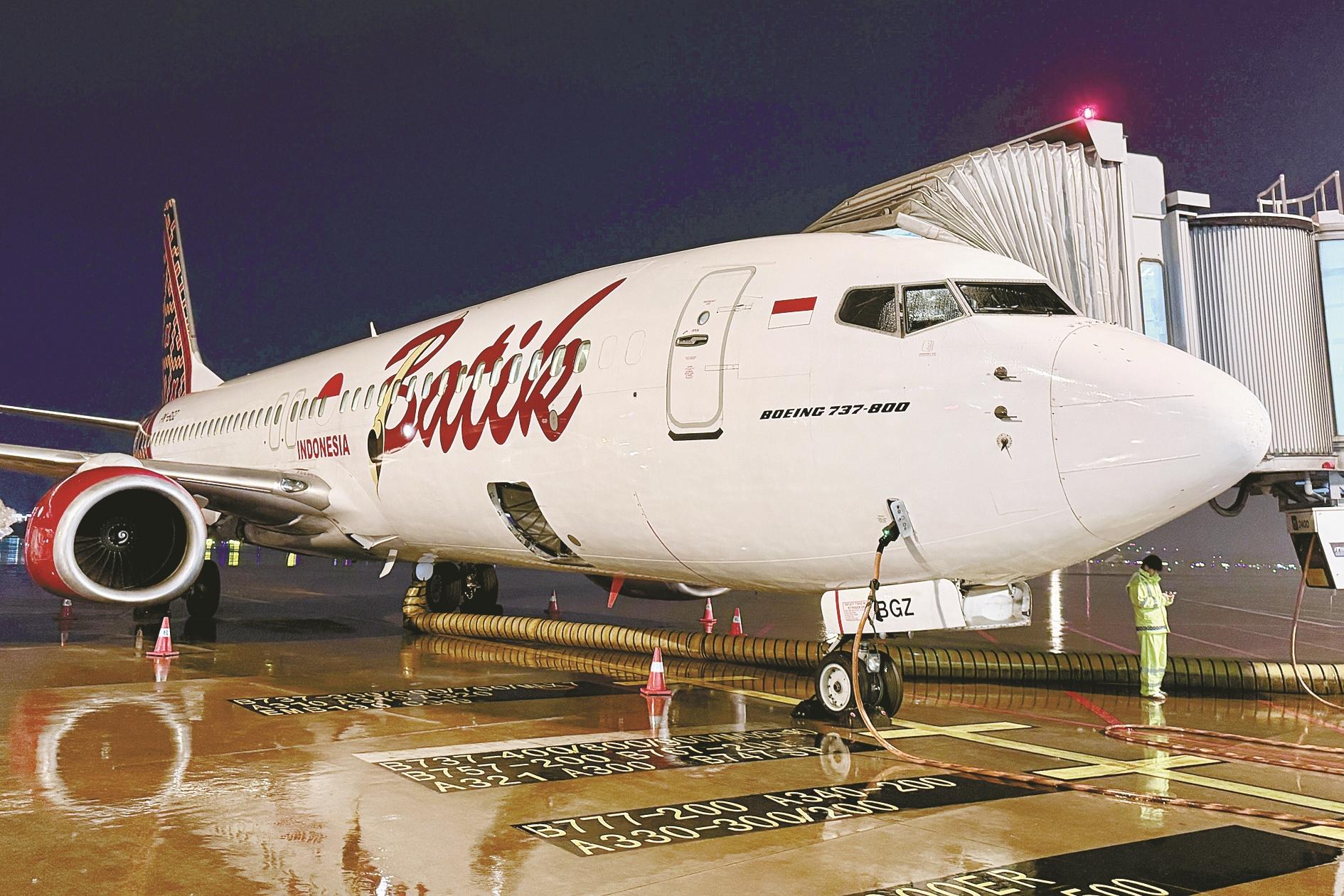
Expanded international flight capacity has also supported the growth. Ningbo Airport has opened routes to Budapest, Jeju Island, and Tokyo, while Indonesia's Batik Air recently launched a direct service to Manado.
"Average passenger load factors on international routes are now above 70%," a representative from the Ningbo Airport Market Department said.
Tourism Lags Behind Transit Traffic
Despite rising inbound passenger numbers, Ningbo retains only a limited share of visitors as tourists.
Data on traveler purpose show that just 27.3% of foreign arrivals listed tourism on their arrival cards. By comparison, 34.3% came for business, 13.1% for family visits, and 16.2% for other purposes. The profile differs from cities such as Shanghai, where tourism dominates, and Hangzhou, which attracts a higher share of both leisure and business travelers.
"Stopovers accounted for a significant portion of the increase last year," said Chu Wei, deputy director of the border inspection department at Ningbo Airport Immigration.
Due to factors such as ticket pricing and flight schedules, many international travelers use Ningbo as a stopover en route to other destinations, including Budapest, Vietnam, Shanghai, and Zhangjiajie.
Industry observers say limited international visibility is a key factor. "Compared with nearby tourism hotspots, Ningbo has a relatively low profile overseas," said Chen Minxian, a senior cultural tourism expert. "Many foreign visitors are unfamiliar with its attractions, such as Tianyi Pavilion, the Old Bund, and Xiangshan's coastal scenery, as well as local foods like tangyuan and niangao." As a result, even short-stay visitors often lack the incentive to explore the city.
Service gaps also remain a constraint. While travel platforms list one- to three-day tours in Ningbo priced between 200 and 1,000 yuan, operators said they typically cater to pre-arranged group tours and are not equipped to serve individual foreign travelers. Services such as multilingual guides are generally unavailable, limiting options for transit passengers.
Turning Stopovers into Stays
With China's inbound tourism market expanding, Ningbo faces a key challenge: how to move beyond its role as a transit hub, converting brief stopovers into meaningful visits that drive spending and engagement.
"Inbound visitors travelling through Ningbo represent untapped consumption potential," said Chen. "Providing positive stopover experiences can boost word-of-mouth, raise the city's international profile, and create long-term opportunities for local commerce, culture, and tourism, while supporting the broader open-economy strategy."
Meeting this goal means presenting Ningbo's distinctive charm in a way that cater to the preferences of foreign travelers while taking into account their time restraints.
Sun Mengyang, professor at Beijing Union University's Tourism College, said the city's travel agencies should develop more appealing inbound travel routes and services tailored to the varied profiles and preferences of transit visa-free tourists, maximizing the impact of policy incentives.
Chen suggested showcasing Ningbo's distinctive culture and cuisine by offering interactive experiences for visitors. These could include hands-on culinary activities, such as making tangyuan, qingtuan, niangao, and other rice-based treats, as well as opportunities to create personalized souvenirs—turning each visit into a lasting, tangible memory.