

By Jin Yuhan
On March 11, a letter of appreciation from the Royal Norwegian Embassy in China arrived in Xiangshan. "On behalf of Innovation Norway, I would like to extend our sincere gratitude for the outstanding support you provided to Nordic Aqua (Ningbo) Co., Ltd. during the construction of its land-based Atlantic salmon farm in Xiangshan," wrote Henning Kristoffersen, Counsellor at the Royal Norwegian Embassy in China and Country Director of Innovation Norway China, praising Ningbo's business environment. The message highlights a successful example of cooperation between China and Norway.
A Norwegian Venture Takes Root in Ningbo
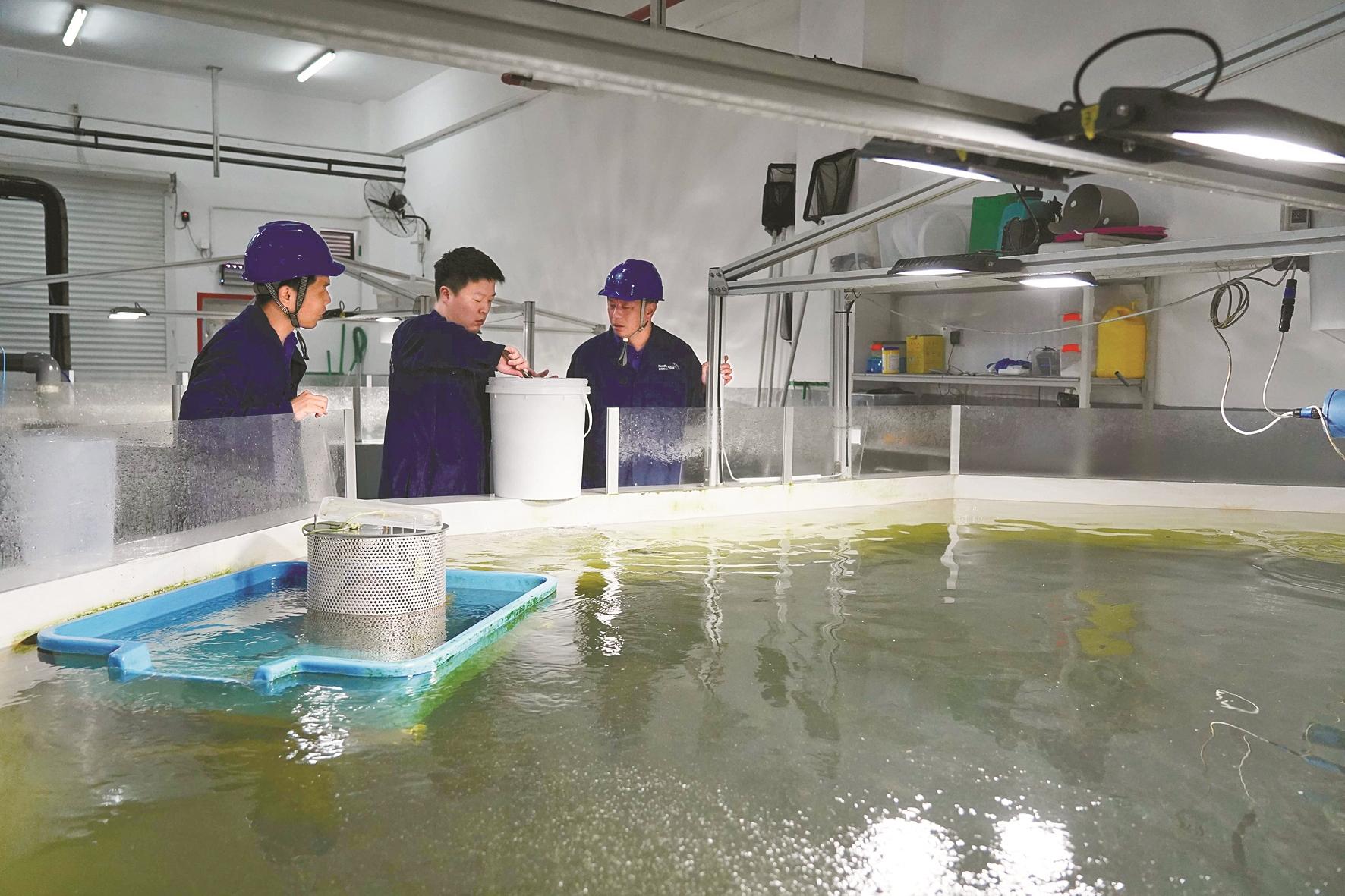
At the Nordic Aqua farms facility in Gaotang Island Township, the large recirculating aquaculture tanks are filled with healthy Atlantic salmon. The facility, located in Xiangshan County, is Asia's first large-scale land-based salmon farm using recirculating aquaculture technology. Once fully operational, it supplies about 70 tons of fresh salmon each week to markets across the Yangtze River Delta and other parts of China.
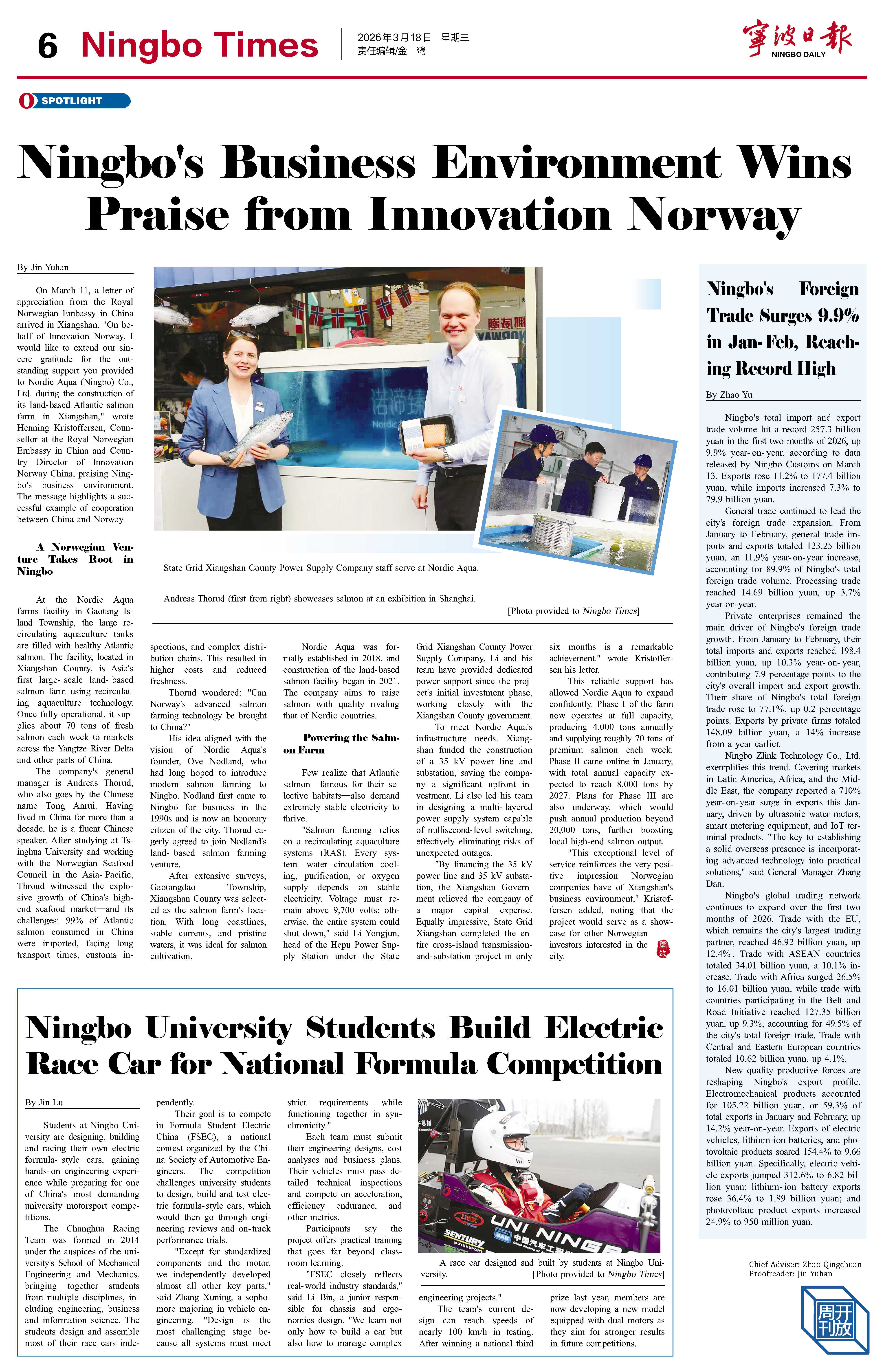
The company's general manager is Andreas Thorud, who also goes by the Chinese name Tong Anrui. Having lived in China for more than a decade, he is a fluent Chinese speaker. After studying at Tsinghua University and working with the Norwegian Seafood Council in the Asia-Pacific, Throud witnessed the explosive growth of China's high-end seafood market—and its challenges: 99% of Atlantic salmon consumed in China were imported, facing long transport times, customs inspections, and complex distribution chains. This resulted in higher costs and reduced freshness.
Thorud wondered: "Can Norway's advanced salmon farming technology be brought to China?"
His idea aligned with the vision of Nordic Aqua's founder, Ove Nodland, who had long hoped to introduce modern salmon farming to Ningbo. Nodland first came to Ningbo for business in the 1990s and is now an honorary citizen of the city. Thorud eagerly agreed to join Nodland's land-based salmon farming venture.
After extensive surveys, Gaotangdao Township, Xiangshan County was selected as the salmon farm's location. With long coastlines, stable currents, and pristine waters, it was ideal for salmon cultivation.
Nordic Aqua was formally established in 2018, and construction of the land-based salmon facility began in 2021. The company aims to raise salmon with quality rivaling that of Nordic countries.
Powering the Salmon Farm
Few realize that Atlantic salmon—famous for their selective habitats—also demand extremely stable electricity to thrive.
"Salmon farming relies on a recirculating aquaculture systems (RAS). Every system—water circulation cooling, purification, or oxygen supply—depends on stable electricity. Voltage must remain above 9,700 volts; otherwise, the entire system could shut down," said Li Yongjun, head of the Hepu Power Supply Station under the State Grid Xiangshan County Power Supply Company. Li and his team have provided dedicated power support since the project's initial investment phase, working closely with the Xiangshan County government.
To meet Nordic Aqua's infrastructure needs, Xiangshan funded the construction of a 35 kV power line and substation, saving the company a significant upfront investment. Li also led his team in designing a multi-layered power supply system capable of millisecond-level switching, effectively eliminating risks of unexpected outages.
"By financing the 35 kV power line and 35 kV substation, the Xiangshan Government relieved the company of a major capital expense. Equally impressive, State Grid Xiangshan completed the entire cross-island transmission-and-substation project in only six months is a remarkable achievement." wrote Kristoffersen his letter.
This reliable support has allowed Nordic Aqua to expand confidently. Phase I of the farm now operates at full capacity, producing 4,000 tons annually and supplying roughly 70 tons of premium salmon each week. Phase II came online in January, with total annual capacity expected to reach 8,000 tons by 2027. Plans for Phase III are also underway, which would push annual production beyond 20,000 tons, further boosting local high-end salmon output.
"This exceptional level of service reinforces the very positive impression Norwegian companies have of Xiangshan's business environment," Kristoffersen added, noting that the project would serve as a showcase for other Norwegian investors interested in the city.