


By Zhao Yu
Ningbo's 28,000 private businesses with actual import and export records surpassed the trillion-yuan mark in total trade one month ahead of schedule, posting year-on-year growth of 4%. Their share of the city's total foreign trade rose 1.2 percentage points from the same period last year, reaching 77.6%, according to a report released by Ningbo Customs on December 10.
Despite unprecedented uncertainties in global trade this year, private enterprises helped to boost Ningbo's overall import and export volume by 3 percentage points during the first 11 months.
Exports from private companies totaled 737.6 billion yuan, up 5.1% year on year, representing 82.8% of the city's total export value. Imports reached 288.35 billion yuan, rising 1.1% and accounting for 66.8% of Ningbo's total import value.
Resilience Through Structural Optimization
Inside the standardized smart manufacturing facility of Ningbo Jingwei Systemtechnik Ltd., automated production lines run with high precision and efficiency.
After passing rigorous quality inspections, intelligent fabric-tailoring machines equipped with IoT modules are being prepared and packaged for shipment to Slovenia, where they will support the digital upgrading of local textile manufacturers.
Built with customizable configurations and standardized modules, the equipment allows users to run fully automated production lines, moving directly from design input to finished output. It can raise production efficiency by up to 300% and push material utilization above 90%, said Zheng Zhaoze, deputy general manager of Jingwei.
The company now serves more than 30,000 clients worldwide. In the first 11 months of this year, its export value reached 120 million yuan.
Jingwei is one of many Ningbo-based private enterprises strengthening their competitiveness through technological upgrading. By enhancing in-house capabilities and shifting exports toward more technology-intensive and greener products, these firms are improving the resilience of their global sales through structural optimization.
According to Ningbo Customs, private businesses in the city exported 430.96 billion yuan worth of mechanical and electrical products in the first 11 months of 2025, up 6.9% year on year. These products accounted for 58.4% of total exports by Ningbo's private sector during the period, forming a key pillar of export stability.
At Zhejiang Zhongzhe New Energy Technology Co., Ltd, vice president Chen Bin demonstrated both older and newer models of energy storage batteries. "The new generation is lighter and more compact, while delivering stronger storage performance," he said, attributing the improvement to higher energy density.
The market has responded positively. This year, Zhongzhe 's exports of energy storage batteries to ASEAN markets exceeded 20 million yuan, a year-on-year increase of more than 50%.
"By being laser focused on our core product lineup, we've expanded our new energy business to more than 40 countries and regions," said Chen.
Seizing Opportunities Through Flexibility and Adaptation
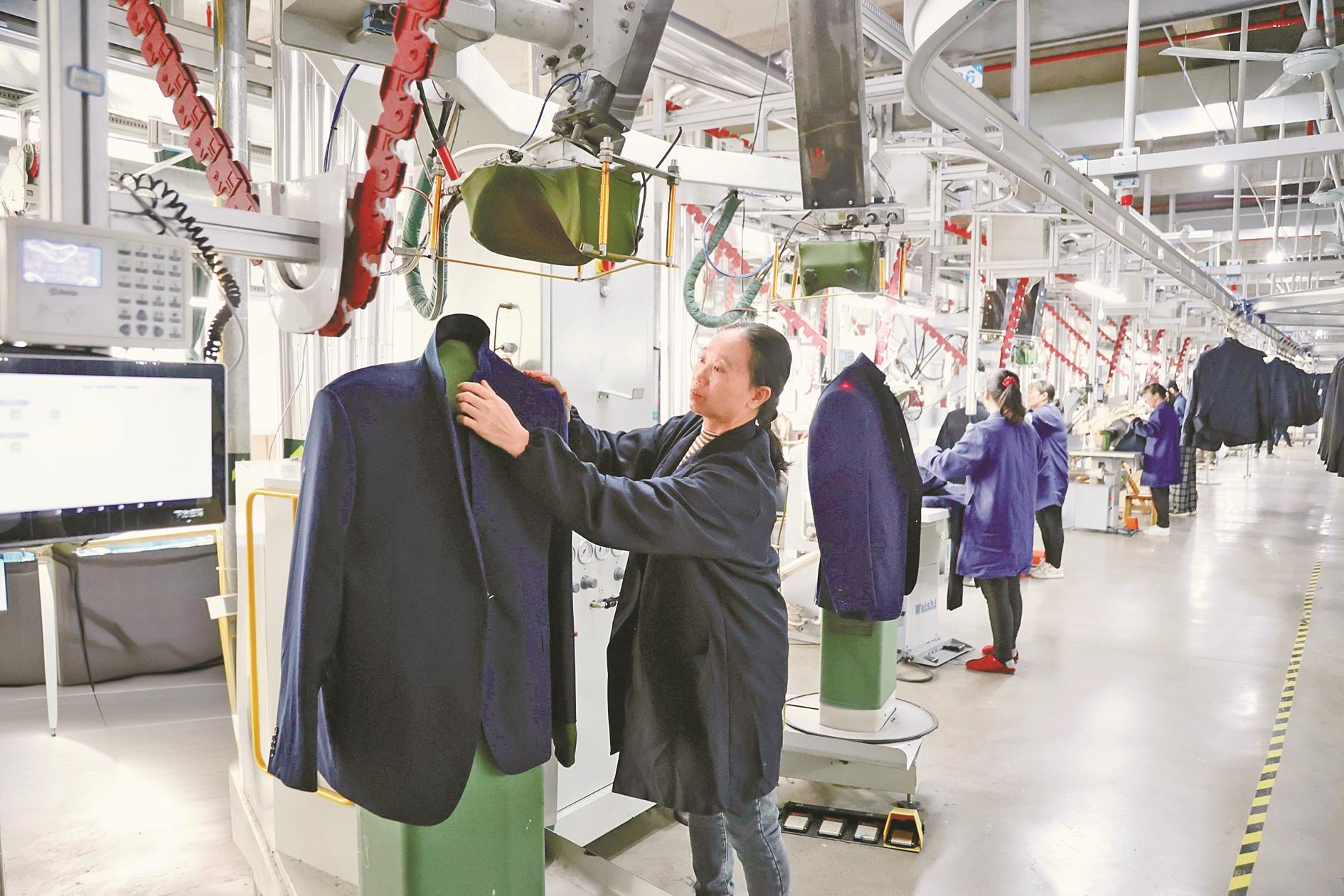
"With the launch of a new business model, our export value reached 160 million yuan in the first 11 months of this year, up more than 10% year on year," said Zhou Bin, head of Zhejiang Aiyimei Clothing Co., Ltd., standing beside a shipment of made-to-order suits awaiting export.
The growth stems from what Zhou describes as a dual strategy combining cross-border e-commerce with customization.
Aiyimei traces its roots to the craftsmanship of Ningbo's traditional "Hongbang tailors," but for years relied mainly on OEM manufacturing. As garments are highly standardized and face low technical barriers, export margins steadily narrowed.
To break the cycle, Aiyimei partnered with six local partners to establish Ningbo Fengshang Technology Co., Ltd., shifting toward a cross-border supply-chain service model aimed at small and medium-sized buyers overseas.
Through the platform, customers can select styles and submit measurements using 3D virtual fitting tools, fully customizing their pieces. Finished garments can be shipped to Europe and the United States in as little as three days. This new business model helped the company secure overseas orders.
New policies are also creating new momentum. On Oct. 28, China and ASEAN signed an upgraded version of the China–ASEAN Free Trade Area agreement, known as CAFTA 3.0, which introduces new rules covering the digital economy, green development and supply-chain connectivity.
"Many ASEAN countries are moving toward Industry 4.0, generating strong demand for industrial automation and robotics," said Ke Sisi, foreign trade director of Ningbo Limon Robot Company. "The upgraded agreement is expected to further enhance the competitiveness of our intelligent manufacturing products in ASEAN."
Limon Robot is intensifying research and development of controllable magnetic levitation conveyor systems tailored to ASEAN markets. The company expects exports to the region to exceed 20 million yuan next year, with annual growth of around 20%.
According to Ningbo Customs, ASEAN is currently the third-largest trading partner of Ningbo's private sector and is expected to rise to second place. In the first 11 months of this year, trade between Ningbo and ASEAN totaled 148.67 billion yuan, up 12.8% year on year.
Despite global uncertainties, Ningbo's private exporters remain confident of their global sales and presence.