

By Jin Yuhan
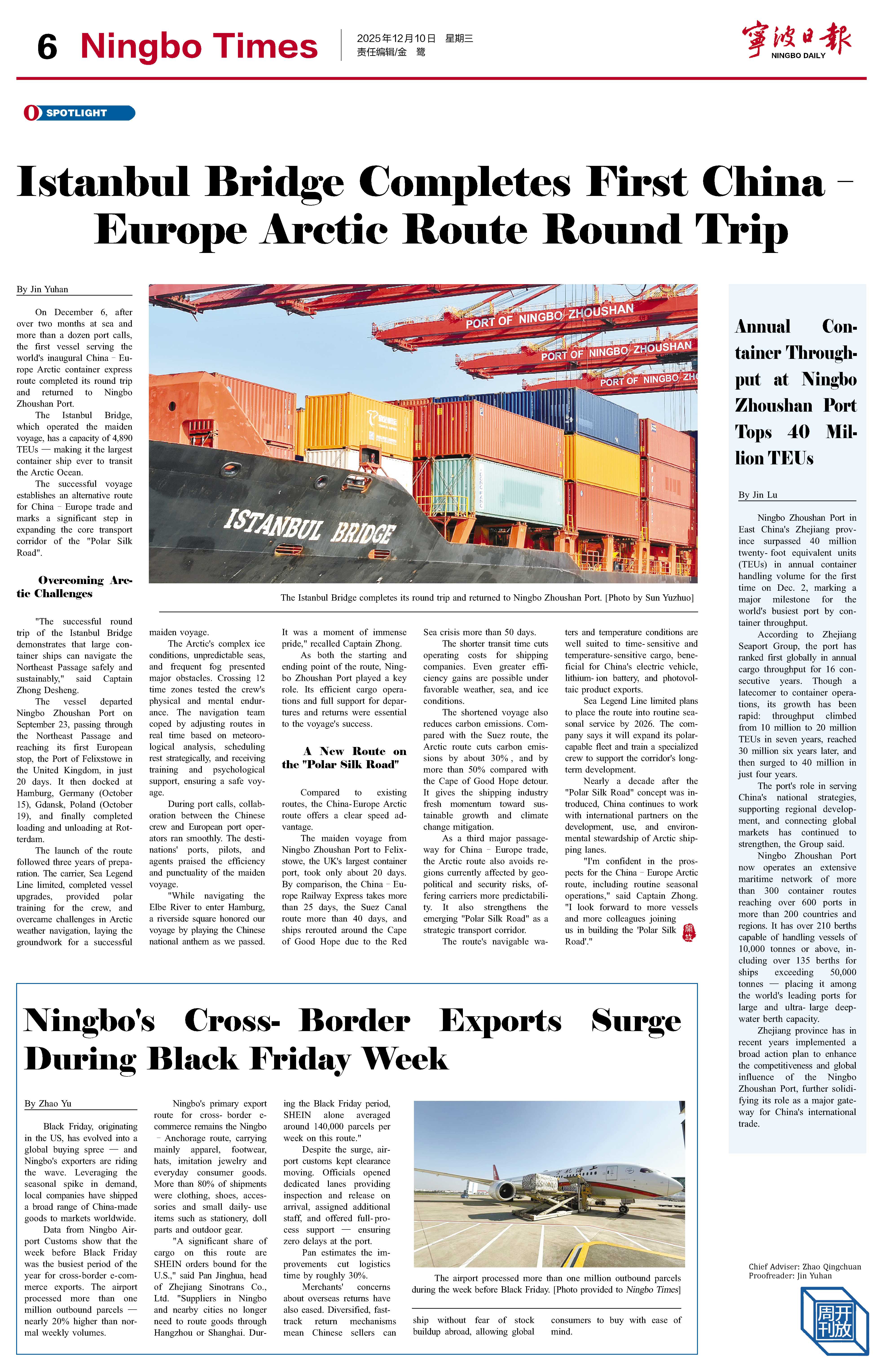
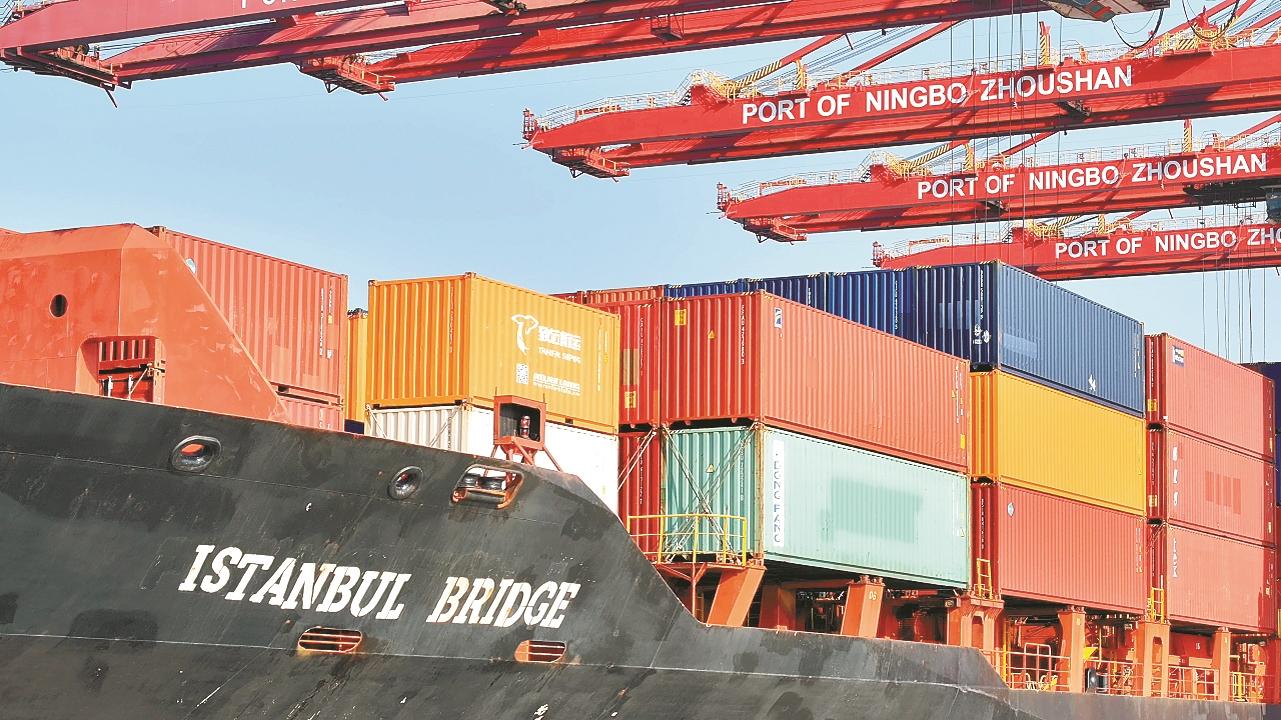
On December 6, after over two months at sea and more than a dozen port calls, the first vessel serving the world's inaugural China–Europe Arctic container express route completed its round trip and returned to Ningbo Zhoushan Port.
The Istanbul Bridge, which operated the maiden voyage, has a capacity of 4,890 TEUs — making it the largest container ship ever to transit the Arctic Ocean.
The successful voyage establishes an alternative route for China–Europe trade and marks a significant step in expanding the core transport corridor of the "Polar Silk Road".
Overcoming Arctic Challenges
"The successful round trip of the Istanbul Bridge demonstrates that large container ships can navigate the Northeast Passage safely and sustainably," said Captain Zhong Desheng.
The vessel departed Ningbo Zhoushan Port on September 23, passing through the Northeast Passage and reaching its first European stop, the Port of Felixstowe in the United Kingdom, in just 20 days. It then docked at Hamburg, Germany (October 15), Gdansk, Poland (October 19), and finally completed loading and unloading at Rotterdam.
The launch of the route followed three years of preparation. The carrier, Sea Legend Line limited, completed vessel upgrades, provided polar training for the crew, and overcame challenges in Arctic weather navigation, laying the groundwork for a successful maiden voyage.
The Arctic's complex ice conditions, unpredictable seas, and frequent fog presented major obstacles. Crossing 12 time zones tested the crew's physical and mental endurance. The navigation team coped by adjusting routes in real time based on meteorological analysis, scheduling rest strategically, and receiving training and psychological support, ensuring a safe voyage.
During port calls, collaboration between the Chinese crew and European port operators ran smoothly. The destinations' ports, pilots, and agents praised the efficiency and punctuality of the maiden voyage.
"While navigating the Elbe River to enter Hamburg, a riverside square honored our voyage by playing the Chinese national anthem as we passed. It was a moment of immense pride," recalled Captain Zhong.
As both the starting and ending point of the route, Ningbo Zhoushan Port played a key role. Its efficient cargo operations and full support for departures and returns were essential to the voyage's success.
A New Route on the "Polar Silk Road"
Compared to existing routes, the China-Europe Arctic route offers a clear speed advantage.
The maiden voyage from Ningbo Zhoushan Port to Felixstowe, the UK's largest container port, took only about 20 days. By comparison, the China–Europe Railway Express takes more than 25 days, the Suez Canal route more than 40 days, and ships rerouted around the Cape of Good Hope due to the Red Sea crisis more than 50 days.
The shorter transit time cuts operating costs for shipping companies. Even greater efficiency gains are possible under favorable weather, sea, and ice conditions.
The shortened voyage also reduces carbon emissions. Compared with the Suez route, the Arctic route cuts carbon emissions by about 30%, and by more than 50% compared with the Cape of Good Hope detour. It gives the shipping industry fresh momentum toward sustainable growth and climate change mitigation.
As a third major passageway for China–Europe trade, the Arctic route also avoids regions currently affected by geopolitical and security risks, offering carriers more predictability. It also strengthens the emerging "Polar Silk Road" as a strategic transport corridor.
The route's navigable waters and temperature conditions are well suited to time-sensitive and temperature-sensitive cargo, beneficial for China's electric vehicle, lithium-ion battery, and photovoltaic product exports.
Sea Legend Line limited plans to place the route into routine seasonal service by 2026. The company says it will expand its polar-capable fleet and train a specialized crew to support the corridor's long-term development.
Nearly a decade after the "Polar Silk Road" concept was introduced, China continues to work with international partners on the development, use, and environmental stewardship of Arctic shipping lanes.
"I'm confident in the prospects for the China–Europe Arctic route, including routine seasonal operations," said Captain Zhong. "I look forward to more vessels and more colleagues joining us in building the 'Polar Silk Road'."